Table of Contents
- The Cal/OSHA Informal Conference: What It Accomplishes
- Immediate Timeline: The 30 Days After Your Conference
- Understanding the Cal/OSHA Citation Appeal Process
- Settlement Agreements and Cal/OSHA Informal Conference Outcomes
- How to Prepare for a Cal/OSHA Informal Conference and Strengthen Your Position
- Negotiating Cal/OSHA Citation Penalty Reduction
- When to Involve Legal Counsel and Expert Support
- Frequently Asked Questions
Last Updated: September 25, 2026
The Cal/OSHA Informal Conference: What It Accomplishes
A Cal/OSHA informal conference is your chance to discuss the citation with the enforcement officer before it becomes final. This meeting happens within 15 days of receiving the citation notice and allows you to reduce penalties, challenge findings, or negotiate a path forward without formal appeal.
The Area Director hasn’t made a final decision yet. Your evidence, corrective actions, and compliance history all matter and can influence the outcome before the citation becomes final.
McNeil Safety Consulting guides employers through these conferences across California and nationwide.
Immediate Timeline: The 30 Days After Your Conference
After your meeting, the Area Director has 30 days to issue a final decision. If you reached a settlement agreement, the Area Director’s office drafts a formal settlement document for both parties to sign. If no settlement was reached, the Area Director issues a decision letter stating whether penalties are reduced, upheld, or withdrawn.
What the Decision Letter Contains
The decision letter includes the violation classification, penalty amount, abatement date, any settlement terms, and your appeal rights. If penalties were reduced, the letter explains the basis. If withdrawn, the violation is no longer cited. If upheld, you have the right to contest it.
The Critical 15-Day Window After Receiving the Decision
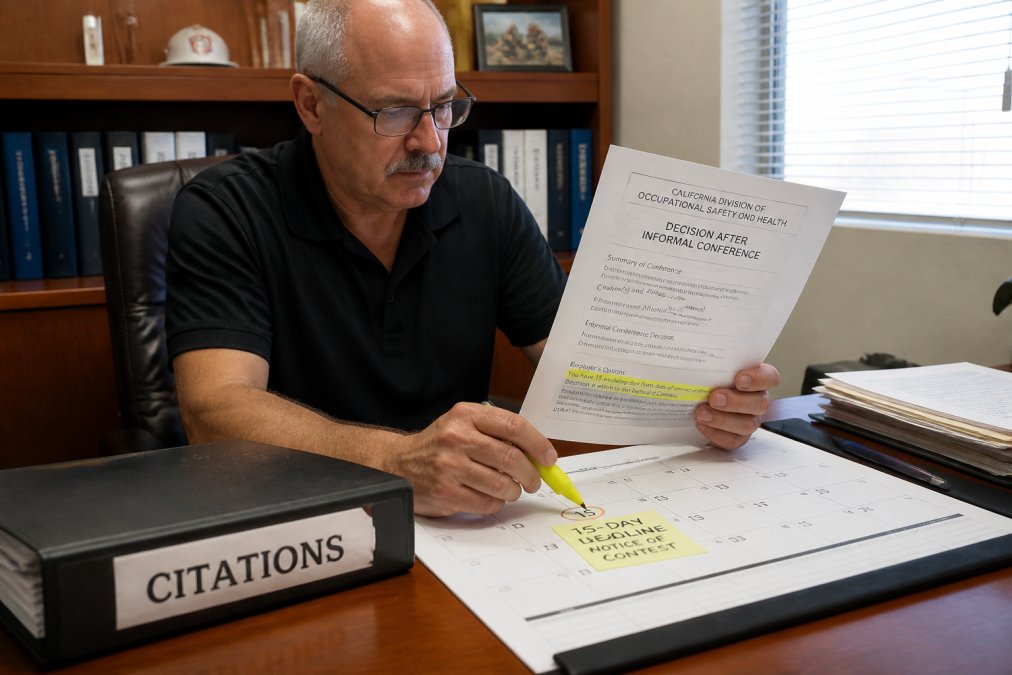
Once you receive the decision letter, a new 15-day clock starts to file a notice of contest if you disagree. This deadline is absolute, missing it makes the citation final and unappealable. Mark your calendar the day you receive the letter.
What to Do During the 30-Day Wait
Use this time strategically:
- Document corrective actions with photographs or video evidence of abatement work.
- Collect supporting documentation: invoices, work orders, training records, equipment certifications, and maintenance logs.
- Prepare your response strategy if you plan to contest. Gather expert reports, industrial hygiene data, or witness statements for an appeal.
- Review your settlement offer if discussed. Contact the Area Director’s office if the decision differs from what you negotiated.
- Communicate with your safety team and counsel about next steps. Do not wait until day 14 to decide whether to appeal.
If You Receive a Settlement Agreement
If you receive a settlement agreement, review it carefully before signing, it is a binding contract and you cannot appeal once signed. Verify the penalty amount, abatement date, conditions, and violation description match your discussion. Contact the Area Director’s office immediately if any terms differ.
If You Disagree with the Decision
If you disagree with the decision, file a notice of contest in writing with the Area Director’s office within 15 days. Include a brief statement of why you contest the decision. The notice must be received (not postmarked) within 15 days. Missing this deadline makes the citation final and unappealable.
Understanding the Cal/OSHA Citation Appeal Process
Filing a notice of contest moves your case to the California Occupational Safety and Health Appeals Board, a formal legal proceeding with different rules, burdens of proof, and stakes than the informal conference.
How the Burden of Proof Shifts
In the informal conference, you persuade the Area Director to reduce or withdraw the citation. In appeals, the burden shifts: Cal/OSHA must prove its case. You can challenge evidence, cross-examine the inspector, and present your own evidence. An administrative law judge decides whether Cal/OSHA proved the violation and whether the penalty is appropriate. Many citations fall apart when Cal/OSHA must prove them under formal rules of evidence.
The Appeals Board Process
The Appeals Board assigns your case to an administrative law judge. Timeline is typically 6-12 months from filing to hearing. Before the hearing, both sides exchange evidence and witness lists. At the hearing, Cal/OSHA presents its case first, then you present yours. You can testify, present witnesses, introduce documents, and challenge evidence. Expert testimony is often critical for technical questions about exposure, ventilation, or equipment. The judge may uphold, reduce, or withdraw the citation. Either side can appeal to the full Appeals Board on legal questions only.
What Evidence Matters Most in Appeals
Evidence that carries the most weight includes:
- Industrial hygiene data: Exposure monitoring, air sampling, or ventilation measurements showing whether the hazard existed or exposure was below limits.
- Expert testimony: A qualified professional testifying about inspector accuracy, abatement feasibility, or violation classification.
- Photographs and videos: Documentation of hazard conditions or completed abatement.
- Regulatory standards: Cal/OSHA regulations, interpretation letters, or industry standards supporting your position.
- Witness testimony: Employees or supervisors testifying about what happened, training provided, or safety procedures.
- Compliance history: Documentation of a strong safety program, low injury rates, and clean record.
Generic arguments carry no weight. The judge wants evidence, not rhetoric.
When to Involve Specialized Representation
Consider involving legal counsel or expert support if the citation is willful, the penalty is substantial, the violation involves complex technical questions, the inspector’s findings are questionable, you plan to present expert testimony, or the inspection itself may have been improper.
Industrial Hygiene Support for Appeals
Industrial hygiene expertise is often the difference between winning and losing an appeal. An industrial hygiene professional can:
- Review the inspector’s sampling methods and calculations to identify errors or questionable conclusions.
- Conduct independent exposure assessments to document what the actual exposure or hazard condition was.
- Evaluate whether your abatement method is feasible and effective.
- Testify at the hearing about exposure levels, ventilation adequacy, or whether the cited standard actually applies to your workplace.
- Prepare a written report that can be submitted as evidence.
McNeil Safety Consulting provides industrial hygiene assessment and expert witness testimony for employers pursuing appeals across California and nationwide. We document exposure assessments, review the inspector’s findings, and testify about whether the cited violations actually exist or whether abatement is feasible.
The Cost-Benefit Analysis
Before you decide to appeal, do a realistic cost-benefit analysis. What is the penalty amount? What is the cost of representation? How strong is your case? What are the odds of winning?
If the penalty is small and your case is weak, accepting the citation and moving forward with abatement may be the smarter choice.
Settlement Agreements and Cal/OSHA Informal Conference Outcomes
Not every informal conference ends in a settlement. Some employers and Area Directors reach agreement. Others don’t. Understanding the difference matters for your next move.
How to Prepare for a Cal/OSHA Informal Conference and Strengthen Your Position
Preparation determines outcomes. Employers who walk in with evidence, documentation, and a clear narrative get better results than those who wing it.
Start by gathering your case file:
- The original Cal/OSHA inspection report
- Photos or videos of the cited hazard
- Your safety policies and procedures
- Training records for affected employees
- Maintenance logs and equipment records
- Any corrective actions you’ve already taken
- Expert reports or industrial hygiene assessments
Negotiating Cal/OSHA Citation Penalty Reduction
Penalty reduction is often the realistic goal. Most citations don’t get withdrawn. But penalties can be reduced significantly if you present the right case.
Common negotiation strategies:
- Challenge the severity classification. Argue that the hazard posed minimal risk or that exposure was limited.
- Highlight your safety program. Show that you have training, procedures, and enforcement in place.
- Demonstrate rapid abatement. If you’ve already fixed the hazard, that reduces the penalty.
- Present your compliance history. A company with no prior violations gets better consideration than a repeat violator.
- Offer a settlement. Sometimes proposing a specific penalty reduction opens a dialogue.
When to Involve Legal Counsel and Expert Support
Not every citation requires outside help. But some do. Knowing when to bring in support can save you money and time.
Involve legal counsel if:
- The citation is for a willful violation (highest penalty category)
- The penalty amount is large enough to justify legal fees
- You plan to appeal and want representation before the appeals board
- The violation involves complex technical or regulatory questions
- The inspection itself was potentially improper or unlawful
Involve an industrial hygiene expert if:
- The citation involves exposure assessment or monitoring
- You need to challenge the inspector’s sampling or calculation methods
- Your abatement plan requires technical justification
- You’re defending against a serious or willful violation classification
Frequently Asked Questions
What happens if an agreement is not reached at the Cal/OSHA informal conference?
If no settlement agreement is reached during the informal conference, the citation remains in effect with the original proposed penalties. You then have the right to file a notice of contest and proceed to a formal appeal before the Cal/OSHA Appeals Board. This formal process allows you to present additional evidence and arguments. The Area Director’s final decision becomes the basis for any further administrative or legal action. Understanding this path ahead of your conference helps you prepare stronger evidence and arguments to increase your chances of negotiation.
How long after the informal conference will I receive a settlement agreement?
The Area Director typically issues a settlement agreement within 30 days following a successful informal conference. However, the exact timeline depends on the complexity of the citation, the number of violations, and the amount of abatement documentation required. You should expect written confirmation of any agreed-upon penalty reductions and corrective action deadlines within this window. If you haven’t received written documentation after 30 days, contact the Area Director’s office to confirm status and obtain a copy for your records.
Can you settle a citation during a Cal/OSHA informal conference?
Yes, settlements are one of the primary purposes of the informal conference. The Area Director has authority to negotiate and reduce penalties, modify citation classifications, or extend abatement deadlines based on your evidence and arguments. Settlements commonly result in penalty reductions of 10-50% depending on your good faith efforts, the severity of the violation, and your compliance history. A successful settlement avoids the time and expense of a formal appeal, but only if both parties reach agreement on the terms.
Is it necessary to have representation during a Cal/OSHA informal conference?
Representation is not legally required, but it is strongly recommended. An experienced representative, whether legal counsel or a safety consultant with citation defense expertise, can present your case more effectively, challenge Cal/OSHA’s evidence, and negotiate better outcomes. Many employers find that professional representation results in significantly better penalty reductions and more favorable settlement terms. The Area Director expects well-prepared arguments and documentation, and a representative ensures nothing is overlooked during the critical negotiation window.
The 15-day window after receiving a Cal/OSHA citation is tight. But the real work happens after your informal conference. Documenting corrective actions, understanding your appeal rights, and knowing when to bring in expert support will protect your business. Contact McNeil Safety Consulting to discuss your citation and develop a defense strategy that fits your situation.