Service area: Available in California, Nevada, Arizona, Oregon, Washington, Idaho, Montana, Utah, Wyoming, Colorado, New Mexico, North Dakota and South Dakota.
Environmental Assessment
Before you buy, sell, or finance commercial property in California, you need to know what’s in the ground. A Phase I Environmental Site Assessment identifies environmental risk from historical records — and a Phase II confirms or rules out contamination through actual sampling. Skipping this step can mean inheriting millions in cleanup liability.
McNeil Safety Consulting provides ASTM E1527-21 compliant Phase I and Phase II ESAs throughout California — with 35+ years of environmental consulting experience and reports that satisfy lender, regulatory, and legal requirements.
- 35+ Years Environmental Consulting
- ASTM E1527-21 Compliant
- Serving All of California
Rush Turnaround Available
What’s Included
Phase I and Phase II ESAs serve different purposes and are often conducted in sequence — Phase I first to identify risk, Phase II to confirm or rule out contamination where warranted.
Phase I ESA
Records review · No sampling · ASTM E1527-21
- Historical records review (aerial photos, Sanborn maps, city directories)
- Federal and state regulatory database review (ASTM E1527-21 standard search)
- Site reconnaissance and visual inspection
- Interviews with current and past owners, operators, and occupants
- Identification of Recognized Environmental Conditions (RECs)
- Written Phase I ESA report compliant with ASTM E1527-21
- Lender-ready documentation for SBA, conventional, and CMBS loans
- Rush turnaround available for time-sensitive transactions
Phase II ESA
Physical sampling · Lab analysis · Triggered by Phase I RECs
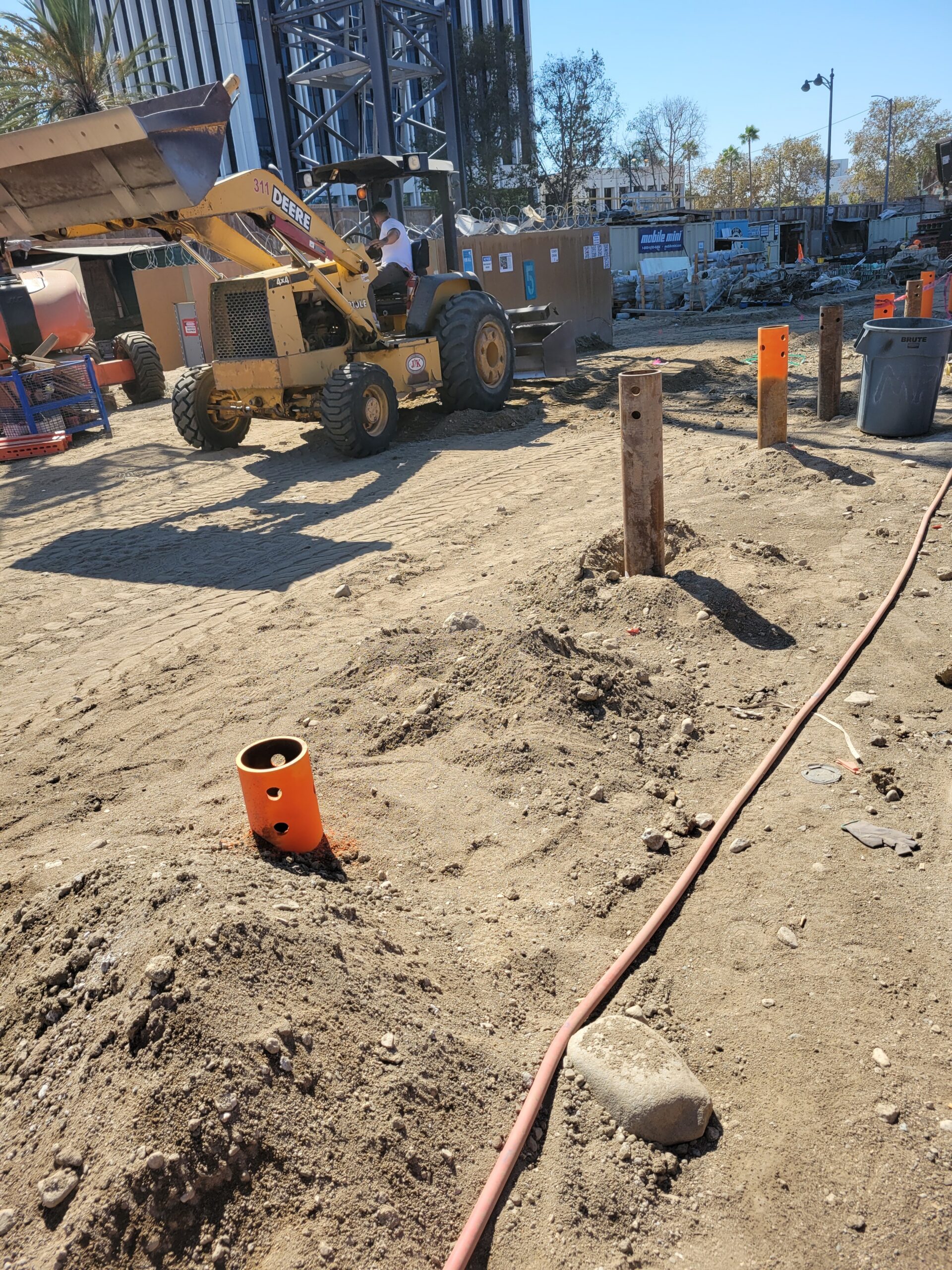
- Soil boring and sampling program design and execution
- Groundwater monitoring well installation and sampling
- Soil vapor probe installation and sampling
- Surface and subsurface soil sampling
- Laboratory analysis through accredited California laboratories
- Comparison to California regulatory screening levels (ESLs, RSLs)
- Written Phase II ESA report with findings and recommendations
- Remedial cost estimation and cleanup strategy development
- Regulatory agency notification and reporting where required
Who We Serve
Environmental site assessments are required across a wide range of commercial real estate transactions and regulatory contexts.
- Commercial real estate buyers
- Commercial real estate sellers
- SBA and commercial lenders
- Real estate investors and developers
- Property managers and REITs
- Attorneys handling real estate transactions
- Title companies and escrow officers
- Businesses acquiring commercial property
- Municipalities and public agencies
- Industrial facility owners
- Agricultural landowners
- Redevelopment and brownfield projects
The Standard a Phase I Has to Meet, and Why the Version Number Matters
A Phase I is not a general environmental opinion. It is a defined legal instrument, and it only does its job if it satisfies EPA’s All Appropriate Inquiries rule at 40 CFR Part 312. EPA recognized ASTM E1527-21 as compliant with that rule, and ASTM E1527-13 stopped satisfying All Appropriate Inquiries on 13 February 2024. A report written to the old standard is not a defective report — it is a report that no longer supports the statutory defenses it was bought for. For forestland and rural property, EPA also recognizes ASTM E2247-23 under a final rule effective 23 August 2024.
What is actually being purchased is a defense. CERCLA imposes strict, joint and several liability on owners and operators. The bona fide prospective purchaser, contiguous property owner and innocent landowner protections are the way out, and each one requires that All Appropriate Inquiries were completed before acquisition and that the continuing obligations were met afterward. No compliant Phase I, no defense — and the question does not come up until someone is already looking for a party to pay for the cleanup.
Shelf life — the part that quietly kills deals
Under 40 CFR §312.20, All Appropriate Inquiries must be conducted or updated within one year before acquisition. Five components have a tighter 180-day clock: interviews with past and present owners, operators and occupants; the search for recorded environmental cleanup liens; the review of federal, tribal, state and local government records; the visual inspection of the property and adjoining properties; and the environmental professional’s declaration.
Escrows slip. A report commissioned in good faith at the start of a long transaction can age out of the 180-day window before closing, and the buyer never finds out until the defense is tested. We flag the expiration dates on the face of the report and update the short-clock components rather than reselling a whole new Phase I.
Who is allowed to sign it
The report has to carry the declaration of an Environmental Professional as that term is defined at 40 CFR §312.10 — a definition tied to specific combinations of licensure, degree and years of relevant full-time experience. It is not a title anyone can adopt. Michael Karl McNeil meets the definition and signs the reports himself; there is no junior staff drafting under a borrowed seal.
The California records the federal standard does not name
The government records review required by ASTM E1527-21 is written to a federal template. In California the state and local sources are where the finding usually is: the Cortese List compiled under Government Code §65962.5, DTSC’s EnviroStor database, the State Water Board’s GeoTracker, the local CUPA’s hazardous materials and underground storage tank files, the air district’s permit and complaint history, and county recorder land use covenants. A Phase I that cites only the standard federal record sources has met the letter of the requirement and missed the property’s actual history.
Where a site is already in an agency’s system, that changes the transaction rather than merely describing it. A property under DTSC or Regional Board oversight, or carrying a recorded land use covenant, comes with continuing obligations that transfer with the deed. We identify that early, in writing, before the buyer is committed.
PFAS changed the analysis in 2024
EPA’s final rule of 8 May 2024, effective 8 July 2024, designated PFOA and PFOS — including their salts and structural isomers — as hazardous substances under CERCLA. That designation is in effect. It brings release reporting, cost recovery exposure and federal property transfer notification into play, and it changes what can constitute a recognized environmental condition on a site with plating, firefighting foam, textile, paper or landfill history. A Phase I written before mid-2024 was not looking for any of it.
Phase II — ASTM E1903-19, and Knowing When Not to Drill
A Phase I identifies recognized environmental conditions. It does not test anything. When a REC is identified, the Phase II Environmental Site Assessment under ASTM E1903-19 is what determines whether a release actually occurred, what it is, where it is, and how far it goes.
The failure mode in Phase II work is not usually bad chemistry — it is bad scoping. A sampling plan written without clear data quality objectives produces numbers that answer a question nobody asked, and the client pays twice: once for the mobilization, and again for the second mobilization that gets the right samples. Every Phase II we scope starts from what decision the result has to support — close the deal, price the remediation, allocate liability between parties, or support a claim — and the sampling design follows from that.
- Soil, soil vapor and groundwater sampling scoped to the specific RECs, not a uniform grid
- Vapor intrusion evaluation where volatile organics are in play, consistent with DTSC and Regional Water Board guidance — the pathway that most often turns a routine deal into an occupied-building problem
- Screening against the appropriate environmental screening levels, with the reasoning stated rather than a bare pass or fail
- Hazardous building materials where demolition or renovation is contemplated — asbestos under 8 CCR §1529 and lead under §1532.1, which is where the environmental file and the worker-protection file meet
- Clear delineation of what was not assessed, and why
Where oversight by DTSC or a Regional Water Quality Control Board is likely, we say so early. Discovering an agency has to be involved after the report is issued is materially more expensive than planning for it.
The advantage of one firm on both sides of the fence
Most environmental consultants stop at the property line of the report. Most safety consultants never touch a Phase I. A contaminated site is both problems at once: there is a liability question for the buyer and an exposure question for everyone who will work on it. The same office that assesses the site also writes the HASP, SWPPP and hazardous materials plans for the work that follows, and can testify about any of it later as a retained expert.
Signed by Michael Karl McNeil, RIH, QSD — federal and multi-state qualifications. Call (626) 546-9384.
Regulatory citations current as of publication. This page is informational and is not legal advice.
Frequently Asked Questions
What is a Phase I Environmental Site Assessment?
A Phase I Environmental Site Assessment (ESA) is a records-based investigation of a property’s environmental history — conducted in accordance with ASTM Standard E1527-21. It involves a review of historical records, regulatory databases, aerial photographs, and Sanborn fire insurance maps, combined with a site reconnaissance and interviews with current and past owners. The goal is to identify Recognized Environmental Conditions (RECs) — evidence of past or present releases of hazardous substances that may have impacted the property. A Phase I does not involve sampling; it is a records and visual review only.
When is a Phase I ESA required?
A Phase I ESA is required by most commercial lenders as a condition of financing — including SBA loans, conventional commercial mortgages, and CMBS loans. It is also required for CERCLA innocent landowner defense (to establish that a buyer conducted “all appropriate inquiries” before purchasing a contaminated property). Many buyers and sellers commission Phase I ESAs voluntarily as part of commercial real estate due diligence, even when not required by a lender, to understand the environmental risk profile of a property before closing.
What is a Phase II Environmental Site Assessment?
A Phase II Environmental Site Assessment involves actual physical sampling — soil borings, groundwater monitoring wells, soil vapor probes, and/or surface samples — to confirm or rule out contamination identified or suspected in a Phase I ESA. Phase II sampling is triggered when a Phase I identifies a Recognized Environmental Condition (REC) that warrants further investigation. The results determine whether contamination is present, what contaminants are involved, and at what concentrations — information needed to assess cleanup costs, regulatory obligations, and deal risk.
How long does a Phase I ESA take?
A standard Phase I ESA typically takes 2–3 weeks from engagement to final report delivery — including database research, site reconnaissance, and report preparation. Rush turnaround is available for time-sensitive transactions. The timeline can be affected by the complexity of the property’s history, the availability of historical records, and the responsiveness of regulatory agencies to database requests.
What is a Recognized Environmental Condition (REC)?
A Recognized Environmental Condition (REC) is the presence or likely presence of any hazardous substances or petroleum products in, on, or at a property due to a release to the environment, under conditions indicative of a release, or under conditions that pose a material threat of a future release. RECs are the primary output of a Phase I ESA — they are the findings that may warrant further investigation through a Phase II ESA. Not all RECs result in actual contamination, but they represent environmental risk that a buyer, lender, or investor needs to understand.
What types of properties need a Phase I ESA in California?
Any commercial or industrial property transaction in California may require a Phase I ESA — including office buildings, retail centers, industrial facilities, warehouses, gas stations, dry cleaners, auto repair shops, agricultural land, and mixed-use properties. Properties with a history of industrial use, underground storage tanks, or proximity to known contaminated sites are particularly likely to have RECs identified. Residential properties are generally not subject to Phase I requirements, but multi-family properties and residential developments on formerly commercial or industrial land may be.
What is ASTM E1527-21 and why does it matter?
ASTM E1527-21 is the current standard practice for Phase I Environmental Site Assessments, published by ASTM International and adopted by the EPA as the standard for “all appropriate inquiries” under CERCLA. The 21 refers to the 2021 update, which replaced the previous E1527-13 standard. Lenders and regulatory agencies require that Phase I ESAs comply with the current ASTM standard — a Phase I conducted under an outdated standard may not satisfy lender or regulatory requirements. All of our Phase I ESAs are conducted in full compliance with ASTM E1527-21.
Don’t Close Without Knowing What’s in the Ground
Call today for a free consultation. We’ll discuss your property, your transaction timeline, and what level of environmental due diligence is appropriate — so you can close with confidence.
Headquartered in San Gabriel, CA · Serving California statewide · Rush turnaround available
Every engagement is handled personally — nothing is farmed out. Michael Karl McNeil performs the site work, the sampling, the program writing and the citation defense himself; Zennin Sedacey-McNeil, LVN handles the occupational health and medical surveillance side. Work is never subcontracted, brokered to a partner firm, or assigned to a contract inspector hired locally for the assignment. See the service area page for what we do in each of the eleven states.
States We Serve
McNeil Safety Consulting provides this service to clients in the following states:
- California
- Nevada
- Arizona
- Oregon
- Washington
- Idaho
- Montana
- Utah
- Wyoming
- Colorado
- New Mexico
- North Dakota
- South Dakota
To confirm coverage for your site, call (626) 546-9384.