Table of Contents
- What Environmental Safety Solutions Cover in Manufacturing
- Core EHS Compliance Checklist for Manufacturing Operations
- Workplace Hazard Assessment Templates That Actually Work
- Environmental Safety Training Programs for Employees
- IoT, AI, and Modern Environmental Safety Solutions
- Cost-Benefit Analysis of Safety Investments in Manufacturing
- Emergency Response Planning and Safety Audits
- Sustainability, ESG Reporting, and Environmental Stewardship
Last Updated: August 26, 2026
What Environmental Safety Solutions Cover in Manufacturing
Environmental safety solutions are integrated programs, assessments, and compliance systems that protect workers, communities, and the environment from manufacturing hazards. At McNeil Safety Consulting, we see manufacturers struggle not with identifying hazards but with building a system that connects regulatory compliance, industrial hygiene, and emergency preparedness into a coherent whole.
Environmental safety solutions typically span occupational health monitoring, process safety management, air quality controls, waste management protocols, and regulatory reporting. Gaps between these areas are where citations occur. A well-structured EHS system reduces incident rates, lowers workers’ compensation exposure, and creates the documentation record that protects a facility during inspections.
Core EHS Compliance Checklist for Manufacturing Operations
A functional EHS compliance program is built on documentation, scheduled assessments, and clear accountability. Most facilities have pieces in place; the problem is usually gaps between them.
| Compliance Area | Key Requirement | Review Frequency |
|---|---|---|
| OSHA Hazard Communication | Updated SDS library, labeled containers | Annually + when new chemicals added |
| Process Safety Management | PSM program for highly hazardous chemicals | Continuous; full PHA every 5 years |
| Industrial Hygiene Monitoring | Exposure monitoring for regulated substances | Per OSHA substance-specific standards |
| Air Quality Permits | Title V or minor source permits current | Per permit schedule |
| Waste Management | Hazardous waste manifests, storage compliance | Ongoing; annual reporting |
| Emergency Response Plan | Written plan, trained response team | Annual review and drill |
| PPE Program | Hazard assessment, fit testing, training records | Annual + after any process change |
| Safety Training Records | Documentation of all required training | Ongoing; retained per OSHA requirements |
OSHA Standards and Process Safety Management
Process safety management is where manufacturing facilities face the highest-consequence regulatory risk. OSHA’s PSM standard at 29 CFR 1910.119 applies to facilities handling threshold quantities of highly hazardous chemicals and requires process hazard analysis, operating procedures, mechanical integrity programs, management of change protocols, and incident investigation systems.
The most common PSM gap is a PHA completed years ago and never updated after process modifications. OSHA inspectors specifically look for this. A process hazard analysis must reflect current operations.
Manufacturers must also align with the full body of applicable OSHA standards under 29 CFR 1910, including lockout/tagout, respiratory protection, confined space entry, electrical safety, and machine guarding. According to OSHA’s official standards database, these requirements are substance-specific and process-dependent.
Failing to update your PHA after a process modification is one of the most cited PSM violations. If your facility has changed equipment, chemicals, or operating procedures since the last analysis, the existing PHA is out of compliance.
Industrial Hygiene Assessments and Air Quality Monitoring
Industrial hygiene assessments establish whether worker exposures to chemical, physical, or biological agents fall within acceptable limits. Exposure monitoring is the quantitative backbone of any occupational health program.
Air quality monitoring covers both indoor workplace exposures and facility emissions under environmental permits. Indoor air quality and worker exposure are governed by OSHA permissible exposure limits; outdoor emissions are regulated by the EPA under the Clean Air Act. A facility can be compliant with one and out of compliance with the other.
Workplace Hazard Assessment Templates That Actually Work
Effective workplace hazard assessment templates are process-specific, tied to actual job tasks, and connected to the control hierarchy. A practical framework follows this structure:
- Identify the task – Describe the specific job task
- List associated hazards – Chemical, physical, biological, and ergonomic exposures
- Assess severity and probability – Score each hazard on a risk matrix
- Identify existing controls – Document what is already in place
- Identify gaps – Note where controls are absent or inadequate
- Assign corrective actions – Specific, time-bound, with named owners
- Verify and re-assess – Confirm controls are effective after implementation
Risk matrix scoring should be based on actual exposure data and incident history, not intuition.
Gas Detection, PPE Protocols, and Exposure Monitoring
Gas detection and PPE management are connected layers of a hazard control system and must be designed together. Fixed gas detection systems provide continuous monitoring for combustible gases, oxygen deficiency, and toxic vapors in areas where release events are credible. Portable gas monitors extend coverage to confined spaces and maintenance activities.
PPE protocols follow the hierarchy of controls: detection and engineering controls come first, PPE is the last line of defense. Per OSHA’s PPE standards and guidance, employers must conduct a written hazard assessment to determine required PPE, ensure proper fit, and document training for each affected employee.
Exposure monitoring results feed directly into PPE selection. If air monitoring shows exposures approaching the action level for a regulated substance, the PPE program must reflect that.
Calibrate portable gas monitors before each use, not just on a weekly schedule. A detector that drifts between calibrations can give false negatives in confined space entry situations.
Environmental Safety Training Programs for Employees
Training is the most commonly cited gap in OSHA inspections. The problem is usually incomplete records, training content that does not match specific hazards, or training conducted once and never refreshed.
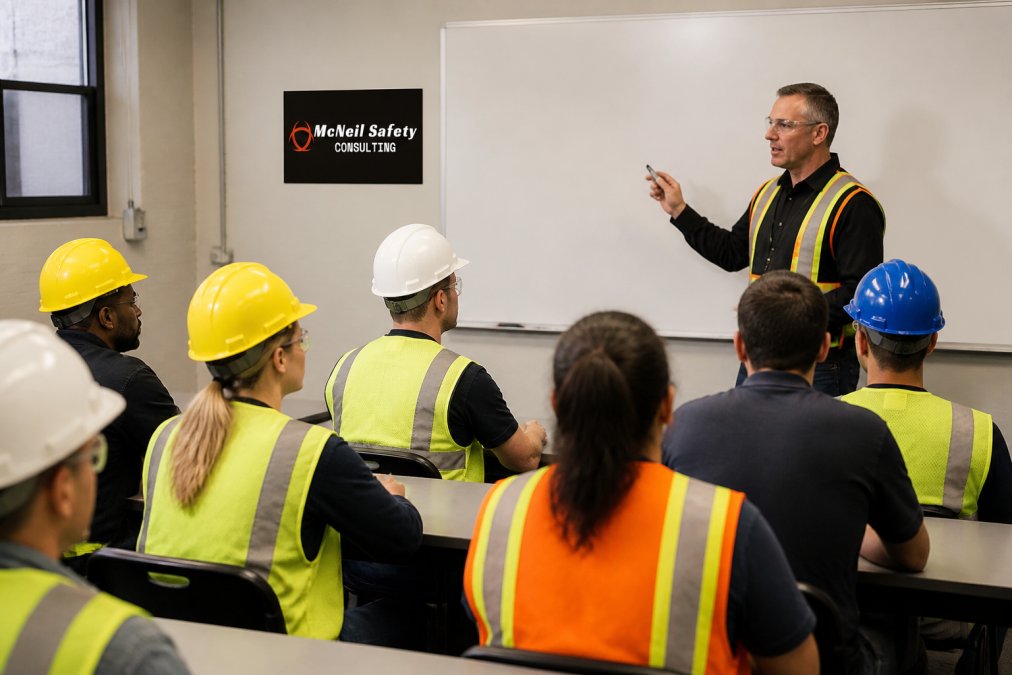
Effective training programs are built on specificity, documentation, and verification. Generic safety videos do not satisfy OSHA requirements. Training must address actual hazards in the specific workplace.
A compliant program typically covers hazard communication, process-specific safety procedures, emergency response, PPE selection and use, incident reporting, lockout/tagout, and confined space entry. Documentation must include the date, content covered, trainer’s name, and employee’s signature. OSHA inspectors will request these records.
According to NIOSH’s occupational health training resources, training effectiveness improves when employees can apply knowledge immediately in their work environment.
IoT, AI, and Modern Environmental Safety Solutions
The biggest shift in environmental safety solutions is the move from periodic assessment to continuous monitoring. IoT sensor networks now make it practical to track air quality, temperature, noise levels, and chemical concentrations in real time across an entire facility.
Continuous monitoring captures the actual exposure profile, not just a snapshot. AI-driven analytics identify patterns that human review would miss, flag equipment anomalies before release events, and prioritize maintenance based on risk rather than schedule.
For manufacturers with ESG reporting obligations, IoT monitoring infrastructure generates the continuous emissions and environmental data that sustainability reporting frameworks require. The practical constraint is integration: IoT safety platforms must connect with existing process control systems, maintenance management software, and compliance reporting workflows.
Cost-Benefit Analysis of Safety Investments in Manufacturing
Safety investments are risk transfer. The question is whether to spend money proactively on controls or reactively on incidents, citations, and litigation.
The cost structure of a workplace incident is larger than most operations managers account for. Direct costs include workers’ compensation claims and medical treatment. Indirect costs include lost productivity, incident investigation time, equipment damage, increased insurance premiums, and management time. The ratio of indirect to direct costs is consistently higher than facilities expect.
OSHA penalties for serious violations can reach substantial amounts per violation; willful or repeat violations carry significantly higher exposure. A single citation for an inadequate PSM program can cost many times more than the investment required to build a compliant program.
The most cost-effective safety investment is made before an OSHA inspection or workplace incident. Citation defense, incident investigation, and reactive compliance work cost more in time, money, and operational disruption than prevention programs.
A structured risk assessment provides the prioritization framework. High-severity, high-probability hazards should receive investment first.
Emergency Response Planning and Safety Audits
An effective emergency response plan is a practiced capability, not just a document. Response teams need to know their roles, equipment must be maintained and accessible, and the plan must be tested through drills that simulate realistic scenarios.
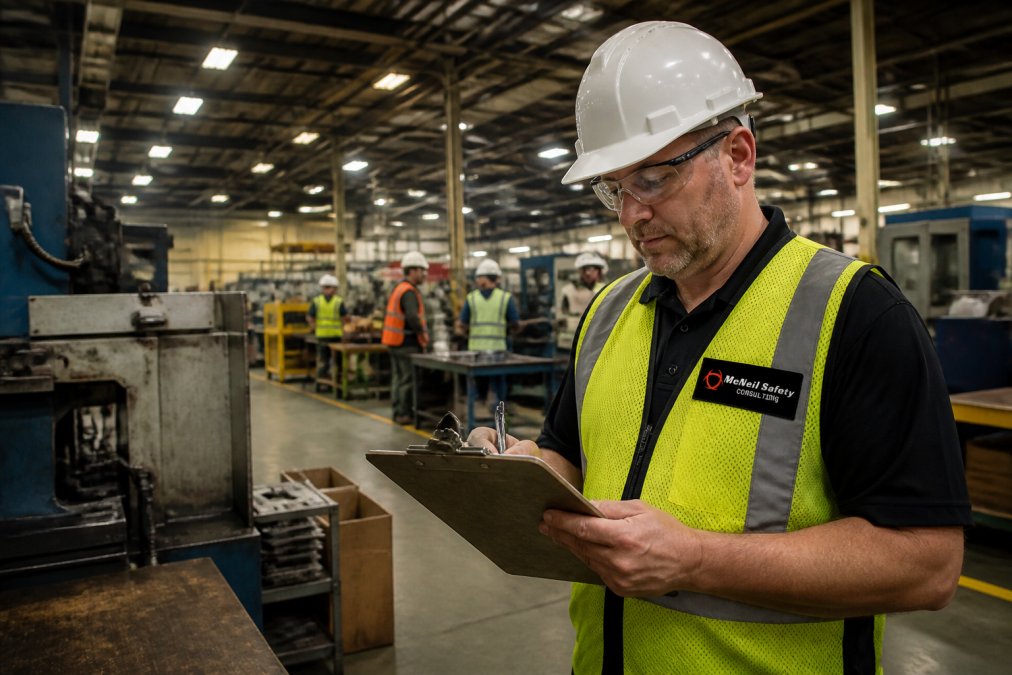
Facility safety audits identify gaps before an incident or OSHA inspection. A well-designed audit program covers both compliance requirements and operational hazards and produces findings with assigned corrective actions and completion deadlines.
Internal audits are management tools for identifying deficiencies. OSHA inspections are enforcement actions. Facilities with active internal audit programs are better positioned in both scenarios because they have documented evidence of compliance efforts.
According to EPA’s emergency planning guidance for facilities, facilities subject to EPCRA Section 302 requirements must coordinate emergency planning with Local Emergency Planning Committees.
Safety audits should be conducted by personnel with technical knowledge to identify hazards accurately and organizational independence to report findings without filtering. External auditors provide both.
Sustainability, ESG Reporting, and Environmental Stewardship
Environmental stewardship in manufacturing has shifted from a reputational consideration to a business requirement. Institutional investors, supply chain partners, and customers require documented evidence of environmental performance. ESG reporting frameworks provide the structure for that documentation.
The connection between environmental safety solutions and ESG reporting is direct. The monitoring data, compliance records, and incident history that a well-managed EHS program generates are the same data that ESG frameworks require. Facilities with mature EHS programs have a significant advantage in ESG reporting.
Environmental compliance sets the floor: facilities must meet permit limits, manage hazardous waste properly, and report releases above threshold quantities. Sustainability performance goes beyond compliance to measure resource efficiency, emissions intensity, and environmental impact over time.
For manufacturers building ESG reporting capability, the practical starting point is a gap assessment against the relevant reporting framework. The gap assessment identifies what data is already being collected, what needs to be added, and what reporting obligations actually require.
McNeil Safety Consulting works with manufacturing facilities to build the EHS program infrastructure that supports both regulatory compliance and sustainability reporting. The firm’s Registered Environmental Professional designation and industrial hygiene expertise provide the technical foundation for both environmental compliance work and ESG reporting.
Manufacturing operations face compounding regulatory, operational, and reputational risks that require a coordinated EHS approach rather than isolated programs. McNeil Safety Consulting provides the industrial hygiene expertise, Cal/OSHA compliance support, and environmental safety solutions that manufacturing facilities need to build that coordinated system. With credentials including REP, RIHP, and QSD designations and an on-staff licensed nurse for occupational health support, the firm brings the full technical range that complex manufacturing environments require. Get a free consultation with McNeil Safety Consulting and build an EHS program that protects your workforce and your operations.
Frequently Asked Questions
What are the core components of an effective environmental safety program in manufacturing?
An effective environmental safety program in manufacturing covers OSHA compliance, industrial hygiene assessments, process safety management, gas detection and monitoring, PPE protocols, employee safety training, emergency response planning, and regular safety audits. Together these elements form a safety management system that addresses both regulatory adherence and day-to-day hazard mitigation. Facilities that treat these as integrated rather than separate functions consistently see fewer incidents and stronger compliance outcomes.
What is EHS in manufacturing, and why does it matter?
EHS stands for Environment, Health, and Safety. In manufacturing, it refers to the combined management of environmental impact, occupational health risks, and workplace safety compliance. A structured EHS program helps facilities meet OSHA standards, reduce exposure to chemical and physical hazards, manage waste responsibly, and avoid costly citations. For most manufacturers, EHS is not optional, OSHA and EPA regulations impose specific obligations, and failing to meet them can result in fines, shutdowns, or legal liability.
What are common environmental hazards in industrial manufacturing environments?
Common environmental hazards in manufacturing include airborne chemical exposures, toxic dust and particulates, flammable gases, noise-induced hearing loss, hazardous waste generation, and contaminated stormwater runoff. Industrial hygiene assessments and air quality monitoring are the standard tools for identifying and quantifying these hazards. Once exposure levels are measured against OSHA permissible exposure limits, facilities can determine which engineering controls, PPE protocols, or process changes are needed to protect workers.
How do manufacturing facilities maintain compliance with OSHA and EPA regulations?
Compliance starts with a current EHS compliance checklist mapped to applicable OSHA standards and EPA requirements. Facilities should conduct routine safety audits and facility inspections, maintain up-to-date safety plans such as an IIPP and emergency response plan, document employee safety training, and keep records of exposure monitoring results. When citations occur, a prompt and well-documented response within OSHA's required timeframe is critical. Many facilities work with external consultants to fill gaps in internal expertise and manage inspection defense.
This article was written using GrandRanker