Table of Contents
- What an IIPP Safety Program Is and Why It Matters
- Steps to Create a Compliant California IIPP
- IIPP Training Documentation Best Practices
- Implementing Your Program Across Your Organization
- Common Mistakes to Avoid When Writing Your IIPP
- Reviewing and Updating Your IIPP Program Annually
- Frequently Asked Questions
Last Updated: October 1, 2026
What an IIPP Safety Program Is and Why It Matters
An Injury and Illness Prevention Program (IIPP) is a written safety system that identifies workplace hazards, prevents injuries, and ensures compliance with occupational health regulations. Every employer in California must have one. It’s not optional, it’s the foundation of your legal defense if something goes wrong.
Your IIPP demonstrates to regulators, injured employees, and courts that you have systems in place to protect people. When Cal/OSHA conducts an inspection or investigates an incident, the first thing they request is your IIPP. A strong one reduces citation exposure significantly.
An effective IIPP safety program reduces injuries, lowers workers’ compensation costs, and builds a safety culture where employees report hazards. Companies that invest in real IIPPs see fewer incidents and less turnover.
Many IIPPs are outdated, incomplete, or written in language employees don’t understand. The best ones are specific to your operation, updated annually, and actually used by your team.
Steps to Create a Compliant California IIPP
Creating an effective IIPP safety program takes planning, but it’s not complicated. Follow these five core steps, and you’ll have a document that works in the real world and holds up under regulatory scrutiny.
1. Document Management Commitment and Responsibility
Your IIPP must start with a clear statement from leadership committing your company to preventing injuries and illnesses. Name the person responsible for the program (usually the owner, safety manager, or operations director) and spell out their duties: review the IIPP, ensure it’s updated, and oversee hazard correction.
Include specific responsibilities for managers, supervisors, and employees. Managers enforce safety rules; employees report hazards, follow procedures, and participate in training. Reference your specific job titles, departments, and reporting structure, generic language won’t help in citation defense.
2. Establish Employee Involvement Processes
Employees see hazards that management misses. Your IIPP must include a clear process for them to report problems without fear of retaliation.
Create a hazard reporting system (form, email, suggestion box, or verbal report). Document how reports are tracked, who reviews them, and your response timeline, most companies aim for 24 to 48 hours.
Hold regular safety meetings (monthly for high-hazard operations, quarterly minimum) and document attendance, topics, and actions. Involve employees in hazard assessments, floor staff identify risks management misses and build buy-in for the program.
3. Conduct Workplace Hazard Assessment Procedures
A hazard assessment is a systematic walk-through to find things that could hurt people, the core of your effective IIPP safety program. List every area and activity: for construction, each trade and phase; for offices, each department and task; for warehouses, receiving, storage, packing, and shipping.
Walk through each area and document potential injury sources: slips, trips, falls, chemical exposure, noise, repetitive strain, heavy lifting, machinery, electrical hazards, and environmental conditions.
Rate each hazard by severity: high-severity (serious injury or death risk) addressed first, medium-severity on timeline, low-severity documented and corrected. Update annually, or more often if operations change, equipment is added, or after an incident.
4. Develop Hazard Correction and Control Plans
Finding hazards is only half the job. You must have a plan to fix them.
For each hazard, identify the control method in this priority: eliminate the hazard, substitute a safer method or material, engineer a control (guards, ventilation, barriers), use administrative controls (procedures, schedules, training), or require personal protective equipment as a last resort.
Assign responsibility, deadline, and budget for each hazard. Verify controls are working after implementation, check guards, PPE use, and ventilation, and document verification.
5. Build Communication Systems and Reporting Structures
Safety communication keeps your program alive. Without it, your IIPP becomes a filing cabinet document that nobody reads.
Create an easy reporting system (form, phone, email) and post it where people work. Establish a response process: who investigates, timeline, and outcome communication. Communicate your IIPP to new hires during onboarding with signed acknowledgment. Post hazard warnings, emergency procedures, first aid locations, and contact numbers visibly.
IIPP Training Documentation Best Practices
Training is where your IIPP comes alive. Without it, you have a document but no culture. Without documentation, you have no proof you trained anyone, and Cal/OSHA will cite you for it.
Establish a training schedule tied to your IIPP. Initial training occurs during onboarding; refresher training at minimum annually. Increase frequency when the IIPP is updated, after hazard-related incidents, with new equipment or processes, on employee role changes, or when records show knowledge gaps.
Document the schedule and stick to it. If annual training is supposed to happen in January, schedule it in December. Don’t let it slip.
Train on three levels: general IIPP, job-specific hazards, and supervisor-level management.
General IIPP training covers all employees: what the IIPP is, how to identify and report hazards, what happens after reporting, emergency procedures, their safety responsibilities, and consequences of non-compliance. Duration: 30-60 minutes for new hires; 15-30 minutes for refresher.
Job-specific hazard training is tailored to each employee’s work: fall protection, chemical safety, machinery operation, ergonomics, bloodborne pathogen protocols, etc. Be specific to your workplace, “hard hats required in concrete pour and steel erection zones” beats generic “wear a hard hat.” Duration: 30 minutes to 2 hours. Document specific hazards covered.
Supervisor training covers the full IIPP, hazard assessment, incident investigation, enforcement without punitiveness, procedure correction, and Cal/OSHA documentation requirements. Supervisors are your front line of safety management. Duration: 2-4 hours initial; 1-2 hours annual refresher.
Document every training event: date, employee name and title, trainer, specific topic, duration, method, attendance confirmation, competency verification, and follow-up needed. Keep records for at least 5 years, Cal/OSHA will request them during inspection.
Verify competency, don’t just check attendance. After training, confirm the employee understands and can apply what they learned: ask questions, observe performance, use simple checklists for complex topics. Document the method and result. If an employee fails, retrain and verify again.
Trigger refresher training when procedures change or after incidents. Retrain affected employees within 30 days of procedure changes. After injuries or near misses, retrain the affected crew on what went wrong and prevention, this reinforces that safety is dynamic and the company learns from incidents.
Use multiple training formats: in-person classroom, videos, hands-on practice, printed materials, and online modules. Variety prevents training fatigue and reaches different learning styles.
Track training completion rates and flag gaps. Maintain a spreadsheet showing who has completed required training, who is due for refresher, and which topics or supervisors have low completion rates. Review monthly and investigate delays.
Handle training failures as a management issue first. Investigate whether training was clear, the employee had time to attend, or additional support is needed. Retrain and verify. Only after retraining failure does it become a performance issue.
Cal/OSHA expects training to be effective, not just documented. Show that you trained, verified understanding, and followed up on failures, this protects you if an incident occurs.
Implementing Your Program Across Your Organization
Writing your IIPP is one thing. Getting people to use it is another. The difference between a document that sits in a filing cabinet and one that actually prevents injuries is implementation strategy and cultural integration.
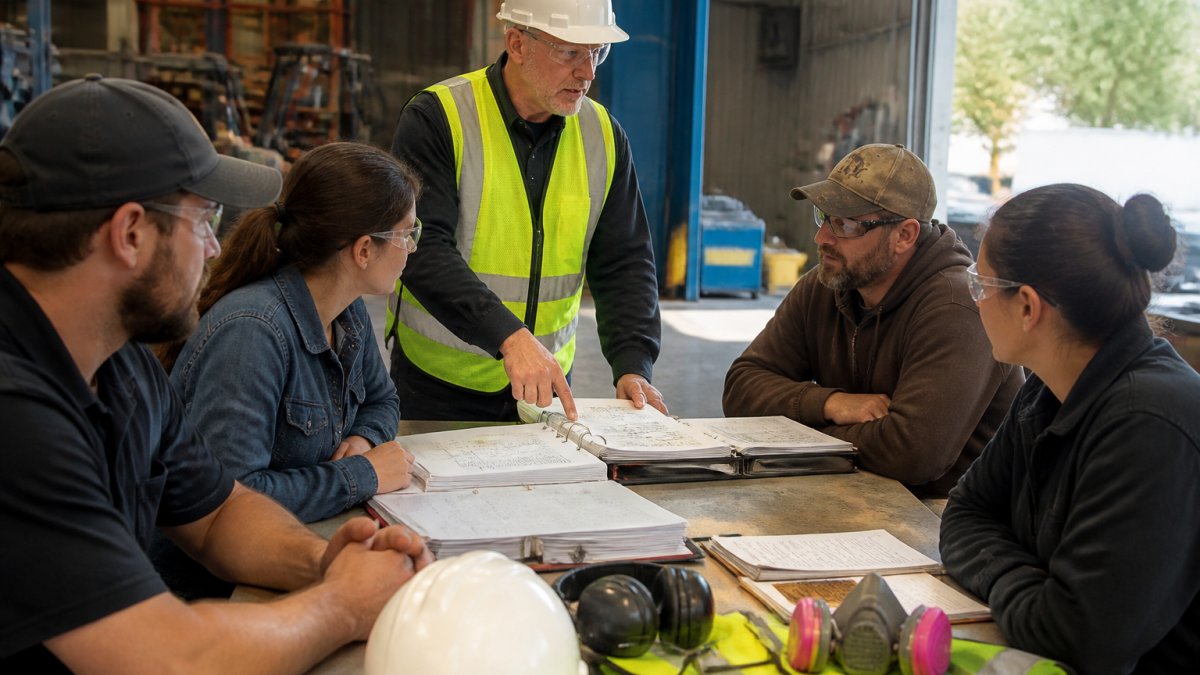
Start with leadership alignment, not just buy-in. Schedule a kickoff meeting with ownership, operations leadership, and your safety champion. Establish a monthly safety metrics review, track hazard report volume, correction completion rates, training attendance, and incident trends. When leadership discusses these alongside production metrics, safety becomes a business priority.
Assign a safety champion with real authority to own the IIPP day-to-day: schedule training, track hazard reports, follow up on corrections, and update the document. Give them authority to pause unsafe work without production pushback, this signals safety is non-negotiable.
Integrate the IIPP into existing workflows. Add a 2-minute hazard check to daily job briefings. Make hazard reporting routine with forms or QR codes at work stations. Include safety performance in reviews and tie safety metrics to team incentives.
Make the IIPP accessible in the format your workforce uses. Print laminated copies for job sites, host on intranet for office staff, or use mobile apps for mixed workforces. The goal is that an employee can find the relevant section in under 30 seconds.
Roll out changes incrementally and communicate the “why.” Prioritize by hazard severity.
Common Mistakes to Avoid When Writing Your IIPP
Most IIPPs fail not because they’re poorly written, but because they’re never actually used. Here’s what goes wrong.
Reviewing and Updating Your IIPP Program Annually
Your IIPP isn’t static. It needs regular review and updates to stay relevant and compliant.
Frequently Asked Questions
What are the mandatory elements of an IIPP in California?
Cal/OSHA requires an IIPP to include management commitment and responsibility, employee involvement and participation, hazard identification and assessment, hazard correction and control, safety training and instruction, communication systems, and program evaluation. Each element must be documented in writing and integrated into daily workplace operations. The program must address work-related injuries, preventative measures, and incident investigation procedures. Documentation should show how your organization identifies hazards, corrects them, trains employees, and maintains records of safety activities.
How often should an IIPP be reviewed and updated?
Cal/OSHA requires annual program evaluation at minimum, but best practice is quarterly reviews for organizations with active workplace hazards or recent incidents. After any significant workplace injury, near-miss, or regulatory inspection, your IIPP should be reviewed and updated within 30 days. Small business operations should conduct reviews when staffing changes, new equipment is introduced, or work processes change. Documentation of each review, including dates, attendees, and changes made, is essential for demonstrating compliance during audits or citation responses.
What is the difference between an IIPP and a general safety manual?
An IIPP is a regulatory mandate under Cal/OSHA that requires documented systems for identifying hazards, correcting them, training employees, and investigating incidents. A general safety manual is often broader, covering company policies and procedures that may exceed regulatory requirements. Your IIPP is the legally required foundation, it must address specific hazards present in your workplace and include accountability measures. A safety manual can support your IIPP but does not replace it. The IIPP focuses on occupational health and hazard management; a safety manual may include additional topics like facility rules or benefits information.
Who is responsible for implementing an IIPP within an organization?
Management holds ultimate responsibility for IIPP implementation, but the program requires active participation from supervisors, safety committees, and employees. A designated safety manager or coordinator typically oversees day-to-day administration, hazard assessments, training documentation, and incident reporting. Supervisors must enforce safety protocols and correct hazards in their areas. Employees must participate in hazard identification, report unsafe conditions, and attend required training. For small businesses, the owner or operations director may serve as the primary safety contact. Clear assignment of responsibilities and accountability measures must be documented in your IIPP.