Last Updated: November 21, 2026
Quick Summary
Every new hire’s cal/osha training record must capture seven elements: employee name, hire date, job classification, trainer identity, topics covered, employee acknowledgment, and a comprehension check. Missing any one weakens the record, and an inspector who cannot find it treats the training as if it never occurred.
- Record the employee’s full legal name, hire date, and job classification so training matches the role.
- List topics in plain terms, such as hazard communication, fall protection, and emergency evacuation.
- Pre-fill the header block before the first shift and mark each topic row as it is covered.
- Scan or upload the signed record the same day and file it under a fixed naming convention.
- Backfilling a signature or date makes a record look fabricated and undermines the entire file.
Table of Contents
- Why Cal/OSHA Training Documentation for New Employees Fails Inspections
- The 7 Elements Every Cal/OSHA Training Record Must Contain
- Cal/OSHA IIPP Training Requirements and the New-Hire Gap
- How to Use an Employee Safety Training Documentation Template
- Cal/OSHA Training Requirements by Occupation: What Changes for Each Role
- Cal/OSHA Fall Protection Training Requirements for New Construction Hires
- Verifying Comprehension and Retaining Records That Survive an Inspection
- Request a Consultation on Your New-Hire Training Records
- Frequently Asked Questions
Why Cal/OSHA Training Documentation for New Employees Fails Inspections
Many citations do not come from a missing training session. They come from a missing record.
The stakes are simple. Under the Cal/OSHA Title 8 regulations, employers must keep records that show who was trained, when, on what, and by whom.
Below, we break down the seven elements every new-hire training record needs, a template you can copy, and how to keep those records defensible.
The 7 Elements Every Cal/OSHA Training Record Must Contain
A defensible training record answers seven questions. Miss one and the record weakens.
| Element | What It Proves | Common Failure |
|---|---|---|
| Employee name | Who received training | Nicknames or initials only |
| Hire date | Training happened at the right time | Date missing or backfilled |
| Job classification | Training matched the role | Generic “employee” label |
| Trainer identity | A qualified person delivered it | Trainer name absent |
| Topics covered | Required content was taught | “Safety orientation” with no detail |
| Employee acknowledgment | The worker confirmed understanding | Signature missing |
| Comprehension check | The worker actually understood | No verification at all |
Employee Name, Hire Date, and Job Classification
Record the employee’s full legal name, hire date, and job classification. Classification matters because training must match the work: a laborer, an equipment operator, and a supervisor each need different instruction, and the record should show which one the worker is.
Trainer Identity, Topics Covered, and Employee Acknowledgment
Name the trainer and list topics in plain terms. “Hazard communication, fall protection, and emergency evacuation” beats “safety training.” The employee then signs and dates an acknowledgment confirming attendance and understanding.
Cal/OSHA IIPP Training Requirements and the New-Hire Gap
A common gap is between the Injury and Illness Prevention Program on paper and what actually happens on day one.
New hires are the weak point. For what the program itself must contain, see the IIPP compliance requirements guide; to build one from scratch, the step-by-step guide to a compliant IIPP walks through each part.
How to Use an Employee Safety Training Documentation Template
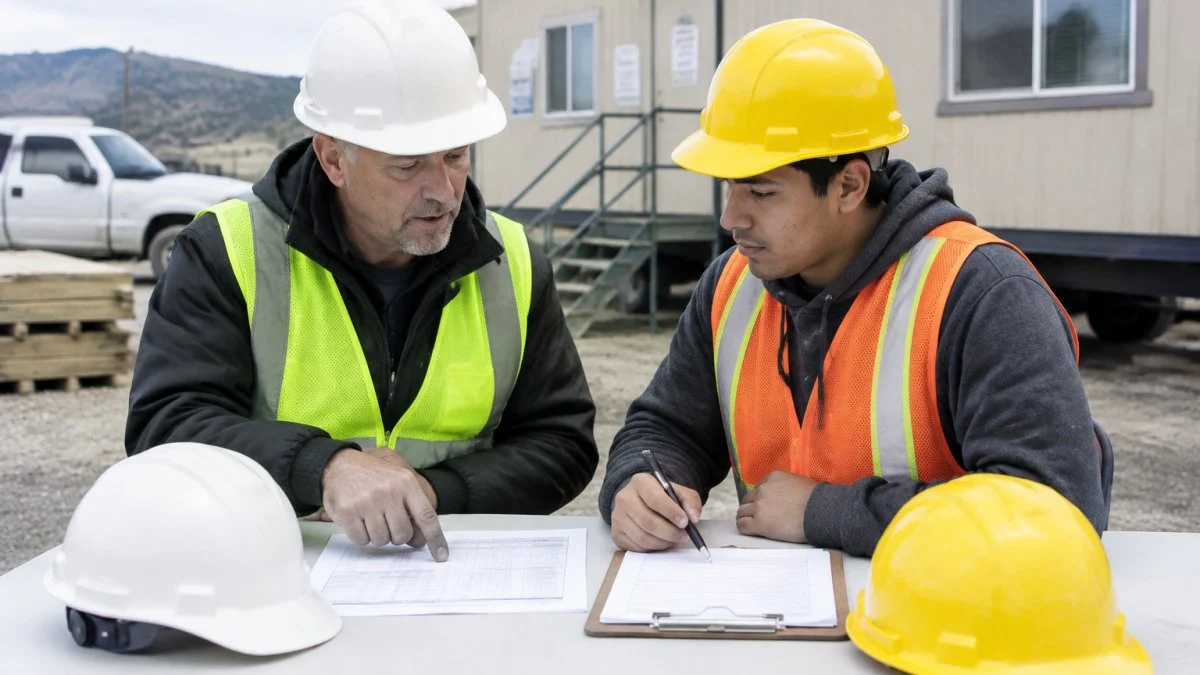
An employee safety training documentation template is a fill-in form that captures the seven elements in one place. Use it for every new hire, every time. The template is only half the tool; the other half is the workflow around it, who fills it in, when, where it is stored, and how completion is verified.
What the Template Should Contain
Build the form so a stranger could read it and reconstruct what happened. A workable layout has four blocks:
- Header block: employee full legal name, employee ID, hire date, job classification, department, and the trainer’s name and title.
- Session block: date of training, start and end times, location, delivery method (in person, online, on-the-job demonstration), and the language of instruction.
- Content block: one row per topic, with the specific standard or program section it satisfies, the training method used, and a pass/fail or completed mark for the comprehension check.
A completed row might read: “Hazard communication, Title 8 Section 5194, classroom plus container-label walkthrough, quiz passed 8/10, employee and trainer signed same day.” That line ties the record to the hazard, content, trainer, employee understanding, and applicable standard, exactly what an inspector tests.
The New-Hire Documentation Workflow
Run the same sequence for every hire so the record is never an afterthought:
- Before the first shift. The hiring manager or safety coordinator pre-fills the header block from the offer packet. Job classification drives which topic rows are required.
- During orientation. The trainer delivers general instruction, then task-specific instruction. Each topic row is marked as it is covered, not reconstructed afterward.
- At the end of the session. The comprehension check is administered and scored. Employee and trainer both sign and date.
- Same day. The record is scanned or uploaded to the designated folder and the paper original filed under a fixed convention (last name, first name, hire date) so records can be pulled in seconds during an inspection.
- Before task assignment. If a task-specific module (fall protection, lockout, chemical handling) is delivered later, a supervisor adds that row and signs the verification line before the employee performs the task unsupervised.
- At the close of onboarding. The safety coordinator reviews the record against the role’s required-topic list and marks it complete. Anything missing is scheduled, not skipped.
Watch out: backfilling a signature or a date weeks later is the fastest way to make a record look fabricated, and an inspector who spots a backfilled date will treat the entire file as unreliable.
Where to Store It and How to Verify Completion
Store the completed record in one system of record, not a manager’s inbox, an uncontrolled shared drive, or paper alone.
Verification is separate from completion. A record is verified when a second person, typically the safety coordinator, confirms every required topic row is filled, both signatures are present, the comprehension check is scored, and the record is filed under the correct name.
A Sample Completed Record
A finished record for a new equipment operator might show: header block complete with hire date and classification; a two-hour orientation on the hire date; content rows for hazard communication, PPE, emergency procedures, and machine-specific safe operation, each tied to its standard; a comprehension check scored 9/10; employee and trainer signatures dated the same day; a supervisor verification line signed before the first solo shift; and a verification log entry the following morning.
Cal/OSHA Training Requirements by Occupation: What Changes for Each Role
Training requirements shift with the job. General safety instruction applies to everyone, but hazard-specific rules apply to certain roles.
- General labor: hazard communication, PPE, emergency procedures
- Equipment operators: machine-specific instruction and safe operation
- Supervisors: hazard identification and their oversight duties
The Cal/OSHA compliance guide sets the framework, and our Cal/OSHA requirements guide maps the broader rule set. Match the record to the role, not to a single company-wide form.
Cal/OSHA Fall Protection Training Requirements for New Construction Hires
Fall protection is where a thin record gets the most scrutiny on construction sites. New hires who work at height must be trained before exposure, and the record should name the specific systems covered: guardrails, personal fall arrest, and safe ladder use.
The training must also cover hazard identification, so the worker can spot an unprotected edge. Document the topics, the trainer, and the date. If the worker has not been trained, keep them off elevated work until they are.
Verifying Comprehension and Retaining Records That Survive an Inspection
A signature proves attendance, not understanding. The record is only defensible if it shows the employee could do the work safely after training, and if the record itself can still be produced, intact and readable, months or years later.
Verifying Comprehension Beyond a Signature
Pick a verification method that matches the hazard and the role, and record the method and the result on the same form:
- Verbal walkthrough: the trainer asks the employee to explain a procedure in their own words and notes the topics covered and any gaps corrected on the spot.
- Short written quiz: a handful of questions tied to the specific standards taught, scored and attached to the record.
- Demonstrated task: the employee performs the task under observation (donning PPE, locking out a disconnect, inspecting a harness) and the observer signs off.
Record the method, score or outcome, date, and the name of the person who verified. A record that says only “trained” invites “how do you know?”; one that says “demonstrated harness inspection, passed, verified by [supervisor], same day” answers it.
Multilingual Training and Documenting Comprehension
Training must be delivered in a language and literacy level the employee understands, and the record should say so. Note the language of instruction in the session block. If an interpreter or bilingual trainer delivered the session, record that person’s name and role alongside the primary trainer. For comprehension, prefer a demonstrated task or verbal walkthrough in the employee’s language over a written quiz in a second language, a low quiz score may reflect language rather than understanding.
Retention: How Long and Why
Set a retention period that satisfies the applicable standard for each topic and your own policy, then apply the longer of the two. Retention periods vary by standard, some hazard-specific training records carry their own minimums, so confirm the current period against the official Cal/OSHA standards before you set your schedule, and revisit it whenever a standard changes.
Digital Recordkeeping and Version Control
Electronic records are acceptable and usually preferable, provided they are legible, complete, and protected from alteration. A few practices make digital records defensible:
- One system of record. Pick a single location and forbid duplicate copies in personal inboxes.
- Fixed file naming. Use a consistent convention (last name, first name, hire date, topic) so records can be retrieved during an inspection without a search.
- Version control. When a template changes, keep the old version and note the effective date. Never overwrite a completed record with a revised form.
Employee Access to Training Records
Employees are entitled to view their own training and safety records on request, and the procedure should be written down. Designate a contact, set a reasonable response window, provide a copy in a readable format, and log the request and response. The guide to California EHS training best practices covers how to make those records hold up under review.
Retention Periods and Employee Access to Training Records
Set a retention period that meets the applicable rule and your own policy, then stick to it. Confirm current periods against the official Cal/OSHA standards before you set your schedule. Give employees access to their records when they ask, and log that access. Review the whole procedure at least annually, and immediately after any inspection, citation, or serious incident, so the system of record stays current as standards and headcount change.
Request a Consultation on Your New-Hire Training Records
If your new-hire records are thin, the fix starts with an honest audit. See the compliance assistance services and how to engage.
Your training records are only as strong as the weakest form in the binder. Build the seven elements into every new-hire record, complete them on day one, and verify comprehension before you file.
Frequently Asked Questions
What documents should employers keep for new-hire safety training?
Keep a signed training record for each new employee that shows the employee name, hire date, job classification, training date, topics covered, trainer name and signature, and the employee acknowledgment. Pair it with the hazard assessment or IIPP section that drove the training, any safety data sheets for chemicals the worker handles, and the competency verification note. Store them together so an inspector can trace the hazard to the instruction to the signature in one file.
How long should employers keep employee safety training records?
Retention depends on the standard that triggered the training. Cal/OSHA rules under Title 8 set specific periods for several hazard programs, so check the section that applies to each record rather than applying one blanket period. As a practical floor, keep new-hire training records for the duration of employment plus the retention period named in the applicable standard. Digital copies with a backup and a clear index are acceptable and make employee access requests easier to fulfill.
Does Cal/OSHA require employees to sign training records?
Several Title 8 standards require a record of training that identifies the employee and the date, and a signature or initialed acknowledgment is the cleanest way to prove the worker received the instruction. Even where a signature is not spelled out, an unsigned record is weak evidence during an inspection. Have the employee sign and date the record, and have the trainer sign too, so both sides of the instruction are documented.
When should new employees receive workplace safety training?
Initial training should happen before the worker faces the hazard, which for most roles means day one, before the first shift on a task covered by a Cal/OSHA standard. Job-specific and hazard-specific instruction follows as the worker takes on each task. Retraining is required when a new hazard is introduced, when work duties change, or when the employer sees evidence that the worker’s understanding is incomplete. Document each session at the time it happens.
