Last Updated: October 29, 2026
Quick Summary
Start the witness interview within the first 24 hours, because memory fades fast after an industrial accident. Secure the scene, list every witness, ask open-ended questions before specifics, and write the account in the witness’s own words.
- Most witness interviews should run 20 to 45 minutes, and longer sessions tire people out.
- Interview witnesses separately so one person’s story cannot shape another’s account.
- Use a consistent statement form with a header, scene details, account, equipment, training and signature block.
- Record facts, not opinions: write that the guard was missing, not that he was careless.
- Store signed forms in one file, back up recordings, and log every interview.
Table of Contents
- Why the First 24 Hours Decide Your Witness Interview
- Step 1: Secure the Scene and Identify Every Witness
- Step 2: Use These Workplace Accident Witness Interview Questions
- Step 3: Set the Ground Rules Before You Ask Anything
- Step 4: How Long Should a Witness Interview Take?
- Step 5: Fill In the Workplace Incident Witness Statement Template
- Step 6: Apply Accident Investigation Interview Best Practices
- Step 7: Preserve Statements and Survive an OSHA Inspection
- Frequently Asked Questions
Why the First 24 Hours Decide Your Witness Interview
Memory fades fast after an industrial accident. A witness who saw the event clearly at 9 a.m. may recall half of it by the next morning.
The first 24 hours set the record that follows you for months. Good notes protect the company. Sloppy notes create gaps that a compliance officer will find later.
Below, we break the process into seven steps. Each step builds on the one before it.
Step 1: Secure the Scene and Identify Every Witness
Start by making the area safe, then lock it down. Stop work in the zone, tape it off, and keep people out unless they are needed for rescue or repair. Photograph the scene before anything moves.
Next, list everyone who was nearby. On a multi-employer site, it also helps to manage Cal/OSHA multi-employer worksite responsibilities so each employer’s duties for those workers are clear. That includes:
- Direct eyewitnesses
- Workers who heard the event
- Supervisors on shift
- Contractors and temp staff on site
Step 2: Use These Workplace Accident Witness Interview Questions
Good workplace accident witness interview questions are open-ended first and specific later. Start wide, then narrow.
Open with:
- “Tell me what you were doing right before the accident.”
- “Walk me through what you saw, in your own words.”
- “What did you hear?”
Then move to specifics:
- “Where were you standing?”
- “Was anyone else in the area?”
- “Did you see any warning signs or hear any alarms?”
- “Was the worker following the usual procedure?”
Avoid leading questions like “You saw him skip the lockout, right?” That puts words in the witness’s mouth and weakens the statement later.
Step 3: Set the Ground Rules Before You Ask Anything
Tell the witness three things up front. First, this is a fact-finding interview, not discipline. Second, give your best recollection and say “I don’t know” when unsure. Third, do not discuss the event with other workers until the investigation closes.
Then explain the basics:
- The interview will be written down or recorded.
- The witness can review the statement before signing.
- Honesty matters more than sounding certain.
One common mistake is letting a supervisor run the interview. Workers may clam up or shade the truth. Use a neutral person when possible.
Step 4: How Long Should a Witness Interview Take?
Most witness interviews should run 20 to 45 minutes. Longer sessions tire people out, and tired witnesses start guessing. If a witness saw a lot, split the session into two shorter talks.
Keep these points in mind:
- Fresh witnesses: 20-30 minutes is usually enough.
- Complex events: allow up to an hour, with breaks.
- Follow-ups: 10-15 minutes to clear up gaps.
Stop the interview if the witness is injured, shaken, or needs medical care. Their health comes first, and a calm witness gives a better account.
Step 5: Fill In the Workplace Incident Witness Statement Template
A workplace incident witness statement template keeps every interview consistent, but consistency is only half the value. The stronger reason to use one form is that each field should map to something an employer has to prove later.
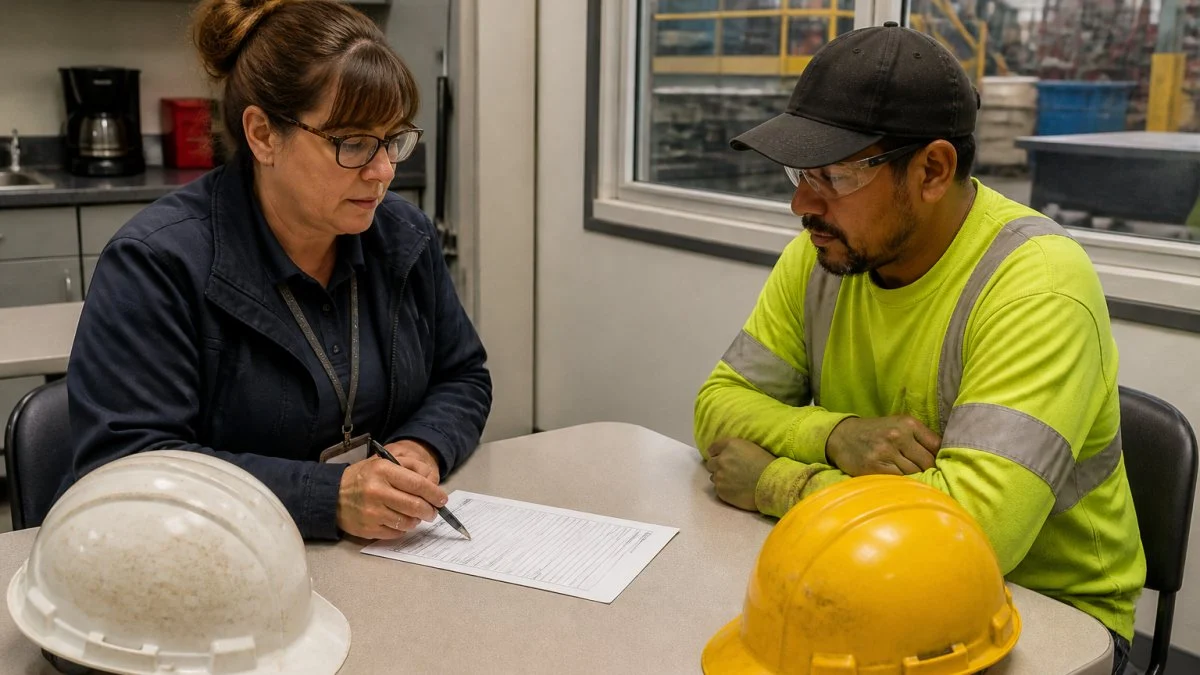
Here is the structure we recommend, with the reason each block earns its place:
- Header: Date, time, location, interviewer name, witness name and job title. This fixes the timeline and shows the interview happened while memory was fresh.
- Scene details: Where the witness stood, what they could see, what blocked their view. This tells you later how much weight the account can carry.
- Account: The witness’s own words, written in first person. Paraphrase invites challenges that the statement was shaped by the interviewer.
- Equipment and conditions: Tools, guards, lighting, housekeeping, weather. This is where you capture the physical facts that explain the event.
- Training and rules: Did the witness know the rule? When was it last trained? Was it enforced on the crew? This block is the one most often left blank and the one most often needed.
- Signature block: Witness signature, date, and a line for corrections.
Write the account in the witness’s words, not yours. Read it back, let them fix errors, and have them initial each change.
Map each statement to the evidence you will need
A statement form is only as good as the records it points to. For each interview, note in the file where the supporting evidence lives, so the file is usable months later during an inspection or a citation contest. A practical checklist:
- Written safety rules: The specific rule that applied to the task, with its revision date.
- Training records: Sign-in sheets, training-system completion records, and the date the witness last completed the relevant module.
- Enforcement history: Disciplinary records, coaching notes, and documented corrections for the same rule across the crew.
- Discovery efforts: Inspection logs, audit reports, corrective-action tracking, and who closed each item and when.
- Access and knowledge: Access-control data, badge logs, and maintenance records showing who could reach the area or equipment.
Build the checklist into the statement form itself as a short footer: rule cited, training date, enforcement reference, and evidence location. A witness interview that produces a statement plus four cross-references is worth far more than a statement alone.
Common failure points in the form
- Blank training block. If the witness cannot recall the training, write that down rather than leaving it empty. An honest gap is easier to address than a form that looks incomplete.
- Opinion dressed as fact. Keep “the guard was missing” separate from “he was careless.” The first is evidence; the second is argument.
- One form for every role. A supervisor, a direct eyewitness, and a contractor may need different follow-up questions. Use the same template but add role-specific prompts.
- No cross-reference to the rule. If the statement does not name the rule the worker was expected to follow, the file cannot show that the rule was communicated.
A consistent form, tied to a short evidence checklist, is what lets an employer show a functioning program rather than a pile of interviews. That is the difference between a file that supports a defense and one that only documents that people were talking.
Step 6: Apply Accident Investigation Interview Best Practices
Solid accident investigation interview best practices come down to discipline. Keep these habits:
- Interview separately. Group interviews let one person’s story shape another’s.
- Take notes in real time. Do not rely on memory.
- Stay neutral. Do not argue or correct the witness.
- Record facts, not opinions. Write “the guard was missing,” not “he was careless.”
- Ask one question at a time. Stacked questions confuse people.
Document who you talked to, when, and for how long. That log becomes evidence of reasonable diligence if a citation follows.
Step 7: Preserve Statements and Survive an OSHA Inspection
Statements are only useful if they are kept safe, organized, and reachable on short notice. For a deeper walkthrough of how to preserve evidence after a workplace fatality, review the linked steps.
When a compliance officer arrives, hand over what the law requires and keep the rest organized. Readers facing an inspection can turn to this OSHA inspection defense guide for manufacturing for a deeper look at defending the company.
A step-by-step timeline from inspection through citation contest
- Immediately after the event: Secure the scene, list witnesses, and begin interviews the same day. Preserve video, access-control data, and equipment records before they are overwritten or rotated out.
- Before the compliance officer arrives: Confirm who will accompany the officer, what documents are ready, and which records are privileged or under review. Keep the witness log current.
- During the inspection: Stay with the officer, take your own notes on what was photographed, sampled, and requested, and record the scope of the walkaround. Do not volunteer documents outside the request.
- After the opening conference: Consolidate statements, training records, inspection logs, and enforcement history into one indexed file. Note any gaps and start filling them.
- When citations issue: Calendar the response deadline the day the citation arrives. Contest windows are short, so confirm the current deadline for your jurisdiction with the issuing agency rather than relying on memory.
- Before the contest or informal conference: Re-interview key witnesses only where a gap remains, prepare a written summary of the safety program, and coordinate with counsel where the matter is heading to a formal contest.
- Through resolution: Keep the evidence file intact and log every addition. Do not let the file drift out of date as the matter moves.
The contest window is short. Calendar the deadline the day the citation arrives.
Investigate without undermining the defense
A neutral, documented investigation protects the employer; a rushed one can hurt it. Keep these habits:
- Interview separately and consistently. The same questions, the same form, the same interviewer where possible.
- Record facts, not blame. Conclusions belong in a separate summary, not in the witness statements.
- Treat similar conduct the same way. Inconsistent discipline is one of the fastest ways to undercut a claim that rules were enforced.
- Keep the file chronological. A dated log of who was interviewed, when, and what was collected is itself evidence of reasonable diligence.
Where the rules differ
Federal OSHA and state-plan jurisdictions do not apply every test the same way, and the practical steps around an inspection can differ. In California, Cal/OSHA runs its own inspection and citation process, so confirm current requirements with the agency before relying on them.
If citations follow, the clock starts fast. Confirm the response deadline and process with the issuing agency.
| Step | What You Do | Time Needed |
|---|---|---|
| 1 | Secure scene, list witnesses, preserve digital records | First hour |
| 2 | Prepare documents and accompaniment plan | Before officer arrives |
| 3 | Accompany officer, log scope and requests | During inspection |
| 4 | Consolidate and index the evidence file | Same week |
| 5 | Calendar the contest deadline | Day citation arrives |
| 6 | Prepare summary and coordinate with counsel | Before contest or conference |
| 7 | Maintain the file through resolution | Ongoing |
Frequently Asked Questions
How soon should you interview witnesses after an industrial accident?
Interview as soon as the scene is secure and injured workers have been treated, ideally within the first 24 hours. Memory fades fastest in the first day, and witnesses who talk to each other before you record their accounts tend to align their stories. Conduct each witness interview separately, note the date and time on every statement, and record whether the person was still on shift. If a witness is too shaken to continue, stop, document the reason, and reschedule within 48 hours.
Should witnesses be interviewed separately after an industrial accident?
Yes. Group interviews invite contamination: one person’s version becomes the group version, and you lose any chance of spotting conflicting accounts. Bring each witness in alone, ask open questions first, and keep the room free of supervisors who were involved in the event. If two accounts conflict, do not confront either person with the other’s statement. Note the discrepancy, ask each witness to clarify the specific detail, and let the physical evidence and records resolve it.
What should you ask a witness after a workplace accident?
Start with open prompts: what were you doing, what did you see, what did you hear, and what happened next. Follow with specifics about the task, the equipment, the training the person received, and any safety rule in play. Avoid leading questions like was the guard missing, which put words in the witness’s mouth. Close by asking whether anything else stands out and whether the witness knows anyone else who saw the event. Write down the questions you asked so the record shows a neutral process.
Can an employer record a workplace accident witness interview?
Recording is allowed in many situations, but check your state’s rules on consent before you press record, and tell the witness plainly that the interview is being recorded. Audio alone is usually enough. If you record, keep the original file unedited, note the device and the start time, and store it with the written statement. A written statement signed by the witness remains the core record, so never rely on a recording as a substitute for documentation.
