Last Updated: October 23, 2026
Quick Summary
Multi-employer worksite responsibilities require each employer to identify, communicate, and correct hazards based on their role as creating, exposing, correcting, or controlling employer. Cal/OSHA holds all employers accountable for hazards they create, expose workers to, or fail to correct, regardless of who caused the problem.
- Cal/OSHA defines four distinct employer roles: creating, exposing, correcting, and controlling, each with different citation risk.
- Controlling employers must inspect at least weekly, document hazards, notify responsible employers in writing, and verify corrections were made.
- Multiple employers can be cited for the same hazard; one employer’s mistake triggers citations for everyone on site.
- Keep all inspection reports, hazard assessments, corrective action notices, and photos for at least three years as your defense.
- You have 15 calendar days from citation date to file a notice of contest; missing this deadline means accepting the citation.
Table of Contents
- Understanding Multi-Employer Worksite Liability Under Cal/OSHA
- Cal/OSHA Controlling Employer Responsibilities and Authority
- Building a Multi-Employer Worksite Safety Coordination Plan
- Contractor Hazard Reporting and Corrective Action Protocols
- Cal/OSHA Multi-Employer Citation Defense Strategy
- Common Mistakes to Avoid on Multi-Employer Worksites
- Conclusion
- Frequently Asked Questions
Understanding Multi-Employer Worksite Liability Under Cal/OSHA
A multi-employer worksite is any job where more than one employer has workers on site at the same time. Construction is the most common example, but these sites also occur in manufacturing, utilities, warehousing, and facility maintenance.
One employer’s mistake can trigger citations for everyone on site. If a general contractor fails to address a fall hazard, both the GC and any subcontractors whose workers are exposed can be cited.
The Four Employer Roles on a Multi-Employer Worksite
Cal/OSHA defines four distinct employer roles. Each role carries different responsibilities and different citation risk.
Creating employer. This employer brings the hazard into existence.
Exposing employer. This is any employer whose workers are exposed to the hazard, whether they created it or not.
Correcting employer. This employer has the authority and responsibility to fix hazards on the worksite, usually the general contractor or site owner.
A single employer can hold multiple roles at once. A general contractor is usually both correcting and controlling.
When Multiple Employers Can Be Cited for the Same Hazard
Cal/OSHA can cite more than one employer for a single violation. This happens when:
- The creating employer failed to build the job safely
- The exposing employer failed to protect its workers
- The correcting employer had the power to fix it but didn’t
- The controlling employer failed to oversee the work
All four employers can be cited for the same hazard. Each citation stands independently. You cannot escape liability by blaming another contractor.
Cal/OSHA Controlling Employer Responsibilities and Authority
The controlling employer carries the heaviest burden on a multi-employer worksite. Cal/OSHA expects it to run the safety program, inspect the work, identify hazards, and enforce corrections. If you are the general contractor, project manager, or site owner, you are almost certainly the controlling employer.
Controlling employers must take reasonable steps to prevent and correct hazards. “Reasonable steps” means:
- Regular site inspections (at least weekly, more often on active projects)
- Written hazard assessments before work starts
- Clear communication of hazards to all contractors
- Documented corrective action when hazards are found
- Follow-up verification that corrections were made
You cannot delegate this responsibility to a safety consultant or another contractor. You own it.
Identifying and Documenting Hazards Created by Others
Start with a baseline hazard assessment before any work begins. Identify potential sources of accident or injury systematically across all contractors and work areas.
Document what you find. Use a simple form: location, hazard description, who created it, who is exposed, what the fix is. Keep these records. They become your defense if Cal/OSHA shows up.
During work, inspect at least once per week. More often if the scope changes or new trades move in. Look for:
- Incomplete fall protection systems
- Unsecured equipment or materials
- Electrical cords and connections
- Scaffolding and ladder safety
- Housekeeping and debris
- PPE compliance
- Trenching and excavation safety
Take photos. Write down what you see. Note the date and time. If you find something unsafe, document it the same day.
Enforcing Corrective Action and Follow-Up
When you identify a hazard, notify the responsible employer in writing. Email works. Text does not.
Give the employer time to fix it, but verify the fix yourself. Do not assume it got done. Go back to the site and check.
If the employer does not fix it, escalate. Stop work in that area if the hazard is serious.
This protects you. Cal/OSHA will ask whether you knew about the hazard, told the contractor to fix it, and can prove they refused.
Building a Multi-Employer Worksite Safety Coordination Plan
A safety coordination plan is your roadmap for managing hazards across all contractors. Write it before work starts and review it with every employer on site.
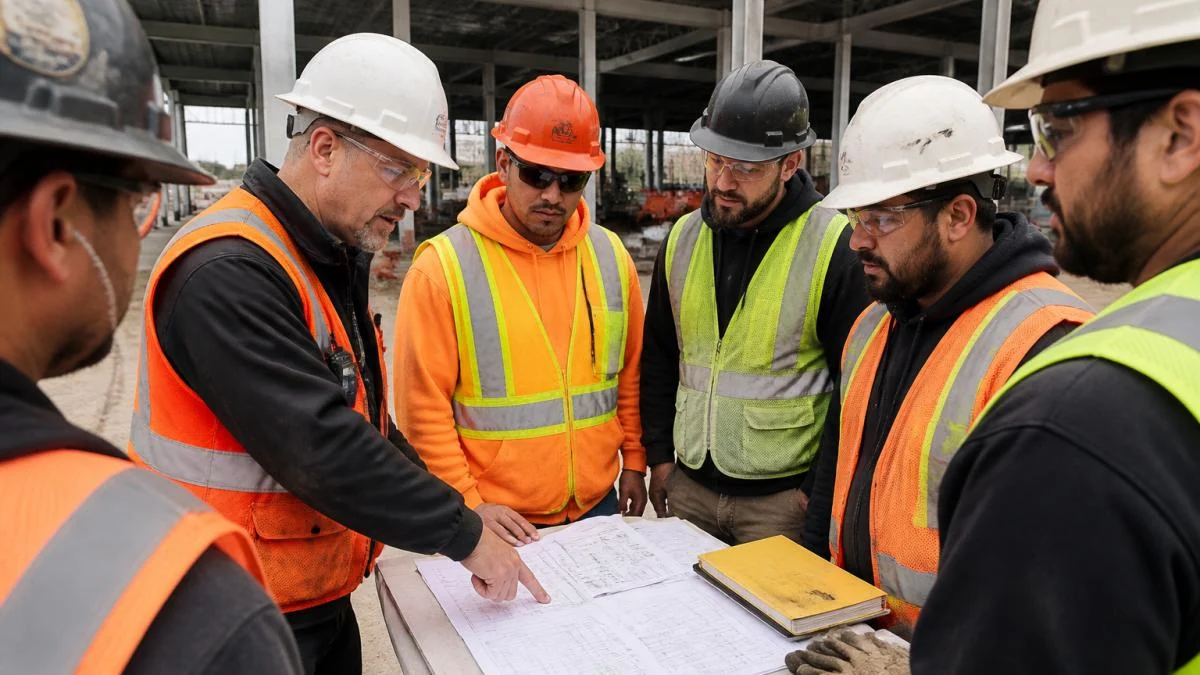
The plan should cover:
- Names and contact info for all contractors
- Roles and responsibilities (who is creating, exposing, correcting, controlling)
- Hazard identification process
- How contractors will communicate hazards
- Corrective action procedures
- Inspection schedule
- Emergency response plan
- How disputes will be resolved
Learn how to write an IIPP for a California workplace to document your safety coordination plan as part of your injury and illness prevention program.
Keep the plan simple. A five-page document is better than a fifty-page manual no one reads.
Pre-Work Communication and Site Meetings
Hold a safety meeting before any work starts. Invite the general contractor, all major subcontractors, the site owner, and your safety person. Go through the hazard assessment together.
Give each contractor a copy of the safety plan. Have them sign a form saying they received it and understand their responsibilities. Keep those signatures.
During the project, hold weekly 15-minute toolbox talks and rotate who leads them. Discuss hazards found that week, corrective actions taken, and upcoming work that might introduce new hazards.
Defining Roles, Hazards, and Corrective Procedures
Create a responsibility matrix. List each hazard down the left side. List each employer across the top. Mark who is creating, exposing, correcting, and controlling for each hazard.
Example:
| Hazard | General Contractor | Electrical Subcontractor | Framing Subcontractor |
|---|---|---|---|
| Fall protection | Controlling | Exposing | Creating |
| Electrical shock | Controlling | Creating | Exposing |
| Nail puncture | Controlling | Exposing | Creating |
This matrix makes roles clear: everyone knows who owns each hazard, and when something goes wrong you know who was responsible.
For corrective procedures, write them down. “If a fall hazard is found, the contractor must install guardrails or fall arrest systems within 24 hours.
Contractor Hazard Reporting and Corrective Action Protocols
Every contractor on site should have a way to report hazards, a simple form, a text to the project manager, or a daily log. The method does not matter; what matters is that hazards get reported and documented.
When a contractor reports a hazard, acknowledge it the same day. Tell them what you are doing about it. If the hazard is serious, stop work immediately.
Create a corrective action log. Write down:
- Date hazard was found
- Who found it
- Description of the hazard
- Who is responsible for fixing it
- Deadline for correction
- Date corrected
- Who verified the fix
This log is your proof that you managed the worksite responsibly. Cal/OSHA will ask to see it.
Documentation Requirements and Record Retention
Keep every inspection report, hazard assessment, corrective action notice, and photo for at least three years in one place, dated and labeled clearly.
If a worker gets hurt, Cal/OSHA will request all your safety records. Complete documentation shows you were managing hazards; thin or missing records suggest you were not paying attention.
Your documentation should prove:
- You knew about the hazard
- You told the responsible employer to fix it
- You gave them a reasonable deadline
- You verified the fix
- You followed up
Cal/OSHA Multi-Employer Citation Defense Strategy
If Cal/OSHA cites you for a hazard created by another employer, you can contest the citation, request an informal conference, or settle with a penalty reduction.
The key to a strong defense is documentation. If you can show that you did everything reasonable to identify and correct the hazard, Cal/OSHA may reduce the penalty or dismiss the citation.
Responding to Citations Within the 15-Day Window
You have 15 calendar days from the date of the citation to file a notice of contest. This deadline is hard.
Read the citation carefully. Understand exactly what Cal/OSHA is alleging. Note the specific regulation, the hazard description, and the proposed penalty.
Decide whether to contest. If the allegation is clearly wrong or your documentation shows you acted responsibly, contest it.
If you contest, file the notice of contest within 15 days. You can request an informal conference with the Cal/OSHA area office.
For guidance on responding within the tight timeline, read about the 15-day response process to understand your options and how to build a strong response.
Building Your Defense Case
Your defense rests on three things: knowledge, authority, and action.
Knowledge. Did you know about the hazard? Your inspection records prove you knew.
Authority. Did you have the power to fix the hazard? If you are the general contractor, yes.
Action. What did you do about it?
Gather all relevant documents:
- Site inspection reports
- Hazard assessment
- Photos of the hazard before and after correction
- Written notices to the contractor
- Emails about the hazard
- Corrective action log
- Proof that the fix was verified
Organize these by date. Create a timeline showing what you knew and when you knew it.
If the citation is for a hazard you did not create and could not control, emphasize that.
For detailed guidance on reducing penalties and building a stronger case, explore penalty reduction strategies to understand what Cal/OSHA considers in settlement negotiations.
Common Mistakes to Avoid on Multi-Employer Worksites
Most employers make the same mistakes on multi-employer sites.
No written safety plan. A verbal agreement is not enough.
No regular inspections. Inspecting once a month is not enough. Weekly minimum.
No follow-up. Telling a contractor to fix something is not enough.
Ignoring worker reports. If a worker tells you about a hazard, take it seriously.
No communication. Contractors need to know what hazards exist and how to avoid them.
Conclusion
Managing multi-employer worksite responsibilities is not optional. Cal/OSHA expects you to identify hazards, communicate them clearly, and enforce corrections, or you will be cited.
The strategy is straightforward: document everything, inspect regularly, communicate in writing, and verify corrections. Build a responsibility matrix so every contractor knows their role. Hold regular safety meetings. Keep records for three years.
If you get a citation, respond within 15 days. Build a defense case based on your documentation.
McNeil Safety Consulting helps employers navigate multi-employer worksites and defend against Cal/OSHA citations. We handle site inspections, hazard assessments, corrective action protocols, and citation defense. Request a consultation to discuss your worksite safety challenges, or call (626) 546-9384 to speak with our team about your specific situation.
Frequently Asked Questions
What are the four employer roles under Cal/OSHA multi-employer worksite rules?
Cal/OSHA identifies four roles: the creating employer causes the hazard; the exposing employer allows employees to work in the hazard; the correcting employer is responsible for fixing the hazard; and the controlling employer has authority over the worksite and the authority to correct hazards. A single employer can hold multiple roles. Understanding these distinctions is critical for determining who can be cited when a hazard exists on a multi-employer worksite.
Can a controlling employer be cited for a hazard created by another contractor?
Yes. Under Cal/OSHA multi-employer citation policy, a controlling employer can be cited if they knew or should have known of a hazard and failed to take reasonable steps to correct it or require its correction. This liability exists even if another contractor created the hazard. The controlling employer’s authority over the worksite creates a duty to inspect, identify recognized hazards, and enforce corrective action across all contractors.
What should a subcontractor do when another employer controls the work area but hasn’t corrected a hazard?
A subcontractor should immediately document the hazard in writing, report it to the controlling employer and general contractor, and request corrective action in writing. Keep copies of all reports and follow-up communications. If the hazard remains uncorrected and poses imminent danger, the subcontractor should remove workers from the area and escalate the issue. Subcontractors are still exposing employers and can face citations if they fail to protect their own workers from recognized hazards.
How should employers document compliance with multi-employer worksite responsibilities?
Maintain records of site inspections, hazard assessments, contractor safety meetings, written hazard reports from all employers, corrective action requests, completion dates, and follow-up verification. Document communication between the controlling employer and other contractors. Keep copies of safety plans, contract terms addressing hazard responsibility, and evidence of corrective action taken. These records are essential if Cal/OSHA cites you and you need to defend your compliance efforts.
