
Table of Contents
- What Professional Industrial Hygiene Programs Deliver
- Workplace Exposure Assessment: The Foundation of Protection
- Industrial Hygiene Monitoring That Catches Problems Early
- Identifying and Controlling Workplace Hazards
- Industrial Hygiene Program Elements and Implementation
- Industrial Hygiene Best Practices for Sustained Compliance
- Eight Concrete Benefits for Your Organization
- 1. Reduced Worker Illness and Injury Claims
- 2. Regulatory Compliance and Citation Defense
- 3. Lower Insurance Premiums and Liability Exposure
- 4. Improved Worker Retention and Morale
- 5. Faster Response to OSHA Citations
- 6. Data-Driven Decision Making
- 7. Operational Continuity and Reduced Downtime
- 8. Competitive Advantage in Bidding and Contracts
- Getting Started with Professional Industrial Hygiene Support
- Frequently Asked Questions
Last Updated: October 12, 2026
What Professional Industrial Hygiene Programs Deliver
Professional industrial hygiene programs protect workers from health hazards before illness or injury happens. They identify workplace dangers, measure worker exposure, and put controls in place to reduce risk.
An effective industrial hygiene program identifies hazards consistently, measures exposures with real data, and keeps controls in place. Healthier workers, a cleaner compliance record, and lower insurance costs follow.
Workplace Exposure Assessment: The Foundation of Protection
Exposure assessment answers one question: are workers actually getting hurt by what’s in the air, on surfaces, or in their tasks?
An exposure assessment involves three steps:
- Identify what hazards exist (chemicals, dust, noise, biological agents, ergonomic stress)
- Measure how much workers are exposed to each hazard
- Compare the measurements to regulatory limits and best practices
Without this data, you’re guessing. With it, you know which areas need engineering controls, which need better training, and which are already safe.
Industrial Hygiene Monitoring That Catches Problems Early
Monitoring is ongoing assessment: it tracks whether controls are working and whether new hazards have emerged.
Effective monitoring includes:
- Air sampling for chemical vapors, dust, or biological agents
- Noise level measurements in high-risk areas
- Thermal stress monitoring in hot environments
The key is frequency. Quarterly monitoring in high-risk areas plus annual monitoring in lower-risk areas gives you data trends, early warning of degrading controls, and documentation for your OSHA file.
Identifying and Controlling Workplace Hazards
Hazard identification and control is where protection happens: you find the problem, then fix it using a hierarchy of controls.
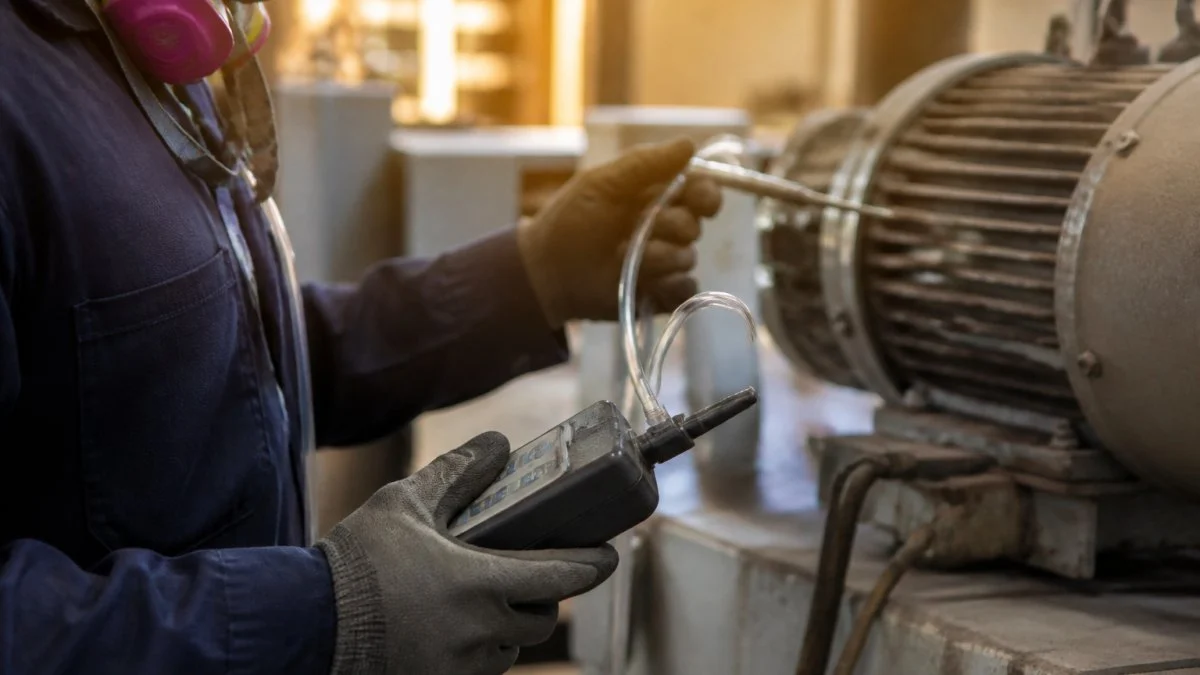
Chemical Hazard Management
Chemical hazards include solvents, cleaners, pesticides, fuels, and industrial compounds. Each can cause acute injury or chronic disease after years of exposure.
Control starts with substitution: can you use a less toxic chemical instead?
Documentation matters: keep safety data sheets current, label containers clearly, and train workers on hazards and controls.
Air Quality and Biological Hazards
Air quality covers dust, mist, vapor, and biological agents like mold, bacteria, or viruses, which cause respiratory disease, allergies, and infections.
Control options include:
- Local exhaust ventilation (capture hazards at the source)
- Dilution ventilation (general air circulation)
- HEPA filtration (removes fine particles)
Biological hazards need special attention in healthcare, food processing, and water treatment settings. A professional assessment identifies where they thrive and what controls work best.
Industrial Hygiene Program Elements and Implementation
A complete industrial hygiene program has structure. The implementation layer, how the pieces fit together, who owns them, and how the program gets built inside a working facility, is where programs succeed or quietly die.
The Core Elements
A defensible program contains these components, each with a named owner and a review cadence:
- Written policy stating management commitment to worker health, signed at the top of the organization
- Hazard identification procedures that describe how problems get found, not just that they should be
- Exposure assessment and monitoring protocols, including who samples, how often, and where results are stored
Roles: Who Actually Owns This
A program without a single accountable person drifts. Three roles matter:
- Program owner. One named individual coordinates industrial hygiene activity across operations, maintenance, safety, and human resources. This is often a safety manager, but it can be an operations leader in smaller facilities. The owner does not have to be an industrial hygienist; the owner has to be accountable for the schedule and the records.
- Technical resource. A qualified industrial hygienist performs or directs exposure assessments, interprets sampling results against regulatory limits, and selects controls. This is where an outside professional is most useful, because the sampling methods, laboratory accreditation, and limit comparisons are specialized work.
- Supervisors and workers. Supervisors enforce controls on the floor and report changes in process, materials, or staffing that could shift exposures. Workers report symptoms, odors, visible dust, and equipment problems. Both feed the hazard identification loop.
A Practical Phased Roadmap
Building the whole program at once is the most common failure pattern. A phased approach works better:
- Baseline (first 30 to 60 days). Walk the facility, inventory chemicals and processes, pull safety data sheets, and identify the hazard categories present: chemical, noise, thermal, biological, ergonomic, and physical. No sampling yet, just a complete picture.
- Prioritize (next 30 days). Rank hazards by the number of workers exposed, the severity of the potential health effect, and whether a regulatory exposure limit applies. The top two or three become the initial focus.
- Assess (next 60 to 90 days). Commission exposure assessments for the priority hazards. Air sampling, noise dosimetry, and surface checks as applicable. Compare results to the applicable limits and to any internal action levels you set.
- Control (ongoing). Apply the hierarchy: eliminate the hazard, substitute a safer material or process, engineer the exposure out, then administrative controls, then PPE. Document the reasoning for each choice.
- Verify (quarterly for high-risk areas). Re-monitor to confirm controls are working and not degrading. Adjust as data shows drift.
- Sustain (annual). Review the whole program, update the hazard inventory, refresh training, and confirm records are complete.
Documentation That Holds Up
Inspectors and insurers look for a paper trail showing a decision-making process, not a stack of certificates. Keep these records retrievable:
- The current written program and its revision history
- Hazard inventory and the assessment that produced it
- Sampling results with method references, dates, and the limits used for comparison
The difference between a program that survives an inspection and one that doesn’t is rarely the sampling equipment. It’s whether the facility can show a consistent process, identify, assess, control, verify, document, with dates and names attached.
McNeil Safety Consulting builds and maintains industrial hygiene programs for employers across California and the Western US, handling exposure assessments, monitoring protocols, control design, and the documentation structure that supports citation defense when it’s needed.
Industrial Hygiene Best Practices for Sustained Compliance
Sustained compliance means staying safe year after year, not just passing one inspection. The practices below separate programs that hold up over time from those rebuilt after every incident.
Leading and Lagging Indicators
A program you can’t measure is a program you can’t defend. Track both types of indicators.
Leading indicators show whether the program is being executed:
- Percentage of scheduled exposure assessments completed on time
- Corrective actions closed within the target window
- Training completion rate by department and by task
Lagging indicators show outcomes:
- Recordable injury and illness rates
- Workers’ compensation claim frequency and severity
- Occupational disease cases, including hearing loss and respiratory conditions
Neither type alone tells the story. Leading indicators without lagging outcomes can mean you’re busy without being effective. Lagging indicators without leading ones tell you something went wrong but not why.
Worker Participation That Actually Works
Worker participation is not a suggestion box. It’s a structured loop:
- Reporting. Give workers a clear, low-friction way to report symptoms, odors, visible dust, equipment problems, and near misses. Track every report and close the loop by telling the reporter what happened.
- Consultation. Involve workers in hazard identification walkthroughs and in control selection. They know which controls work on the floor and which ones get bypassed.
- Training. Train to the task, not to the calendar. A worker who handles a specific solvent needs to know its health effects, its exposure limit, and the controls for that task, not a general chemical safety overview.
Review Cadence
Set the schedule and hold it:
- Quarterly: high-risk area monitoring, corrective action review, leading indicator review
- Semiannually: internal audit of the program against its own written procedures
- Annually: full program review, hazard inventory refresh, training refresh, and a professional review of the exposure data and control effectiveness
Common Failure Patterns
Most programs that fall apart do so predictably:
- The program exists on paper but no one owns the schedule
- Sampling was done once, years ago, and never repeated
- Controls were installed but never verified
Each is fixable, and cheaper to fix before an inspection or an illness than after.
Pick two leading indicators and two lagging indicators and report them to management on the same cadence as your financial metrics. Programs that get management attention get resources.
McNeil Safety Consulting works with employers across California and the Western US on program review, exposure assessment, monitoring protocols, and the documentation that supports both sustained compliance and citation defense. Request a Consultation.
Eight Concrete Benefits for Your Organization
Professional industrial hygiene programs deliver measurable business outcomes. Here’s what happens when you build one.
1. Reduced Worker Illness and Injury Claims
Workers exposed to controlled hazards stay healthier. Fewer illnesses mean fewer workers’ compensation claims, lower claim costs, and lower experience modification rates, and across a workforce over years, the savings compound.
2. Regulatory Compliance and Citation Defense
OSHA inspectors look for three things: hazard identification, exposure assessment, and control documentation. A professional industrial hygiene program provides all three.
If an inspector finds a violation, your documentation becomes your defense.
McNeil Safety Consulting helps employers respond to Cal/OSHA and federal OSHA citations within the required timeframe.
3. Lower Insurance Premiums and Liability Exposure
Insurance companies reward employers with documented safety programs. Lower experience modification rates translate to lower premiums, and if a worker develops an occupational disease, your documentation shows you took reasonable precautions.
4. Improved Worker Retention and Morale
Workers want to feel safe, and a visible, documented industrial hygiene program signals that management cares about their health. Employees who see controls in place, receive hazard training, and know management listens stay longer, meaning less recruiting cost and more experienced teams.
5. Faster Response to OSHA Citations
When OSHA issues a citation, you have 15 days to respond. A professional industrial hygiene program with current exposure data and documented controls lets you respond quickly without scrambling to gather data.
6. Data-Driven Decision Making
A professional program gives you real data, so decisions rest on measurements rather than guesses. Which area needs a new ventilation system? The one with the highest air sampling results. Which workers need medical surveillance? The ones with the highest exposure levels. You invest in solutions that address real problems, not perceived ones.
7. Operational Continuity and Reduced Downtime
Hazard controls prevent worker illness and injury, so fewer sick days and accidents mean more consistent staffing. Preventive maintenance of control systems, ventilation filters, noise barriers, equipment guards, prevents sudden failures that shut down production.
8. Competitive Advantage in Bidding and Contracts
Many large contractors and clients now require proof of a documented safety program before awarding work. A professional industrial hygiene program with current assessments and monitoring data makes your bid more competitive, you can certify that your workplace meets specific safety standards and demonstrate compliance.
Getting Started with Professional Industrial Hygiene Support
Starting a professional industrial hygiene program doesn’t require a complete overhaul.
Step one: identify your biggest hazard. Is it a chemical process? Dust?
Step two: get a baseline exposure assessment. Measure current conditions.
Step four: implement controls and document what you did.
Step five: monitor regularly. Quarterly is a good starting frequency for high-risk areas.
Step six: train workers on hazards and controls.
Frequently Asked Questions
What does an industrial hygiene program actually do for a workplace?
An industrial hygiene program identifies, evaluates, and controls workplace hazards that could harm worker health. It combines hazard identification, exposure assessment, and control measures to reduce risk. The program documents findings, tracks compliance with OSHA standards, and provides data to support decision-making about worker protection and facility operations. A structured program also creates a record useful if regulatory agencies or insurers request documentation of your safety efforts.
How does industrial hygiene monitoring help protect workers?
Industrial hygiene monitoring uses air sampling, noise assessment, and exposure tracking to detect harmful substances or conditions before they cause illness. Regular monitoring reveals whether engineering controls are working, whether personal protective equipment is adequate, and where additional safeguards are needed. This proactive approach catches problems early, prevents chronic health conditions, and demonstrates to workers that management is committed to their safety.
When should a workplace conduct an exposure assessment?
Exposure assessment should begin when you hire workers who may contact hazardous materials, noise, or biological agents. Reassess whenever work processes change, new equipment arrives, or workers report health symptoms. After controls are put in place, periodic reassessment confirms they are effective. If you receive an OSHA citation or workers’ compensation claim related to a hazard, immediate assessment is critical to understand the scope of exposure and design corrective action.
What is the difference between industrial hygiene and occupational health?
Industrial hygiene focuses on identifying and controlling workplace hazards through exposure assessment, engineering controls, and monitoring. Occupational health is broader and includes medical surveillance, fitness-for-duty evaluations, and treatment of work-related illness. Both are essential: industrial hygiene prevents exposure, while occupational health tracks whether workers are affected and provides medical support. Together they form a complete worker protection strategy.
A professional industrial hygiene program keeps your workers safe, reduces your compliance risk, and improves your bottom line. The question isn’t whether you can afford to build one. It’s whether you can afford not to. Contact McNeil Safety Consulting to discuss your workplace hazards and get started with a baseline assessment.