Table of Contents
- Why Silica Exposure Control Matters on Your Jobsite
- Practice 1: Implement Respirable Crystalline Silica Engineering Controls
- Practice 2: Establish a Written Cal/OSHA Silica Exposure Control Plan Template
- Practice 3: Conduct Silica Exposure Assessment Methods and Monitoring
- Practice 4: Implement Silica Medical Surveillance Requirements
- Practice 5: Maintain Employee Training and Hazard Communication
- Common Mistakes That Undermine Silica Exposure Control
- Responding to a Cal/OSHA Citation: Your 15-Day Window
- Frequently Asked Questions
Last Updated: October 3, 2026
Why Silica Exposure Control Matters on Your Jobsite
Respirable crystalline silica is one of the most serious workplace hazards in construction and manufacturing. When workers breathe in silica dust, it embeds in their lungs and causes silicosis, a permanent, disabling disease that develops over years.
At McNeil Safety Consulting, we work with construction companies and industrial operations to build effective silica exposure control programs. The five practices below are the foundation of compliance. They also keep your team healthy and protect your business from regulatory penalties.
Here’s what we’ll cover: how to engineer dust out of your processes, write a solid exposure control plan, monitor air quality, conduct required medical exams, and train your workforce. We’ll also show you what mistakes undermine these efforts, and how to respond if you get a Cal/OSHA citation.
Practice 1: Implement Respirable Crystalline Silica Engineering Controls
The best way to control silica dust is to stop it from becoming airborne in the first place. Engineering controls are your first line of defense. They’re more reliable than relying on workers to wear respirators correctly every day.
Wet Methods and Integrated Water Delivery Systems
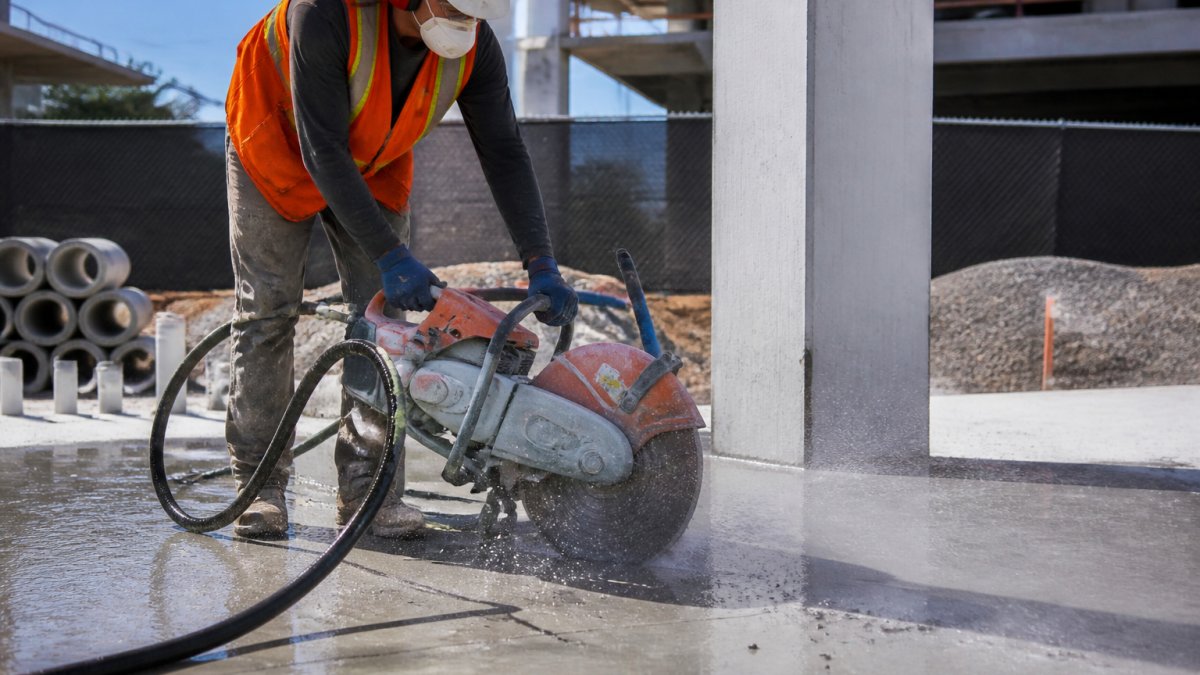
Wet cutting and drilling are the most effective ways to suppress silica dust at the source.
Integrated water delivery systems pump water directly to the cutting blade or drill bit. The water flows continuously during the cut. This approach works for:
- Concrete saws and circular saws
- Diamond core drills
- Grinding and polishing equipment
- Masonry saws
Wet methods reduce airborne silica by 90% or more when done correctly. The key is keeping the water flow steady and making sure it reaches the dust source. Workers should still wear respirators as backup protection, but the engineering control does the heavy lifting.
Local Exhaust Ventilation and HEPA Filtration
When wet methods aren’t practical, local exhaust ventilation captures dust right where it’s created. A dust collector with HEPA filtration removes silica particles from the air before they reach workers’ breathing zones.
This approach works well for:
- Grinding benches and hand tools
- Chipping and jackhammering
- Sweeping and cleanup operations
- Indoor demolition work
HEPA filters trap particles as small as 0.3 microns. Make sure your dust collector is sized correctly for the equipment it serves. Undersized collectors won’t capture all the dust.
Practice 2: Establish a Written Cal/OSHA Silica Exposure Control Plan Template
Cal/OSHA requires a written exposure control plan for any workplace where workers might be exposed to respirable crystalline silica. This isn’t optional. A plan shows regulators that you’ve thought through the hazard and taken steps to manage it.
What Your Plan Must Include
Your silica exposure control plan template should cover these elements:
- Job tasks and exposure levels. List every job that involves silica dust. Estimate which ones are high-exposure and which are lower-risk.
- Engineering controls. Describe the wet methods, ventilation, or other controls you’ll use for each task.
- Work practices. Explain how workers will use tools, clean up, and handle materials to minimize dust.
- Respiratory protection. State when respirators are required and how you’ll fit-test and train workers.
- Medical surveillance. Detail baseline and periodic exams, and who pays for them.
- Regulated areas. Mark zones where exposure might exceed the PEL and restrict access.
- Monitoring and assessment. Explain how often you’ll sample air and adjust controls.
- Training. Describe what workers will learn about hazards and controls.
Your plan doesn’t need to be long. A clear, focused document is better than a thick manual that nobody reads. The plan should be specific to your operations. A generic template won’t satisfy Cal/OSHA if it doesn’t address your actual work.
Regulated Areas and Access Control
A regulated area is any zone where airborne silica could exceed the PEL (permissible exposure limit). You must mark these areas clearly and limit access to trained workers wearing proper protection.
Signage should state:
- “Regulated Area: Respirable Crystalline Silica”
- The hazard and protection required
- Who is authorized to enter
Restrict entry to workers who have been fit-tested for respirators and trained on silica hazards. Contractors and visitors should not enter without approval and proper equipment.
Practice 3: Conduct Silica Exposure Assessment Methods and Monitoring
You can’t manage what you don’t measure. Air sampling tells you whether your controls are working and whether workers are staying below the PEL.
Air Sampling and PEL Compliance
The PEL for respirable crystalline silica is 50 micrograms per cubic meter of air, averaged over an 8-hour work shift. This is the legal limit.
Sample air in the breathing zone where workers are actually exposed. Use a calibrated pump and filter to collect a sample over the full work shift. Send samples to a certified lab for analysis.
How often should you sample? Start with baseline samples on all high-exposure jobs. Then:
- Sample at least every 6 months if you’re below the PEL
- Sample every 3 months if you’re above the PEL or close to it
- Sample more frequently if you change processes or equipment
Keep records of all air samples for at least 30 years. Cal/OSHA will ask to see them during an inspection.
Housekeeping and Decontamination Procedures
Silica dust settles on surfaces and can become airborne again when workers walk through or handle materials. Good housekeeping prevents this.
Use wet methods for cleanup whenever possible:
- Wet sweep or mop floors instead of dry sweeping
- Vacuum only with HEPA-filtered equipment
- Wipe down surfaces with damp cloths
- Never use compressed air to clean, as it blows dust back into the air
Decontamination procedures should include:
- A change room or area where workers remove dusty clothes
- Separate bins for contaminated clothing and street clothes
- Shower facilities if workers have high exposure
- Cleanup procedures at the end of each shift
Workers should also wash hands and face before eating or drinking. Silica dust can be ingested if it gets on food or hands.
Practice 4: Implement Silica Medical Surveillance Requirements
Medical surveillance protects workers and creates a record of their health status. It also helps you detect problems early.
Baseline and Periodic Examinations
Every worker with potential silica exposure needs a baseline exam before or within 30 days of starting work. This exam includes:
- A chest X-ray to establish a baseline
- Pulmonary function tests to measure lung capacity
- A medical questionnaire about respiratory symptoms
- A physician’s review
After the baseline, workers need periodic exams every 3 years. These follow the same format and are compared to the baseline to spot changes.
Keep all medical records confidential and separate from personnel files. Workers have the right to see their own results and to discuss them with a healthcare provider.
Respirator Fit Testing and Selection
If your engineering controls don’t fully protect workers, respirators are the backup. But a respirator only works if it fits properly. Loose-fitting respirators let contaminated air leak around the edges.
Fit testing must happen:
- Before a worker first wears a respirator
- Annually thereafter
- Whenever a worker’s face shape changes (weight loss, dental work, facial hair)
A licensed vocational nurse or certified fit-test technician should conduct fit testing. The tester will use a quantitative method to measure how well the respirator seals.
For silica dust, use respirators rated for fine particles:
- N95 or better for low-exposure tasks
- Powered air-purifying respirators (PAPRs) for higher exposure
- Supplied-air respirators for very high exposure or confined spaces
Train workers on how to inspect, wear, and clean their respirators. A respirator stored wrong or worn incorrectly offers almost no protection.
Practice 5: Maintain Employee Training and Hazard Communication
Workers can’t protect themselves from a hazard they don’t understand. Training is your chance to explain silica exposure, health effects, and the controls you’ve put in place.
Training should cover:
- What silica is and where it’s found in your work
- Health effects: silicosis, lung cancer, kidney disease
- The PEL and why it matters
- Engineering controls and how to use them correctly
- Respiratory protection, fit testing, and care
- Work practices to minimize dust
- Medical surveillance and their rights
- Where to find the exposure control plan and safety data sheet
Train all new workers before they start. Refresh training annually or whenever you change processes or equipment.
Use safety data sheets (SDS) to communicate hazards. Post them in a central location and make sure workers know where to find them. The SDS explains what silica is, health hazards, exposure limits, and first aid.
Common Mistakes That Undermine Silica Exposure Control
Even companies with good intentions often make mistakes that weaken their programs. Here are the most common ones:
Relying too much on respirators. Respirators are personal protective equipment, not engineering controls. They should be the last line of defense, not the first. Too many companies skip wet methods or ventilation and just hand out masks. This fails when respirators aren’t fit-tested, aren’t worn correctly, or develop leaks.
Skipping air sampling. Companies often assume their controls are working without ever measuring.
Ignoring take-home exposure. Workers carry silica dust home on their clothes, hair, and skin.
Poor housekeeping. Dry sweeping and compressed air blow dust back into the air.
Incomplete medical surveillance. Some companies do baseline exams but skip the periodic follow-ups. The follow-ups are what catch early lung damage.
Generic training. Training should be specific to your jobs and controls. Generic safety talks don’t stick with workers.
Responding to a Cal/OSHA Citation: Your 15-Day Window
If Cal/OSHA issues a citation for silica exposure violations, you have 15 days to respond. This is a tight deadline, but it’s manageable with the right support.
Your options are:
Pay the penalty and correct the violation. This is the fastest path if the citation is straightforward and the penalty is acceptable.
Request an informal conference. Ask Cal/OSHA to discuss the citation before you decide. Sometimes the agency will reduce the penalty or modify the violation if you show good faith efforts.
File a notice of contest. This formally disputes the citation. You’ll have a hearing before a judge. This option takes months or years but may be worth it if the penalty is large or the citation is unfair.
McNeil Safety Consulting handles Cal/OSHA citation defense and appeals in California and the Western US.
The 15-day deadline is real. Don’t wait. Contact McNeil Safety Consulting as soon as you receive a citation.
Silica exposure control is not a one-time project, it’s an ongoing commitment.
Frequently Asked Questions
What is the current Cal/OSHA action level for respirable crystalline silica?
The Cal/OSHA action level for respirable crystalline silica is 2.5 micrograms per cubic meter as an 8-hour time-weighted average. When employee exposure reaches or exceeds this level, you must begin exposure monitoring, establish a written silica exposure control plan, and initiate medical surveillance. The Permissible Exposure Limit (PEL) is 5 micrograms per cubic meter. Exceeding the PEL triggers immediate corrective action and regulatory citations.
Which engineering controls are most effective for silica dust suppression?
Wet methods and integrated water delivery systems are the most effective controls for respirable crystalline silica. These include wet cutting, wet grinding, and wet polishing on construction sites. Local exhaust ventilation with HEPA filters ranks second when wet methods are not feasible. Compressed air for cleanup must be avoided entirely. Engineering controls must be in place before relying on respiratory protection, which is a last resort when engineering controls cannot eliminate exposure below the PEL.
What medical surveillance is required for employees exposed to silica?
Employees exposed to respirable crystalline silica at or above the action level must receive baseline medical examinations including chest X-rays and spirometry testing before or within 30 days of initial exposure. Periodic examinations are required every 3 years thereafter. A licensed occupational health provider must review all results and maintain medical records for 30 years after employment ends. These records document baseline lung function and detect early signs of silicosis.
How do I know if my silica exposure control plan meets Cal/OSHA requirements?
Your written silica exposure control plan must identify all tasks that generate respirable crystalline silica, specify engineering controls and work practices for each task, establish regulated areas with access control, detail personal protective equipment requirements including respirator types and fit-testing protocols, outline housekeeping and decontamination procedures, describe employee training content, and include a schedule for air sampling and exposure assessment. The plan must be reviewed and updated whenever work processes change or exposure monitoring reveals exceedances.