
Last Updated: November 19, 2026
Quick Summary
An environmental compliance training program for employers is a structured set of courses and records that teach workers how their jobs affect the environment and what the law requires. Build it around four rule areas that drive most enforcement: waste, air, water, and chemicals, then map each job task to a specific rule set.
- Every training module should end with a competency assessment, not just a sign-in sheet.
- RCRA requires generators to ensure personnel are thoroughly familiar with waste handling and emergency procedures.
- Match training to each role’s risk using a written, role-based matrix tied to job descriptions.
- Blend online modules for regulatory knowledge with instructor-led sessions for hands-on skills.
- Treat process, chemical, equipment, permit, and regulatory changes as documented retraining triggers.
Table of Contents
- What an Environmental Compliance Training Program Must Cover
- Why Employers Need a Training Program, Not Just a Policy
- Environmental Compliance Training for Employees by Role
- EPA Compliance Training and the Federal Rules That Drive It
- Environmental Compliance Training Program for Employers Online
- Environmental Compliance Training Duration and Refresher Triggers
- Building Your Program: A Practical Implementation Roadmap
- Step 1: Inventory obligations before you write a single course
- Step 2: Assign a single program owner and named backups
- Step 3: Build the role-based curriculum matrix
- Step 4: Choose delivery by competency, not by convenience
- Step 5: Build the records system before the first class
- Step 6: Schedule refreshers and event triggers together
- Step 7: Measure effectiveness, not completion
- Request a Consultation to Build Your Training Program
- Frequently Asked Questions
What an Environmental Compliance Training Program Must Cover
An environmental compliance training program for employers is a structured set of courses and records that teach workers how their jobs affect the environment and what the law requires. Effective programs are built around four rule areas that drive most enforcement: waste, air, water, and chemicals.
The Core Curriculum: Waste, Air, Water, and Chemicals
A complete curriculum maps each job task to a specific rule set. The core topics include:
- Hazardous waste handling under RCRA, including container labeling, accumulation limits, and waste minimization
- Air emissions rules under the Clean Air Act, plus permit conditions that apply to your equipment
- Water discharges under the Clean Water Act and NPDES permits, including stormwater and spill response
Every module should end with a competency assessment, not just a sign-in sheet. The U.S. Environmental Protection Agency’s compliance resources publish plain-language guidance on each of these program areas, which makes a good backbone for course content.
Why Employers Need a Training Program, Not Just a Policy
A written policy tells workers what the company believes. Training proves workers know what to do when a drum leaks at 2 a.m.
Federal rules tie many obligations to demonstrated knowledge, not paperwork. Under the Resource Conservation and Recovery Act, generators must ensure personnel are “thoroughly familiar” with waste handling and emergency procedures. The Electronic Code of Federal Regulations, 40 CFR sets out those requirements in detail, and inspectors routinely ask for training records as proof.
In practice, this means three things:
- A policy without training leaves you exposed in an inspection
- Untrained workers make the costly mistakes: wrong container, wrong label, wrong disposal route
- Training records turn a violation into a corrected finding
Environmental Compliance Training for Employees by Role
Training should match the risk each role carries. A shipping clerk and a wastewater operator do not need the same course load, and treating them the same wastes time and money.
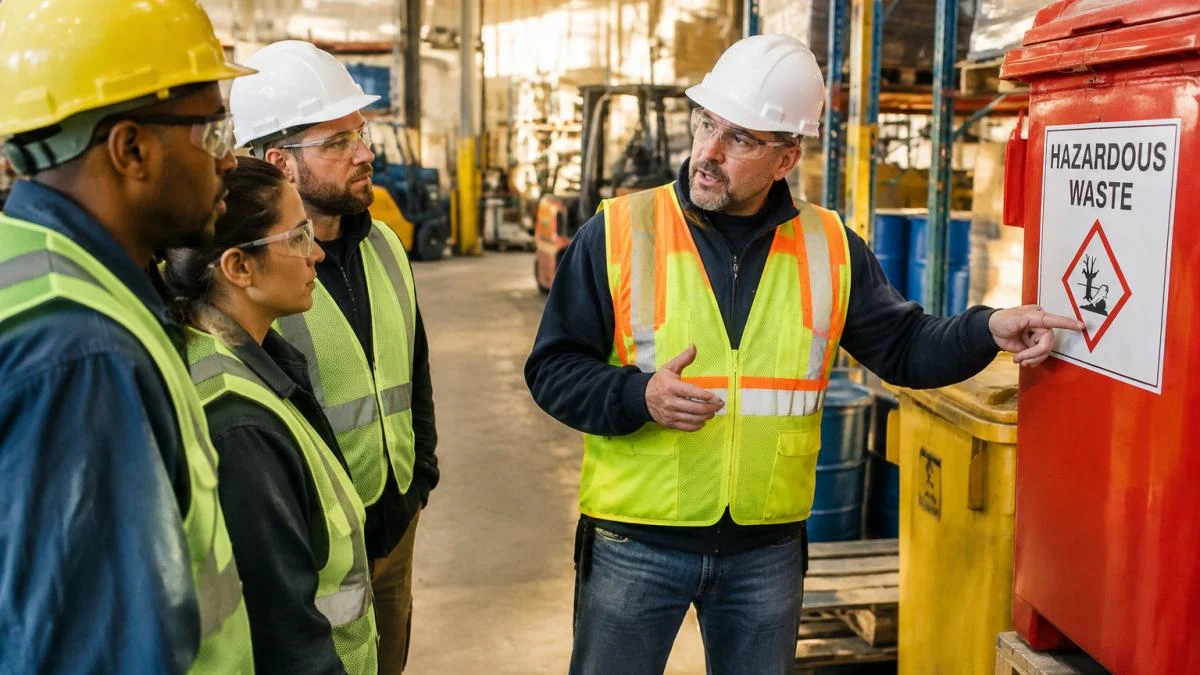
A role-based matrix can help scope programs:
| Role | Core Training | Frequency |
|---|---|---|
| General workforce | Hazard communication, spill response basics, waste awareness | Annual |
| Hazardous waste handlers | RCRA requirements, container management, emergency procedures | Annual plus on hire |
| Maintenance and facilities | Air permit conditions, stormwater best practices | Annual |
| Supervisors and EHS staff | Full regulatory overview, recordkeeping, audits | Annual plus updates |
| New hires and contractors | Site orientation, environmental hazards, protective methods | Before work starts |
Environmental compliance training for employees works best when the matrix is written down and tied to job descriptions. That way, turnover does not quietly create gaps.
EPA Compliance Training and the Federal Rules That Drive It
EPA compliance training means teaching the specific federal requirements your operations trigger, then documenting that workers understood them.
Most employers do not face every rule. A machine shop may only need waste and air modules. A food processor may need wastewater and stormwater too.
For employers who want the wider regulatory picture, including how state rules layer on top of federal ones, our California Environmental Compliance for Manufacturers (2026 Guide) walks through the state-level requirements that sit alongside these federal programs.
Watch out: assuming a state rule matches the federal rule is one of the most common and most expensive mistakes.
Environmental Compliance Training Program for Employers Online
Online delivery has become the default for most mid-size employers. Self-paced courses let you train night shifts and new hires without pulling a supervisor off the floor.
A workable online program includes:
- Self-paced modules with a short quiz at the end of each
- Completion tracking tied to employee IDs, not paper sign-in sheets
- Training records stored where you can pull them during an inspection
Online courses cover the regulatory overview well but cannot replace hands-on practice for spill response or container handling. Blend the two: online for knowledge, instructor-led sessions for skills.
If you are comparing delivery options or want to see what environmental compliance services for manufacturers look like in practice, our environmental compliance services for manufacturers page shows how we scope these programs for employers.
Environmental Compliance Training Duration and Refresher Triggers
Duration depends on the role, the hazards present, and how much hands-on practice the job requires. A general awareness module can be short; a hazardous waste handler module that includes container management and emergency procedures typically spans multiple sessions.
A practical schedule looks like this:
- New hire orientation: 1 to 2 hours before work begins
- Role-specific modules: 2 to 4 hours, split across sessions
- Annual refresher: 1 hour per topic, with an updated quiz
The calendar is the floor, not the program
A fixed annual schedule keeps the baseline current, but it cannot keep up with operations. Retraining is triggered by events, and the trigger matters more than the calendar. A worker who learned a procedure before the process changed is trained on the wrong procedure, and the training record will prove it.
Treat each of the following as a retraining trigger, with a documented completion record:
- New chemical or regulated substance introduced to the site, or a change in quantity above a threshold
- New or modified equipment that changes emissions, discharges, or waste generation
- Permit issuance, renewal, or modification that changes a limit, monitoring method, or reporting duty
How to run change management so triggers actually fire
A trigger list on a shelf does nothing. The mechanism that makes it work is a management-of-change step in your existing workflow: before a process, chemical, or equipment change is approved, someone checks it against the training matrix and decides whether retraining is required.
Watch out: the most common failure is treating a permit renewal as an administrative event. When a permit condition changes a monitoring method or a reporting deadline, the operators who perform that work need to be retrained and the record needs to show it.
Documenting the trigger, not just the class
For event-driven retraining, the record should show what changed, when, who was affected, what training was delivered, and when it was completed. Keep the trigger documentation with the completion record so the two can be read together.
If you are weighing outside help to build the matrix, the trigger workflow, and the records system together, our Cal/OSHA compliance assistance services guide explains what that support looks like from start to finish.
Environmental Compliance Training Duration by Session Type
Building Your Program: A Practical Implementation Roadmap
Most guides stop at “assess your obligations and train your people.” That is not a program; it is a to-do list. A program is a sequence with named owners, written artifacts, and a records trail an inspector can follow without your help. The sequence below outlines one practical approach to scoping employer programs, and each step produces the input the next step needs.
Step 1: Inventory obligations before you write a single course
Walk the site and build a written inventory of every environmental touchpoint: each waste stream and its generator status, each air emission source and its permit, each discharge point and outfall, each chemical storage and transfer area, and each regulated substance above a threshold quantity.
Watch out: the most common failure here is stopping at the federal rule. State programs can be stricter than the federal baseline, and local air or water districts can add permit conditions that never appear in the federal text.
Step 2: Assign a single program owner and named backups
One person owns the program, curriculum, schedule, records, and updates. Name a backup for every role, because turnover is the quiet killer of training programs. Attach training requirements to job descriptions so a vacancy or promotion automatically triggers a training action rather than a gap.
Step 3: Build the role-based curriculum matrix
Map each job duty and exposure to required topics, frequency, and a competency check. The matrix is the controlling document: if a topic is not on the matrix, it does not get trained, and if a role is not on the matrix, that is a finding waiting to happen. Include contractors and temporary workers explicitly, they are on your site and their mistakes are your citations.
Step 4: Choose delivery by competency, not by convenience
Online self-paced modules work well for regulatory knowledge, definitions, labeling rules, and recordkeeping awareness. They do not work for spill response, container handling, drum sampling, or anything where the worker has to physically do the task correctly. Blend the two: online for knowledge, instructor-led and hands-on for skills, with a sign-off by someone competent to judge performance.
Step 5: Build the records system before the first class
Decide now where attendance, course versions, assessment results, certificates, and completion dates live, who can retrieve them, and how fast. An inspector who asks for the training record of a specific employee on a specific date should get it in minutes, not days.
An audit-ready file for each employee should contain:
- Course title and version number, with the date the version was issued
- Completion date and the name of the instructor or the module identifier
- Assessment result, not just attendance
- Certificate or completion record
Retention should follow the longer of your permit condition, your state rule, or your own written policy, and the policy should be written down.
Step 6: Schedule refreshers and event triggers together
Put the calendar refreshers and the event-driven retraining triggers on the same schedule, owned by the same person. A calendar alone misses the process change; a trigger list alone misses the slow drift in worker knowledge.
Step 7: Measure effectiveness, not completion
Completion rate tells you who sat in the room, not whether the program works. Track quiz and assessment scores by topic and role, spot-check field behavior during walkthroughs, review near-miss and incident trends for training-shaped causes, and confirm that corrective actions close on time.
For the curriculum itself, our guide to environmental safety training requirements for employees lists the specific topics workers must be trained on. And when you are assigning courses by role, these California EHS training best practices cover how to deliver training that actually holds up in an inspection.
Request a Consultation to Build Your Training Program
Building a program that survives an inspection takes more than a course library.
McNeil Safety Consulting handles this work personally, with no subcontracting.
If you are weighing outside help, our Cal/OSHA compliance assistance services guide explains what that support looks like from start to finish.
A training program that lives in a binder does not protect anyone.
Frequently Asked Questions
What topics should an environmental compliance training program cover?
A complete program should address hazardous waste handling under RCRA, air emissions rules under the Clean Air Act, water discharges and NPDES permits under the Clean Water Act, and chemical safety and TSCA requirements. Add pollution prevention, waste minimization, spill response, and your site’s specific permits. Role-based modules for handlers, supervisors, and EHS professionals keep the content relevant, and completion tracking plus competency assessments give you audit-ready records.
How long does environmental compliance training duration typically run?
Environmental compliance training duration depends on the role. Duration varies by role, with general awareness and hazardous waste handler training requiring different amounts of time. Supervisors and EHS professionals may need additional hours for permit-specific and reporting content. Build in annual refreshers and retrain whenever regulations, processes, or job duties change so the program stays current.
Is environmental compliance training available online?
Yes. An environmental compliance training program for employers online can cover core curriculum through self-paced courses, with instructor-led sessions for hands-on topics like spill response or hazardous waste labeling. Online formats simplify completion tracking and training records, which helps with audits. Pair online modules with site-specific walkthroughs so employees see their actual waste areas, permits, and emergency equipment.
How often should employers review environmental compliance training?
Review the full program at least annually and update it whenever regulations change, a new permit or process starts, or an incident reveals a gap. Refresher triggers include new hires, job transfers, and equipment changes. Keep completion records and competency assessments on file so you can show regulators that training happened and matched the employee’s role.
