Table of Contents
- Environmental Safety Training Requirements for Employees: 2026 Overview
- Cal/OSHA Employee Training Requirements
- HAZWOPER Training Requirements for Hazardous Materials Exposure
- Workplace Safety Training Checklist by Hazard Type
- SWPPP Training Requirements for Stormwater and Environmental Compliance
- Documentation, Record Retention, and Audit Readiness
- Common Mistakes to Avoid in Environmental Safety Training
- Next Steps: Implementing Your 2026 Training Program
- Frequently Asked Questions
Last Updated: October 12, 2026
Environmental Safety Training Requirements for Employees: 2026 Overview
Environmental safety training requirements for California employees have grown more complex, with overlapping state and federal mandates, different timelines and documentation standards, and Cal/OSHA penalties that increase annually.
This guide covers what your team needs for 2026: Cal/OSHA obligations, hazardous materials protocols, stormwater management, and documentation that holds up under inspection.
With the right framework, environmental safety training requirements are manageable.
Cal/OSHA Employee Training Requirements
Cal/OSHA mandates specific training for all employees exposed to workplace hazards.
New-Hire and Ongoing Training Obligations
Every new employee must receive orientation training before starting work, covering role hazards, emergency procedures, and your Injury and Illness Prevention Program (IIPP).
For ongoing training, you need refresher sessions when:
- New hazards are introduced to the workplace
- Equipment or processes change
- An incident occurs that reveals training gaps
Document who attended, what was covered, when, and who delivered it, and keep records at least three years.
Injury and Illness Prevention Program (IIPP) Training Components
Your IIPP training must cover how employees identify hazards, report unsafe conditions, and participate in incident investigations. Supervisors need additional training on responding to reports and correcting hazards.
The training should address how to recognize hazards specific to your operation, how to report hazards without fear of retaliation, the company’s commitment to correcting unsafe conditions, and how incidents are investigated.
HAZWOPER Training Requirements for Hazardous Materials Exposure
HAZWOPER (Hazardous Waste Operations and Emergency Response) is a federal standard under 29 CFR 1910.120 that applies in California through Cal/OSHA’s adoption of the federal rule. It is not one course but a set of tiers, and the tier an employee needs depends on the job, not the job title.
The Three HAZWOPER Training Tiers
8-hour HAZWOPER (29 CFR 1910.120(e)). Required for workers who visit a hazardous waste site only to perform fully characterized, non-hazardous tasks, and who are not exposed to hazardous substances above background levels.
Annual refresher, the rule most employers miss. Under 29 CFR 1910.120(e)(8), employees trained under the 40-hour, 24-hour, or 8-hour tiers must receive eight hours of refresher training every 12 months.
Emergency Response Training Under 29 CFR 1910.120(q)
HAZWOPER also governs employees who respond to hazardous substance emergencies, spills, leaks, or releases, even if they never set foot on a cleanup site. The rule defines five response levels:
| Response Level | Role | Minimum Training |
|---|---|---|
| First Responder Awareness | Notifies authorities; takes no further action | Sufficient to recognize and notify |
| First Responder Operations | Defensive actions; contains from a safe distance | 8 hours |
| Hazardous Materials Technician | Offensive actions; approaches the release to stop it | 24 hours |
| Hazardous Materials Specialist | Advanced technical support to the technician | 24 hours plus specialized training |
| On-Scene Incident Commander | Assumes control of the incident | 24 hours |
A common pattern is training every employee to Awareness and a smaller group to Operations. That works only if the Operations-level employees are the ones who actually respond; if an untrained employee takes a defensive action during a spill, the employer has a training violation on top of the release.
Who Needs HAZWOPER Certification
HAZWOPER training is required for employees who handle hazardous waste on-site (including container management and labeling), workers involved in cleanup of hazardous substance releases, emergency responders at the level their role requires, supervisors and safety personnel overseeing these activities, and employees at TSDFs who perform corrective actions.
Training must be delivered by a qualified instructor and documented with attendance records, trainer credentials, and content. Employees must demonstrate competency before working with hazardous materials, a certificate alone is not competency verification.
Refresher Training and Competency Verification
HAZWOPER refresher training is annual for the 8/24/40-hour tiers and the (q) emergency response levels. It is a competency verification, not a checkbox.
Keep records showing the date, duration, trainer name, and topics covered. A gap in the annual refresher chain is one of the easiest violations to establish, because the dates are on the face of the records.
HAZWOPER refresher training must occur every 12 months for the 8-hour, 24-hour, and 40-hour tiers. A lapse does not just create a paperwork problem, it means the employee is not authorized to perform hazardous waste work until the refresher is complete.
29 CFR 1910.120, Hazardous waste operations and emergency response
Workplace Safety Training Checklist by Hazard Type
Different work environments trigger different training mandates.
Construction and Outdoor Worker Requirements
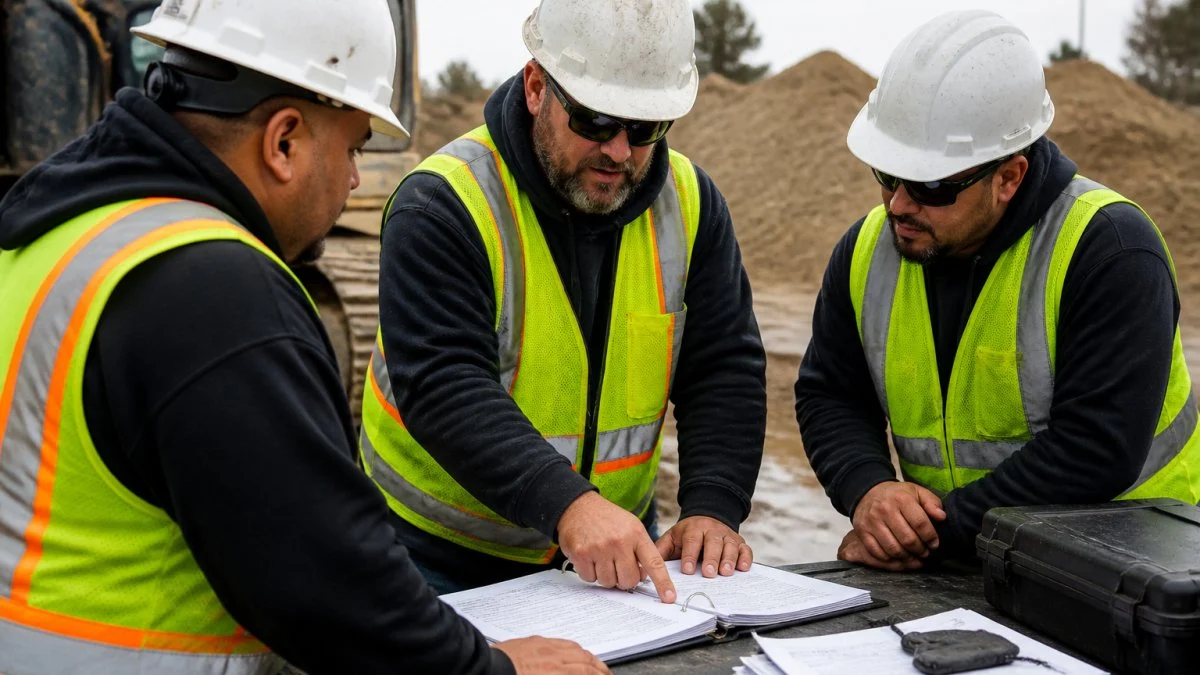
Construction workers face fall hazards, electrical exposure, and equipment operation risks. Your training program must address fall protection systems and rescue procedures, electrical safety and lockout/tagout (LOTO) protocols, equipment operation and maintenance, excavation and trenching hazards, noise exposure and hearing protection, and heat illness prevention (critical in California summers).
Outdoor workers also need training on sun exposure, hydration, and recognizing early signs of heat-related illness, a leading cause of serious injury in California construction.
Manufacturing and Industrial Facility Training
Manufacturing environments require training specific to your processes: machine guarding and point-of-operation hazards, chemical exposure and ventilation systems, confined space entry (if applicable), powered industrial truck operation, forklift certification and safety procedures, and bloodborne pathogen exposure (if relevant).
Manufacturing workers also need training on your facility’s emergency procedures, including evacuation routes, assembly points, and incident response roles.
SWPPP Training Requirements for Stormwater and Environmental Compliance
Stormwater Pollution Prevention Plan (SWPPP) training applies to construction sites and industrial facilities that discharge stormwater, an environmental compliance requirement that overlaps with workplace safety.
SWPPP training covers how to identify pollutants and prevent stormwater contamination, best management practices (BMPs) for erosion and sediment control, spill prevention and cleanup procedures, documentation requirements for stormwater monitoring, and your facility’s specific SWPPP procedures and responsibilities.
The Qualified SWPPP Developer (QSD) on your team, or a consultant like McNeil Safety Consulting, should deliver this training to ensure accuracy. SWPPP violations carry penalties separate from Cal/OSHA citations.
| Training Type | Who Needs It | Frequency | Documentation |
|---|---|---|---|
| IIPP orientation | All employees | Before starting work | Attendance roster, topics covered, trainer name |
| Hazard-specific training | Role-based | When hazards change; annually for high-risk roles | Competency verification, trainer credentials |
| HAZWOPER | Hazmat handlers, responders | Annual refresher | Attendance, trainer qualifications, content outline |
| SWPPP | Construction/industrial sites | Before stormwater work; updates when BMPs change | Site-specific procedures, acknowledgment of training |
| Heat illness prevention | Outdoor workers | Annually; before hot season | Attendance, recognition of heat illness signs |
Documentation, Record Retention, and Audit Readiness
Training records are your defense during a Cal/OSHA inspection. The employers who get cited are rarely the ones who skipped training, they are the ones who cannot prove they delivered it.
Retention Schedule by Training Type
Retention periods are not uniform. Use this schedule as a baseline and confirm each against the current standard:
| Training Type | Minimum Retention | Notes |
|---|---|---|
| IIPP orientation and general safety | 3 years | Cal/OSHA inspection window |
| Hazard-specific (LOTO, fall protection, confined space) | 3 years | Retain certification records for the duration of employment for some standards |
| HAZWOPER 8/24/40-hour | Duration of employment plus 3 years | 29 CFR 1910.120(e)(8) |
| HAZWOPER emergency response (q) | Duration of employment plus 3 years | Annual refresher dates must be visible |
| SWPPP | Duration of construction plus 3 years | Confirm against the current Construction General Permit |
| Heat illness prevention | 3 years | Retain the plan and the training roster |
| Respiratory protection | Duration of employment plus 30 years | Medical evaluation and fit test records |
| Asbestos, lead, and other substance-specific | Duration of employment plus 30 years | Substance-specific standards |
Two rules of thumb: when in doubt, keep it longer, and never destroy a record subject to an open inspection, appeal, or litigation hold.
What Each Training Record Must Contain
A roster with names and a date is not enough. A defensible record contains:
- Employee identification: Full name, job title, and employee ID or last four of SSN
- Training date and duration: Start and end times, not just the date
- Training content: Topics covered, learning objectives, and materials used
For HAZWOPER, add the training tier (8, 24, or 40 hours) and the date of the last annual refresher. For SWPPP, add the site-specific procedures covered and the name of the QSD or qualified trainer who delivered the session.
Building an Audit-Ready File
When an inspector arrives, they will want records within hours, not days. Build the file so you can produce them on the spot:
- Organize by employee and by training type. A single spreadsheet with tabs for each training category is enough for most employers; larger operations may need a learning management system.
- Keep a training matrix. One row per employee, one column per required training, with completion and next due dates. This is the single most useful document during an inspection.
- Maintain a current training calendar. Map onboarding, annual refreshers, and event-triggered training so nothing lapses.
- Verify trainer credentials are on file. For HAZWOPER, SWPPP, and substance-specific training, the trainer’s qualifications are part of the record.
- Cross-check your IIPP. The written program must describe the training you actually deliver; a mismatch is itself a violation.
- Designate a records custodian. One person who knows where every record lives and can produce it under pressure.
Event-Triggered Training: The Records Most Employers Forget
Cal/OSHA requires retraining when a new hazard is introduced, when equipment or processes change, or when an incident reveals a training gap. Add a line to your incident investigation form asking whether retraining was required, and log the completion date in the training matrix. Inspectors frequently look for retraining records after a serious injury, and a missing entry is treated as a missing program.
A one-page training matrix, employee names down the side, required trainings across the top, completion and due dates in the cells, answers more inspector questions than any other document you can produce. Build it before you need it.
Missing or incomplete training records are cited as violations during Cal/OSHA inspections, even if no incident occurred. Documentation is your proof that you met the regulatory requirement.
Cal/OSHA, Training and instruction requirements
Common Mistakes to Avoid in Environmental Safety Training
Most Cal/OSHA violations we see stem from training gaps, not malice. The mistakes that show up repeatedly:
Training without documentation. Without proof, the training didn’t happen as far as Cal/OSHA is concerned.
Generic training that doesn’t match your hazards. A construction safety video doesn’t substitute for training on the specific equipment and processes in your facility.
Trainer without credentials. Unqualified trainers create liability.
Annual training but no updates. Refresher content isn’t updated when processes change or new hazards emerge.
Language barriers ignored. Workers can’t learn if they don’t understand the language of delivery.
No competency check. Competency verification is the difference between checking a box and building a culture of safety.
Next Steps: Implementing Your 2026 Training Program
Start by auditing what you have.
Then build your schedule. Map out when each training needs to happen, who will deliver it, and how you’ll document it.
McNeil Safety Consulting can help you design a training program that covers every mandate, document it properly, and prepare for inspection.
McNeil Safety Consulting brings 25 years of fire service and occupational safety experience to help employers navigate these requirements.
Frequently Asked Questions
Which environmental and safety training do employees need in 2026?
Environmental safety training requirements depend on job duties and workplace hazards. All employees need general workplace safety orientation and hazard awareness. Those handling hazardous materials require HAZWOPER certification. Workers on projects with stormwater impact need SWPPP training. Supervisors need additional training on hazard recognition and Cal/OSHA compliance. Construction and outdoor workers face specific requirements for fall protection, heat illness prevention, and equipment operation. The Cal/OSHA Injury and Illness Prevention Program mandates training on identifying and reporting hazards, emergency procedures, and corrective actions.
How can employers determine which employees need hazardous materials training?
Start with a job hazard analysis for each position. If employees handle, mix, transport, or are exposed to chemicals, solvents, pesticides, or other hazardous substances, they need HAZWOPER training. Even indirect exposure counts: warehouse workers near chemical storage, maintenance staff cleaning equipment, and cleanup crews after spills all qualify. Document each job role and the specific hazards present. If uncertainty exists, assume the employee needs training and consult Cal/OSHA guidance or an industrial hygienist. Your training records should clearly show which employees received what training and why.
What records should employers keep for environmental safety training?
Maintain signed attendance rosters, training certificates, dates of completion, trainer credentials, and course content summaries. For HAZWOPER, keep certification cards and renewal dates. For SWPPP training, document the developer’s QSD status and training scope. Store records for at least three years; Cal/OSHA may request them during inspections. Include employee name, job title, training topic, date, duration, and trainer name. Digital and paper records are acceptable, but ensure they are retrievable within 24 hours if requested. Organize by employee and by hazard type for quick audit preparation.
How often should environmental safety training be conducted?
Initial training must occur before employees begin hazardous work. Refresher training frequency depends on the hazard: HAZWOPER requires annual refresher, SWPPP training refreshes every two years or when procedures change significantly, and general workplace safety training refreshes annually or when new hazards are introduced. Cal/OSHA requires that IIPP training be provided when new hazards are identified and when procedures change. Supervisor training refreshes annually. Document all training dates in your records to demonstrate compliance during inspections.