Last Updated: November 4, 2026
Quick Summary
The three most cited OSHA violations are fall protection, hazard communication, and respiratory protection. Fall protection leads construction while hazard communication leads general industry, and these OSHA violations repeat because each depends on daily habits that slip when work gets busy.
- Fall protection’s height threshold is 6 feet for construction but drops to 10 feet for scaffolding.
- Unlabeled secondary containers are the most common hazard communication failure we see.
- Respiratory citations usually involve missing fit testing or missing medical evaluations, not missing respirators.
- The appeal deadline for federal OSHA citations is 15 working days from receipt of the citation.
- Most repeat violations trace to one root cause: a safety management system that never gets audited.
Table of Contents
- The Three Most Cited OSHA Violations and Why They Repeat
- 1. Fall Protection: The Most Cited Standard in Construction
- 2. Hazard Communication: The Most Cited General Industry Standard
- 3. Respiratory Protection: Training, Fit Testing and Medical Evaluation
- How the OSHA Citation and Penalty Process Works
- OSHA Citation Response: What to Do in the First Days
- The OSHA Citation Appeal Deadline and How to Contest
- OSHA Citation Lookup: Checking an Employer’s History
- Root Cause and Recovery: What the List Does Not Tell You
- Frequently Asked Questions
The Three Most Cited OSHA Violations and Why They Repeat
The three most cited OSHA violations are fall protection, hazard communication, and respiratory protection. Fall protection leads construction; hazard communication leads general industry. These three top the list year after year, and the reason is simple: each one depends on daily habits that slip when work gets busy.
At McNeil Safety Consulting, citation defense work shows the same pattern. The violation is rarely a mystery. It is a program that existed on paper but not on the floor. Below, we break down what triggers each citation, how the penalty process works, and how to respond when one lands on your desk.
1. Fall Protection: The Most Cited Standard in Construction
Fall protection is the most frequently cited standard in construction, and the gap between it and second place is wide. The rule covers anyone working at height on a construction site, and it is cited so often because it depends on equipment, training, and supervision all working on the same day.
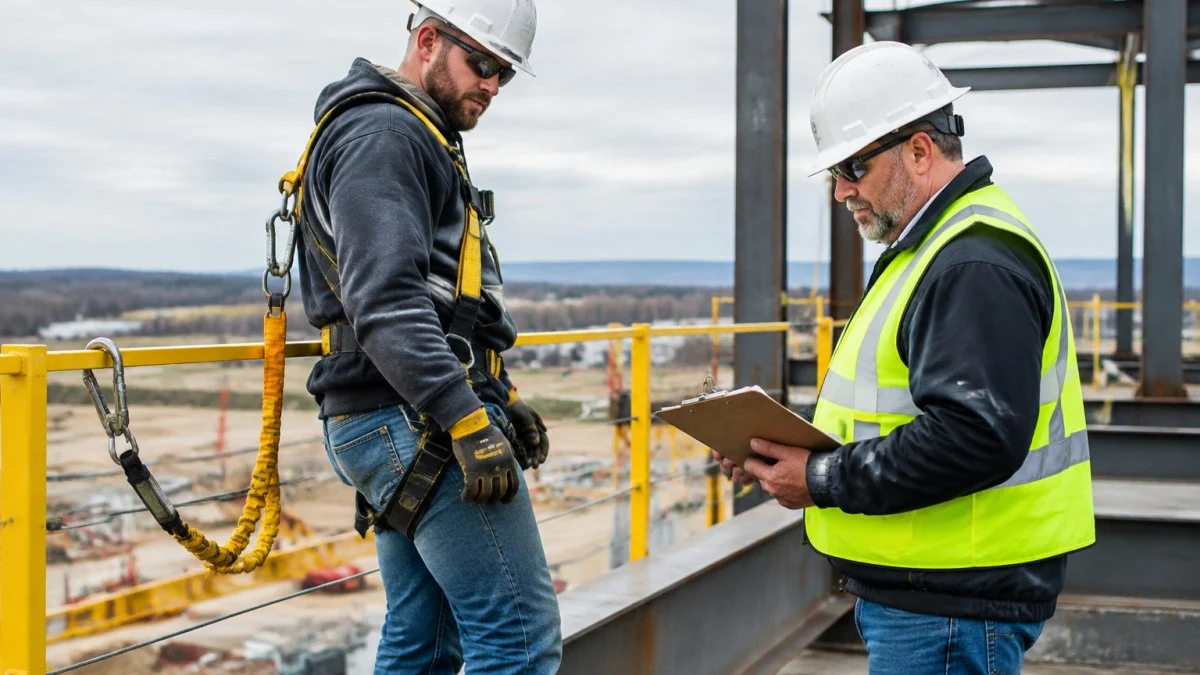
The governing standard is 29 CFR 1926.501, Duty to Have Fall Protection, with the related training requirements at 29 CFR 1926.503. The trigger most employers miss is the height threshold: the general rule is 6 feet for construction work, but the threshold drops to 10 feet for scaffolding, and specific rules apply to ladders, steel erection, and leading edges. A crew that treats “6 feet” as the only number will still get cited on a scaffold.
Citations usually trace back to five failures:
- No guardrail, safety net, or personal fall arrest system in place where the standard requires one
- Workers wearing harnesses but not tied off, or tied off to an anchor that cannot support the load
- Anchors that cannot support a fall load, or lifelines routed over sharp edges
- Untrained workers who do not recognize the hazard or cannot inspect their own equipment
- No written fall protection plan for the job, or a plan that does not match what crews are actually doing
Where Fall Protection Citations Come From
Most fall protection citations start with a compliance officer observing a worker on a roof, scaffold, or beam without protection. The officer then asks for the written program and the training records. Under 29 CFR 1926.503, retraining is required when there is reason to believe a worker lacks the understanding or skill to use the equipment safely.
Watch out: a harness in the truck is not fall protection. The citation is written for the exposure the officer observed, and a documented program that was never enforced on the floor does not defeat it. For a deeper walkthrough of hazard assessment on construction sites, see our guide to workplace hazard assessment for construction.
2. Hazard Communication: The Most Cited General Industry Standard
Hazard communication is the most cited standard in general industry. It governs how employers inform workers about chemicals in the workplace.
The requirements are not complicated, but they are easy to half-finish. A written program, labeled containers, accessible safety data sheets, and trained workers form the core. When one piece is missing, a citation follows.
What a Working Hazard Communication Program Requires
A working program has four moving parts:
- A written hazard communication plan kept current
- Every container labeled, including secondary containers
- Safety data sheets on hand for every chemical on site
- Training workers on the specific hazards they face
Watch out: the most common failure we see is secondary containers. A spray bottle filled from a bulk drum and left unlabeled is a citation waiting to happen.
3. Respiratory Protection: Training, Fit Testing and Medical Evaluation
Respiratory protection citations usually involve missing fit testing or missing medical evaluations, not missing respirators. Employers hand out masks and stop there, and the citation is written against the program, not the equipment.
The governing standard is 29 CFR 1910.134 for general industry, with the construction counterpart at 29 CFR 1926.103. The first fork in the road is whether use is required or voluntary. If the employer requires a respirator, a full written program is triggered: a written plan, medical evaluation before fit testing and before use, annual fit testing, training on use and storage, and recordkeeping. If a worker chooses to wear a filtering facepiece voluntarily, a smaller set of requirements applies, but the employer still has to provide the information in Appendix D and confirm the employee is medically able to use the respirator.
A complete required-use program includes:
- A written respiratory protection plan specific to the workplace and the contaminants present
- Medical clearance before fit testing and before the first use, using the OSHA medical questionnaire or an equivalent evaluation
- Annual fit testing for each respirator model and size the worker uses
- Training on proper donning, doffing, storage, and limitations
- Fit checks before each use, and recordkeeping for fit tests and medical clearances
Skipping the medical evaluation is the single most common gap, and it is the one that turns a simple equipment question into a program citation. A worker who has never been cleared is a worker the employer cannot lawfully require to wear a tight-fitting respirator.
Watch out: fit testing a worker before the medical evaluation reverses the required order and creates a second violation on top of the first. Our licensed vocational nurse covers fit testing and medical surveillance coordination.
How the OSHA Citation and Penalty Process Works
An OSHA citation arrives after an inspection, and the process that follows runs on deadlines. The agency issues citations with proposed penalties, and the employer has a short window to respond.
Violation Categories and What They Mean
OSHA classifies violations by severity, and the category drives the penalty range:
| Category | What It Means | Employer Impact |
|---|---|---|
| Other-than-serious | Hazard unlikely to cause death or serious harm | Lowest penalty tier |
| Serious | Substantial probability of death or serious harm | Mid-tier penalty |
| Willful | Intentional disregard or plain indifference | Highest penalty tier |
| Repeated | Same violation cited again | Multiplied penalty |
| Failure to abate | Hazard not fixed by the deadline | Daily penalties until fixed |
Penalty amounts change, so verify current figures with OSHA directly. What employers can and cannot refuse during an inspection matters here too, and our article on the OSHA inspection warrant explains those limits.
OSHA Citation Response: What to Do in the First Days
The first days after a citation decide the outcome. The response window is short, and missing it costs you the right to contest.
Move in this order:
- Note the deadline on the citation and calendar it immediately
- Post the citation where workers can see it, as required
- Fix any hazard that can be corrected right away
- Gather your training records, programs, and inspection notes
- Decide whether to pay, settle, or contest
For a step-by-step walkthrough of the response window, our 15-day guide to responding to Cal/OSHA citations covers the sequence.
The OSHA Citation Appeal Deadline and How to Contest
The appeal deadline for federal OSHA citations is 15 working days from receipt of the citation. Miss it and the citation becomes final. Confirm the current window for Cal/OSHA citations with the issuing agency.
Contesting starts with a written notice of contest. From there, you can request an informal conference, negotiate a settlement, or proceed to a hearing. Contested cases are often shaped by documented programs, corrected hazards, and available defenses.
Two defenses come up often. One is proving unpreventable employee misconduct, which requires a documented program the employer enforced. The other is penalty reduction, and our guide to reducing Cal/OSHA citation penalties covers strategies that work.
OSHA Citation Lookup: Checking an Employer’s History
OSHA publishes inspection data through its establishment search tool, and anyone can search an employer’s citation history. Contractors bidding on work should expect clients to check.
A clean record can matter in bidding, insurance, and prequalification. A record with repeated violations can follow an employer for years. Check your own history before a client does.
Root Cause and Recovery: What the List Does Not Tell You
The citation list is a symptom, not the disease. Most repeat violations trace to one root cause: a safety management system that never gets audited.
Small employers can close that gap with a simple quarterly review. Check training records, walk the floor, and confirm labels and guards are in place. Post-citation recovery follows the same logic: fix the hazard, document the fix, and update the program so it does not recur.
Frequently Asked Questions
What are OSHA’s three most cited violations?
The three most frequently cited standards are fall protection in construction, hazard communication in general industry, and respiratory protection. Fall protection covers unprotected edges, holes and leading edges at height. Hazard communication covers chemical inventories, safety data sheets and container labeling. Respiratory protection covers written programs, medical evaluation, fit testing and training for employees who wear respirators. The same three standards appear near the top of the list year after year because the underlying hazards are common and the program requirements are easy to let lapse.
How many days does an employer have to contest an OSHA citation?
An employer has 15 working days from receipt of the citation and proposed penalty to file a notice of contest with the OSHA area office. The clock starts on the date the citation is received, not the date it was issued, so keep the delivery record. Missing the deadline makes the citation a final order and gives up the right to contest the violations, the penalty amounts and the abatement dates. If you intend to contest, file the notice in writing before the deadline and request an informal conference in the same period.
How can I look up OSHA citations for an employer?
OSHA maintains a public establishment search tool that lets you look up inspection and citation records by company name, state, industry or zip code. Results show inspection dates, the standards cited, violation categories and penalty amounts. Records stay available for years, so a citation can surface during prequalification, bidding or a customer audit long after the inspection closed. Reviewing your own history before a bid is a practical way to catch repeat-violation exposure, because a repeat finding depends on prior citations of the same standard.
What should an employer do after receiving an OSHA citation?
Log the receipt date and count the 15 working days. Read every citation item and note the standard, the alleged condition, the abatement date and the proposed penalty. Correct hazards that can be fixed immediately and document the correction with photos and dates. Decide whether to pay, request an informal conference or file a notice of contest, and have the decision reviewed by someone who handles citation defense. Do not let the response window close while you wait for internal approvals.
Citations repeat because programs drift. McNeil Safety Consulting handles Cal/OSHA and federal OSHA citation defense, industrial hygiene, and safety plan writing for employers across California and the Western US. Michael Karl McNeil, a former Fire Battalion Chief, and our licensed vocational nurse handle every engagement personally, never subcontracted. Contact McNeil Safety Consulting to review your citation or request a consultation, or call (626) 546-9384.
