Table of Contents
- Industrial Hygiene Monitoring Requirements: What Triggers a Program
- OSHA Exposure Monitoring Requirements by Standard and Hazard
- Industrial Hygiene Sampling Methods: Personal, Area, and Direct-Reading
- Exposure Monitoring Frequency: Decision Rules for When to Repeat
- Employee Exposure Monitoring Results: Notification, Access, and Records
- Interpreting Results and Responding to Overexposures
- Conclusion
- Frequently Asked Questions
Last Updated: October 15, 2026
Industrial Hygiene Monitoring Requirements: What Triggers a Program
Industrial hygiene monitoring requirements are the conditions that oblige an employer to measure worker exposure to a hazard.
McNeil Safety Consulting provides industrial hygiene monitoring, chemical exposure assessments and respirator fit testing for employers in California and the Western states. Call (626) 546-9384 or request a consultation.
“Requirement” is often used loosely. A hazard may be present with no monitoring obligation attached, while an unmeasured hazard can carry a mandatory duty the moment an employee reports symptoms or a substance enters the process.
Federal rules for air contaminants live in OSHA’s air contaminants standard, 29 CFR 1910.1000, while substance-specific standards and state-plan rules add their own triggers.
Monitoring is not a general duty you perform “to be safe.” It begins when a standard’s trigger is met, and the trigger language is specific enough to defend in an inspection.
OSHA Exposure Monitoring Requirements by Standard and Hazard
OSHA exposure monitoring requirements are not uniform. Each standard defines its own trigger, averaging period, and notification timeline, so a single “monitoring policy” rarely satisfies more than one hazard. The crosswalk below separates general guidance from a legally mandated sampling duty.
Air Contaminants: 29 CFR 1910.1000 and Substance-Specific Standards
The general air contaminants table at 29 CFR 1910.1000 sets permissible exposure limits for hundreds of substances, but the table itself does not always mandate sampling.
A few representative triggers illustrate how different the language is:
- Lead (29 CFR 1910.1025), monitoring is required if a employee may be exposed above the action level of 30 micrograms per cubic meter as an eight-hour time-weighted average, and repeat monitoring follows a set schedule tied to the most recent result.
- Cadmium (29 CFR 1910.1027), the action level is 2.5 micrograms per cubic meter as an eight-hour time-weighted average, with periodic monitoring tied to results above that level.
- Benzene (29 CFR 1910.1028), the action level is 0.5 parts per million as an eight-hour time-weighted average, and the standard also sets a short-term exposure limit of 5 ppm over 15 minutes.
- Formaldehyde (29 CFR 1910.1048), the action level is 0.5 ppm as an eight-hour time-weighted average, with a short-term exposure limit of 2 ppm over 15 minutes.
A common mistake is assuming that being under the permissible exposure limit means you are finished. Several standards require periodic monitoring once exposure exceeds the action level, and repeat monitoring on a set schedule regardless of whether conditions changed.
Noise: 29 CFR 1910.95
Noise is the hazard most employers underestimate. The noise standard requires a monitoring program when employees may be exposed at or above an 85-decibel eight-hour time-weighted average. Monitoring must be repeated when production, equipment, or process changes alter exposure.
Two details separate a defensible noise program from a thin one. Sampling must be representative of the employee’s exposure, which usually means full-shift dosimetry rather than a spot reading.
Respiratory Protection and Other Standards That Carry Monitoring Duties
Several standards outside the air contaminants table carry their own sampling obligations:
- Asbestos (29 CFR 1910.1001), initial exposure monitoring is required for employees who may be exposed above the permissible exposure limit or excursion limit, with periodic monitoring on a defined schedule.
- Cotton dust (29 CFR 1910.1043), monitoring is required for employees exposed to cotton dust, with a vertical elutriator or equivalent method and repeat sampling tied to results.
- Certain carcinogens, standards such as those covering coke oven emissions, 1,3-butadiene, and ethylene oxide each carry their own trigger language and averaging periods.
- Respiratory protection (29 CFR 1910.134), while not a monitoring standard itself, it requires exposure assessment before respirators are selected, which in practice means sampling.
Employers in California and the Western US should also confirm whether the state plan imposes a stricter trigger than the federal rule, because state-plan requirements can exceed the federal floor. Cal/OSHA, for example, maintains its own permissible exposure limits for some substances that are lower than the federal table.
The trigger is almost never the PEL. It is the action level, the excursion limit, or a change-in-conditions clause. Read the specific standard before you design the sampling plan.
A Practical Crosswalk Workflow
Rather than memorize each standard, run the same five-step check for every hazard:
- Identify the substance or agent and the specific standard that governs it.
- Pull the trigger threshold, the averaging period, and the repeat schedule from the standard text.
- Determine whether a change-in-conditions clause applies to your process.
- Select a sampling method the standard recognizes.
- Document the trigger you relied on, so the decision is defensible in an inspection.
Industrial Hygiene Sampling Methods: Personal, Area, and Direct-Reading
Industrial hygiene sampling methods fall into three families, and choosing the wrong one is the fastest way to produce data that will not answer the question you asked.
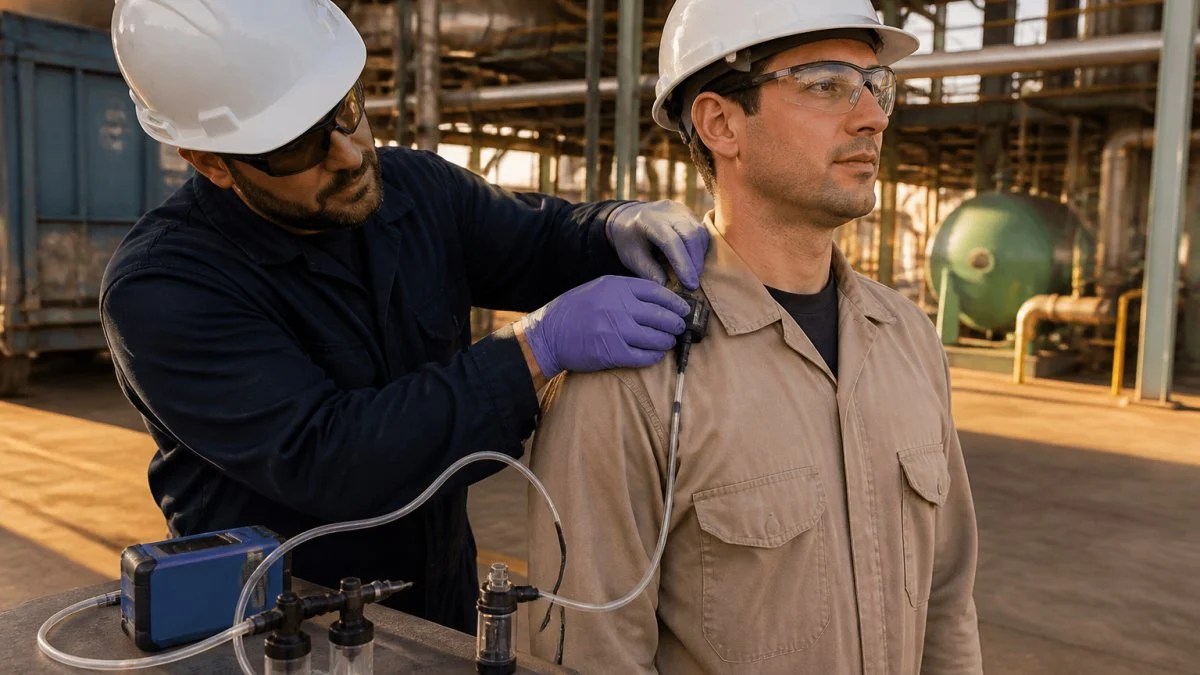
Personal sampling places the collection device in the employee’s breathing zone for the full shift.
Area sampling places fixed devices in a location to characterize the work environment rather than a person.
Direct-reading instruments return a result in real time.
Equipment, Calibration, and Sample Validity
Field samples are only as good as the sampling train behind them, the pump, tubing, collection media, and calibrator working together. Every component can fail.
- Pump calibration, calibrate the pump immediately before and after sampling, and record both numbers. A single pre-calibration reading tells a reviewer nothing about whether the pump held flow for eight hours. Use a primary standard such as a bubble burette or a traceable secondary standard.
- Flow rate, set the flow rate to the method the laboratory will use. A method written for 2 liters per minute will not produce a valid result at 4 liters per minute.
- Media selection, match the collection media to the analyte. Mixed cellulose ester filters for metals, charcoal tubes for many organic vapors, treated filters for formaldehyde. The wrong media means the analyte is not captured.
- Field blanks and media blanks, submit blanks alongside your samples so the laboratory can correct for contamination introduced during handling, transport, or storage.
- Chain of custody, a chain-of-custody form with a gap in it will not survive a citation contest. Record who handled the samples, when, and under what conditions.
Calibrate the pump immediately before and immediately after sampling, and record both numbers. A single pre-calibration reading tells a reviewer nothing about whether the pump held flow for eight hours.
Laboratory Analysis and Quality Assurance
Use an accredited laboratory, and confirm the accreditation covers the specific method you are submitting.
A practical QA checklist for each sampling event:
- Method number and analyte confirmed with the laboratory
- Pump calibrated before and after with a primary or traceable secondary standard
- Flow rate recorded at the start and end of the sample
- Field blanks and media blanks submitted
- Chain-of-custody form complete with no gaps
That checklist is the difference between a result you can defend and a result you have to explain away. The NIOSH Manual of Analytical Methods is the reference we use to confirm method numbers, flow rates, and media selection before a sampling event is designed.
Employers who need a sampling plan designed around a specific exposure limit, with the method, media, and QA documentation built in from the start rather than reconstructed after a citation.
Exposure Monitoring Frequency: Decision Rules for When to Repeat
Exposure monitoring frequency should be set by rule, not by feel. These decision rules cover the situations we see most often.
| Situation | Monitoring Action | Typical Repeat Interval |
|---|---|---|
| Exposure at or above the action level | Mandatory periodic monitoring | Per the specific standard’s schedule |
| Exposure above the permissible exposure limit | Immediate controls plus repeat monitoring | After controls are implemented |
| Process, equipment, or chemical change | Reassess before relying on old data | Prior to restart |
| No exposure expected, no standard trigger | No monitoring obligation | Reassess if conditions change |
| Employee reports symptoms tied to a hazard | Investigate and sample | Promptly |
Two rules override the table: if a standard sets a schedule, follow the standard; and if you cannot explain why you chose an interval, you have not finished the assessment.
Relying on a sampling result from three years ago after you changed a solvent, a ventilation system, or a production rate is one of the most common findings in an inspection. Old data does not cover new conditions.
Employee Exposure Monitoring Results: Notification, Access, and Records
Employee exposure monitoring results are not internal documents. Most substance-specific standards require that affected employees be notified of results, in writing, within a defined period after the employer receives them.
Access obligations run in two directions. Employees and their designated representatives are entitled to see monitoring records, and records must be retained for the period each standard specifies, often thirty years for exposure measurements.
Records to keep together for each monitoring event:
- Sampling date, duration, and employee or area monitored
- Method used and the analytical laboratory
- Calibration records before and after sampling
- Laboratory report with limits of detection
- Written notification issued to affected employees
A licensed vocational nurse on our staff coordinates medical surveillance and OSHA recordkeeping so exposure data and health records stay aligned.
Interpreting Results and Responding to Overexposures
Interpreting results means comparing the measured exposure against the correct occupational exposure limit for that substance and averaging period.
Compare like with like. An eight-hour time-weighted average must be compared to an eight-hour limit, a short-term exposure limit covers a fifteen-minute window, and a ceiling limit is never averaged.
When a result exceeds a limit, the sequence is: notify affected employees, implement engineering and administrative controls, provide respiratory protection in the interim, and re-monitor to confirm the controls worked.
Employers who have a result in hand and need a defensible interpretation, a control plan, and a re-monitoring schedule rather than a raw laboratory report.
Conclusion
The hard part of industrial hygiene monitoring is rarely the sampling itself. It is knowing which trigger applies, choosing a method that will hold up, and acting on the number once you have it. Get the trigger wrong and you either monitor without authority or miss a duty you owed.
McNeil Safety Consulting handles industrial hygiene and exposure assessment, citation defense, and medical surveillance coordination across California and the Western US.
Frequently Asked Questions
When should an employer conduct industrial hygiene monitoring?
Monitoring is triggered when employees may be exposed to hazardous substances or physical agents at or above action levels, or when there is reason to suspect exposure above a permissible exposure limit. It is also required when an employer has notice of a potential hazard, such as a new process, a material substitution, or a reported symptom. If you are unsure whether your operation crosses that line, an industrial hygiene monitoring requirements review can settle it before an inspection does.
How often should exposure monitoring be repeated?
Exposure monitoring frequency depends on the standard and the result. For noise under 29 CFR 1910.95, monitoring repeats whenever a change in production, process, or controls may increase exposure. For many air contaminants, repeat monitoring is required when conditions change or when results exceed the action level. A common practical rule is to re-monitor annually for confirmed exposures and after any process change, but the specific standard governs.
When should the employer post the results of exposure monitoring?
Under OSHA requirements, employers must notify affected employees of monitoring results in writing, either individually or by posting a notice, within 15 working days of receiving the results. The notice must state the results or the representative exposure level and describe any corrective action being taken. Employees and their designated representatives also have the right to observe monitoring and to access the records.
What should an employer do when monitoring results exceed an exposure limit?
When a result exceeds a permissible exposure limit, the employer must notify affected workers, then implement or improve engineering and administrative controls, and provide respiratory protection and medical surveillance where the standard requires it. Re-monitoring follows to confirm the controls worked. The sequence matters: control first, confirm with data second, and document both.
Who is qualified to conduct workplace exposure monitoring?
Sampling can be performed by trained in-house staff, but the design of the sampling strategy, the selection of methods, and the interpretation of results call for industrial hygiene expertise. Laboratories that analyze samples should hold recognized accreditation. For complex exposures or when results may be contested in a citation proceeding, engaging an industrial hygiene professional from the outset produces data that holds up.
What records should employers keep after exposure monitoring?
OSHA requires employers to keep exposure records for at least 30 years, including sampling data, laboratory results, and the identity of the substances monitored. Noise monitoring records must be retained for two years. Medical records follow separate retention rules. Records must be made available to employees, former employees, and their representatives on request, and to OSHA during an inspection.