Table of Contents
- Why Small Businesses Need Safety Consulting Services
- Core Safety Consulting Services for Small Operations
- Building an OSHA Compliance Checklist for Small Business
- Developing a Small Business Safety Program That Works
- Conducting a Workplace Hazard Assessment
- How to Select the Right Safety Consultant for Your Business
- Frequently Asked Questions
Last Updated: October 7, 2026
Why Small Businesses Need Safety Consulting Services
Small business owners often treat workplace safety as a checklist to file away.
A workplace injury disrupts operations, raises insurance premiums, and creates liability exposure that can threaten the business itself.
Small businesses face the same regulatory scrutiny as larger operations; Cal/OSHA and federal OSHA don’t adjust standards by company size. Yet small teams often lack the resources to interpret those standards, respond to citations, or run required assessments.
Most small businesses wait for a citation or incident before engaging a safety consultant. Prevention is always cheaper than remediation.
Core Safety Consulting Services for Small Operations
Safety consulting services for small business typically fall into three areas: regulatory compliance, hazard management, and program development.
OSHA Compliance and Citation Defense
When Cal/OSHA or federal OSHA issues a citation, the clock starts immediately. Small businesses have 15 days to respond, far too narrow to learn the regulations, gather evidence, and mount an effective defense alone.
OSHA compliance consulting means interpreting citations, identifying which violations are defensible, and preparing the documentation to challenge them.
McNeil Safety Consulting handles citation defense for small operations across California and the Western US, with specialized representation in California, Nevada, Oregon, New Mexico, and Wyoming, plus the federal OSHA states of Idaho, Montana, Colorado, North Dakota, and South Dakota.
Workplace Hazard Assessment and Risk Management
A workplace hazard assessment identifies what can go wrong before it does, a systematic walkthrough that recognizes hazards specific to your industry and processes.
An industrial hygiene professional or safety consultant observes work being performed, reviews equipment and materials, and identifies chemical, biological, physical, or ergonomic exposures.
Small businesses often discover their biggest hazards are the ones they’ve gotten used to.
Safety Program Development and Documentation
Safety program development means building the systems that keep hazards controlled day after day: written programs like your Injury and Illness Prevention Plan (IIPP), required by Cal/OSHA, plus hazard communication, bloodborne pathogen protocols if applicable, heat illness prevention plans, and site-specific safety plans for high-hazard work.
A consultant works with your team to document what you’re doing right, fill gaps, and create training materials. The goal is a program practical for your operation, not a binder of generic policies nobody reads.
Building an OSHA Compliance Checklist for Small Business
An OSHA compliance checklist for small business should not try to cover all 500-plus standards in Title 29 CFR, which buries a five-person operation in paperwork it will never finish. Build a short, prioritized checklist around the standards that govern your industry, headcount, and processes, then assign one person to own it.
Step 1: Identify which standards apply to you
Start with the general industry standards in 29 CFR 1910 for manufacturing, warehousing, retail, or office work, or the construction standards in 29 CFR 1926 if you build, remodel, or do site work.
Then layer on the standards triggered by what you actually do:
- Hazard communication (1910.1200) if you have any hazardous chemicals on site, which includes common cleaning products, solvents, and fuels
- Respiratory protection (1910.134) if you have employees who wear respirators, even voluntarily in some cases
- Fall protection (1910.28 for general industry, 1926 Subpart M for construction) if anyone works at height
Step 2: Build the checklist around what an inspector will ask for
A compliance checklist is only useful if it maps to what an inspector requests during an opening conference and walkaround. A workable checklist covers:
- Written programs: hazard communication, IIPP where required, respiratory protection, lockout/tagout, emergency action plan
- Training records: who was trained, on what, when, and by whom, with signatures or electronic equivalents
- Inspection records: dated walkthroughs showing hazards found and corrected, not just blank forms
Step 3: Prioritize by severity, not by convenience
The temptation is to start with the easiest items. Instead, rank by severity and likelihood: a missing guard on a daily-use table saw outranks an outdated training roster, and a blocked emergency exit outranks a missing poster.
Step 4: Assign one accountable owner and a review cadence
The checklist becomes real only when one named person owns it, usually the operations manager, shop foreman, or owner. Set a monthly walkthrough, quarterly program review, and annual full audit, and document each. When an inspector arrives, dated records showing you found and fixed hazards are the strongest evidence of a functioning program.
Step 5: Rebuild the checklist when your operation changes
New equipment, chemicals, hires, shifts, and locations all change which standards apply. A checklist built for a three-person shop does not cover a fifteen-person shop running a second shift. Review it whenever you add equipment, chemicals, or headcount, and at least once a year regardless.
A small-business compliance checklist is not a document you finish. It is a short, prioritized, owned list that changes when your operation changes. The businesses that get cited are usually the ones whose checklist stopped matching the work.
If building and maintaining that checklist is more than your team can absorb, a consultant can run the gap assessment, draft the written programs, and set up recordkeeping so your staff only has to execute it. McNeil Safety Consulting builds these systems for small operations across California and the Western US.
Developing a Small Business Safety Program That Works
A safety program that works is one people actually follow, so it has to be realistic for your operation, not a theoretical ideal requiring resources you don’t have.
Start with your Injury and Illness Prevention Plan, which Cal/OSHA requires. The IIPP should cover:
- Responsibility: who is accountable for safety
- Hazard identification: how you find and assess hazards
- Corrective action: how you fix problems
- Training: what employees need to know
Many small businesses treat the IIPP as a checkbox to file and forget.
The key is consistency. A program followed inconsistently creates liability, showing you knew the hazard existed but didn’t control it reliably.
Conducting a Workplace Hazard Assessment
A workplace hazard assessment is the foundation of any safety program. It identifies what’s actually happening in your operation and what could go wrong.
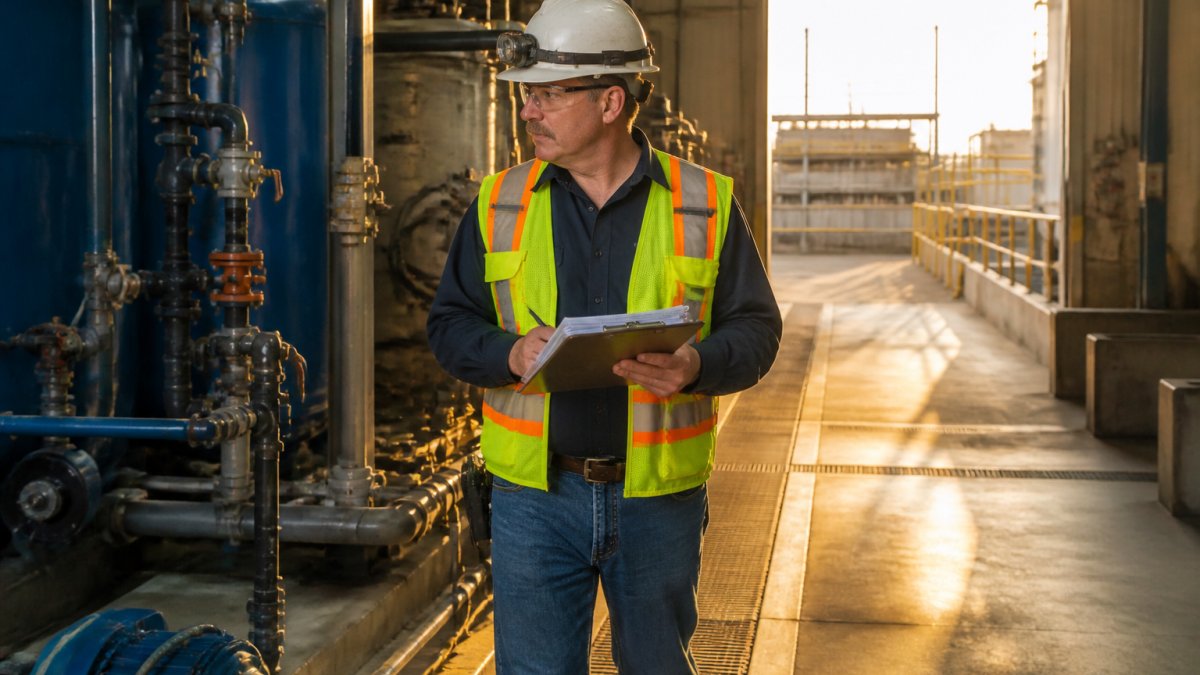
Start by walking through your entire operation with someone trained to recognize hazards.
Document what you find. For each hazard, note:
- What is the hazard (chemical, physical, ergonomic, biological)?
- Where does it occur?
- Who is exposed?
- How often are they exposed?
Once you’ve identified hazards, implement controls in this order: eliminate the hazard, substitute something safer, engineer a control, change work procedures, or provide protective equipment.
How to Select the Right Safety Consultant for Your Business
Choosing a safety consultant is a buying decision most small-business owners make without a framework. Here is the practical version: what to ask, what the engagement looks like, what drives cost, and how to measure whether it worked.
What the engagement should look like
A well-run engagement follows a predictable arc. If a consultant cannot describe it in plain terms, that is a warning sign.
- Scoping call. You describe your operation, headcount, industry, and the trigger for the call (citation, incident, insurance requirement, or preventive). The consultant tells you what they can and cannot do.
- Document and records review. The consultant reviews your written programs, training records, OSHA logs, and any citation or inspection paperwork before setting foot on site.
- On-site assessment. A walkthrough of the actual work, not just the facility. This is where hazards that never appear in a self-audit surface.
- Written findings and prioritized recommendations. A report that ranks findings by severity and likelihood, with specific corrective actions, not a generic checklist.
- Implementation support. Drafting or revising written programs, building training materials, and setting up recordkeeping.
- Follow-up. A re-check at a defined interval to confirm corrective actions closed and to catch drift.
Ask any consultant to walk you through this arc for your specific situation before you engage.
Engagement models and what drives cost
Safety consulting is typically sold three ways. The right model depends on whether you have a one-time problem or an ongoing need.
- Hourly. Best for a single citation response, a one-time assessment, or a narrow question. You pay for time, and scope can drift if the problem turns out to be bigger than expected.
- Project or fixed-fee. Best for a defined deliverable, such as writing an IIPP, building a hazard communication program, or conducting a baseline assessment. You get cost certainty in exchange for a tightly defined scope.
- Retainer. Best for ongoing compliance support, recurring inspections, and program maintenance. You get predictable access and continuity, and the consultant gets a stable relationship.
What drives total cost is not the hourly rate alone but the size and complexity of your operation, number of locations and written programs required, whether industrial hygiene sampling is needed, whether there is an active citation or litigation, and how much implementation your team can absorb.
A selection scorecard
Score each candidate on these, and ask for evidence, not assurances.
- Regulatory experience in your specific standards. Ask which parts of 29 CFR they work in most, and whether they have handled matters under your state plan if your state runs one.
- Industry fit. A consultant with years in construction reads a jobsite differently than one from offices or healthcare. Ask for two examples in your sector.
- Credentials. Look for designations such as Registered Industrial Hygienist (RIH) or Registered Environmental Professional (REP), and ask what each means in practice. Credentials indicate formal training and continuing education; they do not replace relevant industry experience.
- Who actually does the work. Ask whether the person on the scoping call will be the person on site. Some providers subcontract or hand work to junior staff. At McNeil Safety Consulting, every engagement is handled personally by the principals and never subcontracted.
Measurable outcomes to hold them to
“Improved safety culture” is not a metric. These are:
- OSHA recordable incident rate (TRIR) trended quarter over quarter
- Days away, restricted, or transferred (DART) rate
- Near-miss reports submitted per month, which should go up before injuries go down
- Training completion percentage by employee and by topic
Ask a prospective consultant how they will report against these. One who tracks them will manage to them.
Red flags
- A consultant who promises a specific citation outcome before reviewing the paperwork
- A consultant who cannot name the standards that apply to your operation
- A consultant who will not put scope, deliverables, and reporting cadence in writing
- A consultant who subcontracts the site work without telling you
Be cautious with any provider whose assessment is offered at no charge. Request a consultation with a provider who treats the assessment as professional work.
Matching the consultant to your situation
A citation with a 15-day response window calls for a consultant who can start immediately and has handled appeals in your state. A preventive program build calls for someone who will spend time on site and write programs your team will use.
McNeil Safety Consulting handles citation defense and appeals in California, Nevada, Oregon, New Mexico, and Wyoming, plus the federal OSHA states of Idaho, Montana, Colorado, North Dakota, and South Dakota.
Frequently Asked Questions
What does a safety consultant do for a small business?
A safety consultant helps small businesses identify workplace hazards, develop compliant safety programs, and respond to regulatory requirements. Services include hazard assessments, OSHA compliance reviews, safety plan writing (IIPP, HASP, SWPPP), employee training, incident investigation, and citation defense. For small operations with limited internal safety expertise, a consultant provides the specialized knowledge needed to protect workers and avoid regulatory penalties.
How can a small business assess workplace safety risks?
A workplace hazard assessment involves systematically inspecting your work environment, identifying hazards (chemical, physical, biological, ergonomic), and evaluating the risk each poses to workers. Start by walking through all work areas, interviewing employees about concerns, reviewing incident records, and checking equipment condition. A professional safety consultant can conduct a formal assessment, prioritize hazards, and recommend corrective actions tailored to your operations and industry.
When should a small business hire a safety consultant?
Hire a safety consultant immediately if you receive an OSHA citation, are starting a new operation, have had a workplace injury, are expanding into new work processes, or lack formal safety programs. Even without a triggering event, small businesses benefit from consulting when building compliance foundations, training staff on safety procedures, or preparing for regulatory inspections. Early intervention prevents citations and protects your workforce.
Can a safety consultant help with OSHA compliance?
Yes. Safety consultants specialize in OSHA compliance, including understanding federal and state regulations, conducting compliance audits, developing required safety documentation, training employees, and defending citations. If you face an active OSHA citation, a consultant can prepare a timely response and develop corrective actions. Many small businesses lack the regulatory expertise in-house, making professional guidance essential for meeting deadlines and avoiding escalated penalties.