Table of Contents
- What a Small Contractor Safety Consultant in California Actually Does
- California IIPP Requirements Every Contractor Should Know
- Using an IIPP Template for Contractors Without Cutting Corners
- What Belongs on a Construction Safety Audit Checklist
- Building a Small Contractor Safety Program That Survives an Inspection
- How to Vet a Safety Consultant Before You Sign
- Frequently Asked Questions
Last Updated: October 17, 2026
What a Small Contractor Safety Consultant in California Actually Does
A small contractor safety consultant in California is an outside safety professional who builds, audits, and defends a construction employer’s written safety program, typically for crews too small to justify a full-time safety hire.
The work is not abstract. It covers four concrete jobs:
- Writing and updating the written safety program, including the IIPP, HASP, and heat illness plan
- Running worksite inspections and documenting hazard identification and risk assessment
- Delivering construction safety training that satisfies Cal/OSHA compliance requirements
- Responding to citations, including the 15-day window to appeal a Cal/OSHA citation
That last item is where small contractors get hurt most. A citation lands, the clock starts, and the owner is still deciding whether to call anyone.
Where a Consultant Fits on a Small Crew
On a thirty-person crew, safety duty usually lands on a superintendent or project manager who already has a full day. A consultant fills the gap without adding payroll. A consultant handles the technical writing, the inspection documentation, and the regulatory correspondence; your field associates keep running the jobsite.
Ask any consultant you interview one question first: who actually does the work? At McNeil Safety Consulting, every engagement is handled personally by the two principals and never subcontracted. You should know whose name is on the report before you sign.
California IIPP Requirements Every Contractor Should Know
The Injury and Illness Prevention Program is the foundation of California employer requirements, and it is the first document a Cal/OSHA inspector asks for. Title 8 of the California Code of Regulations, Section 3203, sets out what the written program must contain. The Cal/OSHA IIPP guidance is the authoritative source, and it is worth reading directly rather than relying on a summary.
At minimum, a compliant IIPP addresses:
- Who is responsible for the program, by name and title
- The system for ensuring employees comply with safe practices
- How hazards are identified and corrected
- Communication with employees on safety matters
- Training, including new-hire and new-assignment training
- Recordkeeping for inspections and training
Small contractors most often fail on the last two. Training happens informally and goes unrecorded. Inspections happen but nobody writes them down. An inspector reads that as a program that exists on paper only.
The most common mistake is an IIPP written for a different company and never adapted. If the responsible person named in the document left two years ago, the program is not compliant, and an inspector will spot it in the first minute.
Using an IIPP Template for Contractors Without Cutting Corners
An IIPP template for contractors is a starting outline, not a finished program. Templates are useful because they show the required structure under Title 8, Section 3203 and save drafting time. They become a liability when the contractor fills in the blanks, files it, and never trains anyone on it. For a small crew, the failure mode is almost never a missing template, it is a template that was never adapted to the actual work, the actual people, or the actual recordkeeping rhythm of a short project.
Here is how to use one properly on a small crew:
- Pull the template structure from an official or professionally drafted source
- Replace every placeholder with your actual responsible person, your actual job types, your actual hazard list
- Match the hazard section to the work you really do (fall exposure, trenching, silica, heat)
- Build a training log and use it every time someone new starts
- Set a review date and actually review it
The Small-Contractor Template Trap
Three patterns account for most of the template failures on small crews:
- The borrowed program. A template pulled from a larger general contractor names a safety director who does not exist at your company, lists hazards from work you do not perform, and references equipment you do not own. An inspector reads the first page and knows the document was never yours.
- The orphaned responsible person. Section 3203 requires a named person with authority and responsibility for the program. When that person leaves, the program is technically non-compliant until the document is updated. Small crews turn over superintendents often, and the IIPP rarely gets updated to match.
- The training gap. New-hire and new-assignment training are the two recordkeeping items small contractors most often miss. A template that lists training categories without a log format invites informal training that leaves no paper trail.
What to Adapt First
If you are starting from a template, adapt these four elements before anything else:
| Template Element | What to Change | Why It Matters on a Small Crew |
|---|---|---|
| Responsible person | Name your actual superintendent or owner, with title | Section 3203 requires a named person with authority |
| Hazard list | Delete hazards you do not face; add the ones you do | Inspectors compare the list to your actual jobsite |
| Training section | Add a log format and a new-hire trigger | Training without records reads as no training |
| Inspection schedule | Set a frequency your crew can actually keep | A schedule nobody follows is evidence of a paper program |
The federal OSHA guidance on written safety programs is a useful cross-check for the underlying logic, even though California’s Section 3203 governs here.
A template is a drafting shortcut, not a compliance strategy. If the responsible person named in the document left two years ago, or the hazard list describes a different trade, the program is not compliant, and an inspector will spot it in the first minute.
What Belongs on a Construction Safety Audit Checklist
A construction safety audit checklist should cover the hazards that actually injure construction workers, organized so a superintendent can walk a jobsite and score it in under an hour. Generic checklists fail because they list everything and prioritize nothing. On a small crew, the checklist also has to be short enough that someone already running a project will actually use it, a forty-page audit form gets filled out once and never again.
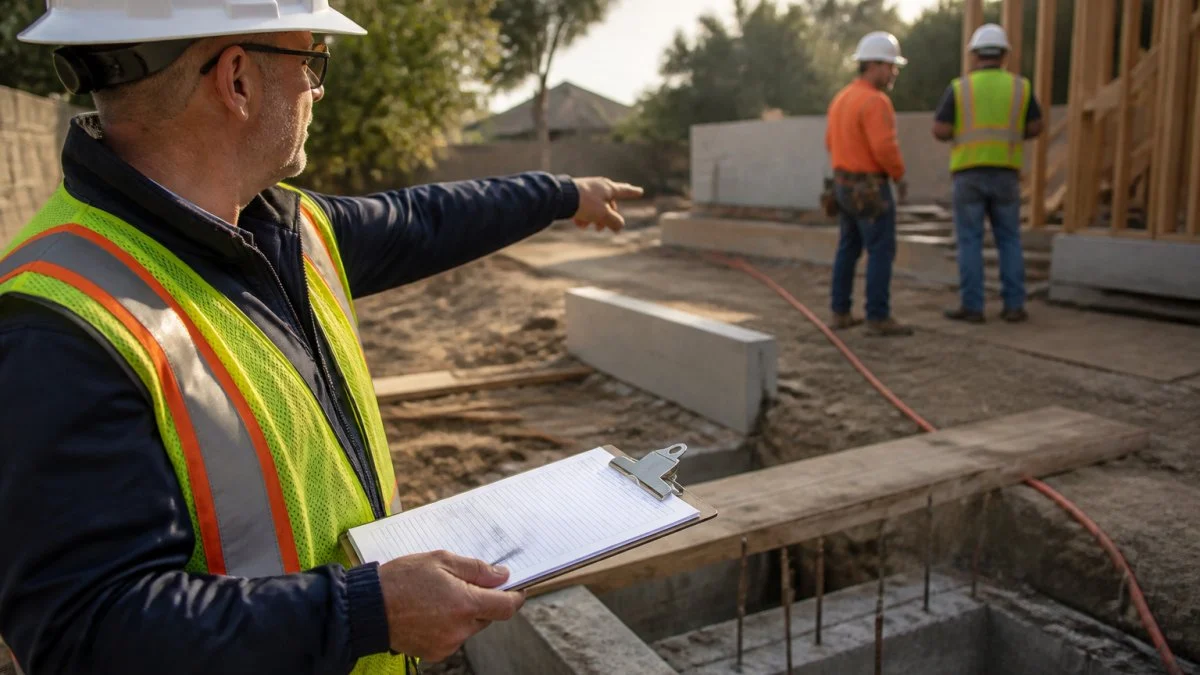
Audit checklists can group items into five blocks, each tied to the California hazard that drives the most citations and serious injuries on small construction sites:
| Audit Block | What Gets Checked | California Anchor | How Often |
|---|---|---|---|
| Fall protection | Guardrails, openings, ladder setup, anchor points | Title 8 fall protection requirements; falls remain the leading cause of construction fatalities | Every walk |
| Hazard communication | SDS access, labeling, container storage | Title 8 Hazard Communication; SDS access is a frequent small-site finding | Weekly |
| Equipment and tools | Guarding, inspection tags, operator training | Title 8 machine guarding and powered tool requirements | Weekly |
| Housekeeping and access | Walking surfaces, egress, material storage | Title 8 housekeeping and access requirements | Every walk |
| Records | Training log, inspection log, IIPP currency | Section 3203 recordkeeping; the block that decides citation outcomes | Monthly |
Scoring the Walk
A checklist that only records pass/fail produces a stack of paper nobody reads. Scoring each block on a simple three-point scale, compliant, corrected on the spot, or open, allows open items to become the correction log. That log is the document an inspector wants to see, because it shows the employer found hazards and fixed them. A checklist with no open items and no corrections is a checklist that was never used honestly.
The Records Block Is the One That Matters
The records block is the one contractors skip, and it is the one that decides citation outcomes. Training logs, inspection logs, and IIPP currency are the three documents a Cal/OSHA inspector asks for first. A small crew that can produce all three, with names that match the payroll, is in a far stronger position than a crew with a perfect jobsite and no paper trail.
Build the audit checklist around the work you actually do. A residential framing crew does not need a trenching block; a sitework crew does. A checklist that mirrors your real hazards gets used, and a checklist that gets used is the one that holds up.
An audit checklist is a correction tool, not a scorecard. The open items and the correction log are the defense.
Building a Small Contractor Safety Program That Survives an Inspection
A small contractor safety program survives an inspection when the written document, the training records, and the actual jobsite conditions all tell the same story. Inspectors are not looking for perfection. They are looking for evidence that the employer knows the hazards and is doing something about them.
That means three things working together:
- A written program that names real people and real hazards
- Training records that match the names on the payroll
- Inspection logs showing hazards were found and corrected
When those three line up, a citation is far less likely and far easier to defend. When they don’t, even a minor hazard becomes evidence of a pattern.
Inspection defense is built before the inspector arrives. The paper trail is the defense.
How to Vet a Safety Consultant Before You Sign
Vetting a safety consultant comes down to credentials, scope, and who performs the work. Ask for the specific registrations the person holds, ask what they will and will not do, and ask whether the work is subcontracted.
A practical screening framework:
- Confirm the consultant’s credentials in writing (for example, REP, RIH, EPP, QSD or EDA designations)
- Ask whether citation defense and appeals are offered in your state
- Ask who performs the fieldwork, and get a name
- Ask for the deliverable list: what documents do you receive?
- Ask how the engagement is scoped, project by project or ongoing
- Confirm the consultant carries the insurance your contract requires
On cost, pricing depends on scope, site count, and whether you need plan writing, monitoring, or citation defense. Pricing depends on quantity, dates, and delivery. Ask for a written scope before any work begins.
McNeil Safety Consulting works with contractors across California and the Western US. Michael Karl McNeil is a former Fire Battalion Chief with occupational safety experience since 1989, and a licensed vocational nurse on staff covers fit testing, bloodborne pathogen programs, OSHA recordkeeping, and medical surveillance coordination.
Frequently Asked Questions
What does a safety consultant do for a small contractor?
A safety consultant handles the work a small crew has no one to assign: writing and updating the written safety program, running worksite inspections, identifying hazards, and preparing for or responding to a Cal/OSHA inspection. For a small contractor, the practical value is having someone who knows the regulations review your jobsite and your paperwork before an inspector does. Many consultants also handle incident investigation, industrial hygiene monitoring, and citation defense when a case is already open.
When should a small construction company hire a safety consultant?
Hire one when you are growing past the point where the owner can track safety personally, when you take on work with new hazards, when a general contractor requires a written program, or when a Cal/OSHA citation arrives with a response deadline running. A consultant is also worth bringing in before an inspection if your IIPP has not been updated in years or your training records are thin. Waiting until a citation is issued usually costs more than a proactive review.
What should a contractor look for in a safety consultant?
Look for current credentials, direct experience with construction hazards, and a clear scope of work in writing. Ask whether the person doing the work is the person you met, whether engagements are subcontracted, and what deliverables you receive. Check that they know Cal/OSHA rules specifically, not just federal OSHA. Ask for examples of programs they have written and citations they have helped respond to, and confirm the response timeline they can meet.
How can a small contractor prepare for a Cal/OSHA inspection?
Keep your written IIPP current and accessible, document training, log inspections and corrections, and make sure hazard corrections are recorded with dates. Walk the site before an inspector arrives and fix obvious hazards. Designate one person to accompany the inspector and take notes. If a citation is issued, calendar the response deadline immediately, because the window to contest is short. A consultant can review the citation, help frame the response, and identify which items are worth contesting.
A citation with days left on the clock is not the moment to start comparing consultants. Build the program, the training log, and the inspection record now, while the jobsite is quiet. Contact McNeil Safety Consulting to request a consultation, or call (626) 546-9384, and we will scope the work personally, principal to principal, with no subcontracting and no surprises in the deliverable list.