Table of Contents
- What Environmental Health Consultants Actually Do
- Environmental Health and Safety Consulting: Scope and Deliverables
- When to Bring In an Industrial Hygiene Consultant
- Workplace Exposure Assessment: What the Report Should Contain
- SWPPP Consulting for Construction and Industrial Sites
- Credentials, Licenses, and Insurance to Verify Before You Sign
- Comparison Criteria: How to Rank Candidates Side by Side
- Frequently Asked Questions
Last Updated: October 17, 2026
What Environmental Health Consultants Actually Do
Environmental health consultants identify, evaluate, and control the hazards that sit at the intersection of human health and the environment. The work spans four areas: hazard identification, exposure assessment, regulatory compliance, and the written documentation that holds up when an inspector arrives.
This guide from McNeil Safety Consulting covers how to choose one of these providers, what to expect from an engagement, and the verification steps most buyers skip.
Here is the core problem. The title “environmental health consultant” is not protected. Anyone can print it on a business card. That means selection has to be driven by evidence, not by a polished website.
Environmental Health and Safety Consulting: Scope and Deliverables
Environmental health and safety consulting is the practice of helping an organization meet workplace safety and environmental regulatory requirements through assessment, program writing, and ongoing technical support. The scope varies widely, which is why two proposals for the same facility can look completely different.
Typical deliverables include:
- A written hazard identification and risk assessment report
- Exposure monitoring data with laboratory results
- Compliance gap analysis against applicable standards
Ask every candidate for a sample deliverable with client identifiers removed. A consultant who cannot produce one is telling you something.
Engagement Models: Project, Retainer, and Citation Response
Three models dominate the market. A project engagement covers a defined scope with a fixed deliverable; an industrial hygiene survey or a Phase I environmental site assessment fits here.
A retainer covers ongoing compliance support: program updates, inspection preparation, and on-call advice. Organizations with active work environments and changing headcounts tend to need this.
Citation response is its own animal. When a Cal/OSHA citation lands on your desk, the clock starts.
When to Bring In an Industrial Hygiene Consultant
Bring in an industrial hygiene consultant when you need to know what workers are actually breathing, hearing, or absorbing, and whether it is within acceptable limits. That is the short answer.
The longer answer involves triggers. Consider outside help when:
- A worker reports symptoms that track with a specific process or shift
- You are adding a process, chemical, or equipment line
- An inspector has requested exposure data
An industrial hygiene consultant brings measurement to a question that has been answered by guesswork. That distinction matters. Hazard evaluation without data is opinion.
Air, Noise, Heat, and Chemical Monitoring
Monitoring covers more ground than most managers expect. Air sampling for particulates and vapors is the familiar piece. Noise dosimetry, heat stress evaluation, and chemical exposure assessment round it out.
Heat illness is worth calling out. Cal/OSHA has two heat illness prevention standards: Title 8 §3395 for outdoor work and Title 8 §3396 for indoor work. Cal/OSHA’s heat illness prevention guidance is posted on the DIR website. If your program has not been reviewed against the current standard, that is a gap worth closing before an inspector finds it.
Workplace Exposure Assessment: What the Report Should Contain
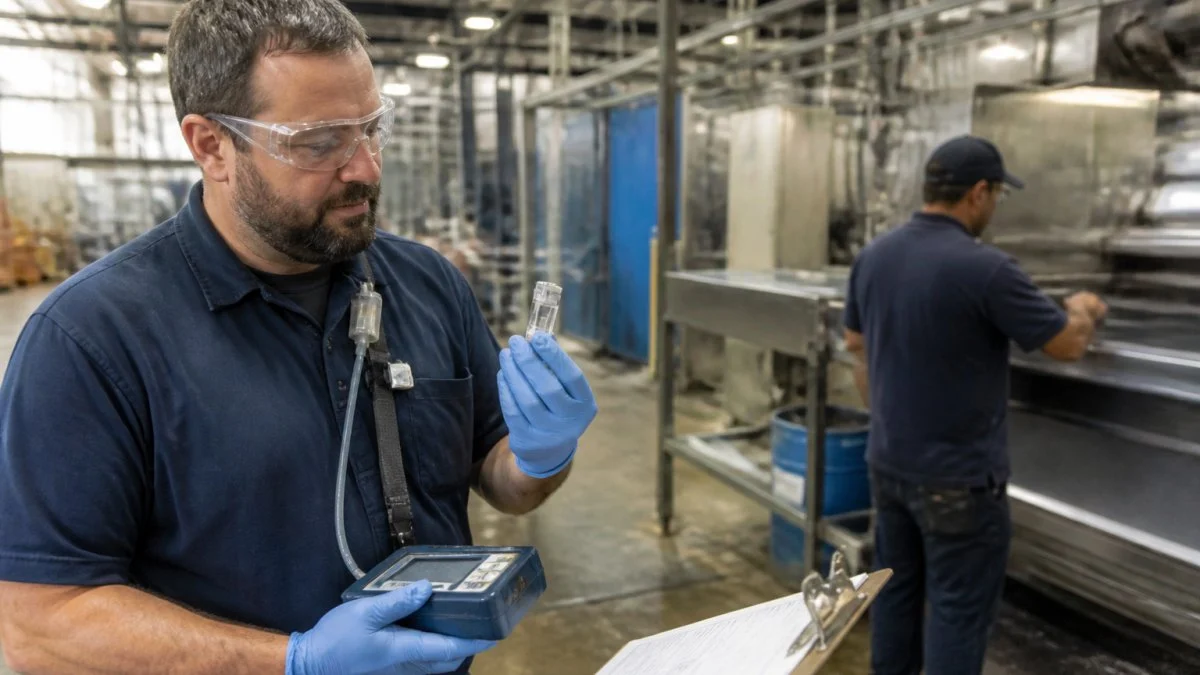
A workplace exposure assessment report should state what was sampled, how, when, and what the results mean against a named exposure limit. Anything less is a data dump.
Check for these elements before you accept a report:
Report Element | Why It Matters |
|---|---|
Sampling method and equipment | Confirms results are defensible |
Calibration records | Shows the instrument was trustworthy |
Laboratory accreditation | Establishes analytical credibility |
Named exposure limit | Tells you what “passing” means |
Worst-case scenario identified | Reveals whether sampling was representative |
Written recommendations | Turns data into action |
SWPPP Consulting for Construction and Industrial Sites
SWPPP consulting covers the development and administration of a Storm Water Pollution Prevention Plan for sites that disturb soil or discharge stormwater.
In California, the Construction General Permit requires the SWPPP to be prepared by a Qualified SWPPP Developer (QSD). This is a credential question, not a preference question. Ask for the QSD registration number and verify it.
A workable SWPPP engagement produces:
- A site-specific plan, not a template
- Inspection and monitoring schedules with named responsible parties
- Rain event response procedures
Poorly maintained SWPPPs are one of the more common findings in construction compliance reviews. The plan gets written, filed, and never touched again while the site changes around it.
Credentials, Licenses, and Insurance to Verify Before You Sign
Verify credentials before you sign, not after the report disappoints you. The verification step takes an afternoon and prevents most bad hires.
Run this checklist:
- Confirm each named credential against the issuing body’s registry
- Ask for the certificate of insurance and call the carrier to confirm it is current
- Confirm general liability and professional liability limits
What Each Credential Actually Qualifies the Holder to Do
A credential is not a decoration. Each one maps to a specific scope of work, and asking a consultant to explain that mapping is a fast way to separate real practitioners from résumé padding.
- Registered Environmental Professional (REP) signals a broad environmental practice background spanning assessment, compliance, and program management. It is not a laboratory certification and does not by itself authorize sampling design.
- Registered Industrial Hygienist (RIH) signals industrial hygiene practice: exposure assessment, sampling strategy, and interpretation of results against exposure limits. Ask what instruments and methods the holder uses in the field.
- Qualified SWPPP Developer (QSD) is a California stormwater credential tied to preparing and amending Storm Water Pollution Prevention Plans. If your project disturbs an acre or more, this is the credential to confirm, and you confirm it by registration number.
- Emergency Planning Professional (EPP), Hazardous Materials Manager, HAZMAT Specialist, and Incident Commander credentials speak to emergency response planning and hazardous materials handling. Relevant if your site stores, uses, or ships regulated materials.
When a consultant lists a credential, ask two follow-ups: what work does this let you sign off on, and when did you last use it on a project like mine?
How to Read a Certificate of Insurance
A certificate of insurance is a snapshot, not a guarantee. Three details matter more than the rest:
- Policy dates. Confirm the policy is active on the date fieldwork begins, not just the date the certificate was issued.
- Professional liability, not just general liability. General liability covers bodily injury and property damage on site. Professional liability covers the errors and omissions in the report you are paying for. If the report is wrong and you rely on it, only professional liability responds.
- Additional insured status. For larger projects, ask to be named as an additional insured. It costs the consultant little and protects you if a claim arises from their work.
Call the carrier’s number on the certificate, not the number the consultant gives you. Certificates are easy to alter and easy to let lapse.
Comparison Criteria: How to Rank Candidates Side by Side
Rank candidates on evidence, not on the quality of their proposal document. Score each one against the same criteria so the comparison means something.
Criterion | What to Look For | Weight |
|---|---|---|
Verified credentials | Registrations confirmed independently | High |
Relevant project history | Similar facility, similar hazard | High |
Named field staff | Specific people with stated qualifications | High |
Written deliverable sample | Real report, redacted | High |
Insurance coverage | Current, adequate limits | Medium |
Response time | Confirmed turnaround for urgent work | Medium |
Scope clarity | Explicit inclusions and exclusions | Medium |
Match the Consultant Type to the Project Type
Most buyers treat “environmental health consultant” as one role. It is not. The scope of work should determine which specialty you hire, and mismatching the two is the most common reason an engagement disappoints.
Use this decision guide before you send out a request:
Your situation | Right specialist | Why |
|---|---|---|
Workers report symptoms tied to a process, shift, or building | Industrial hygienist | Requires sampling design, exposure limits, and defensible data |
A Cal/OSHA or federal OSHA citation has arrived | Citation defense and appeals consultant | Appeal deadlines, abatement timelines, and evidence presentation are a distinct skill set |
You are buying, selling, or refinancing a property | Environmental site assessment provider | Phase I and Phase II work follows recognized practice standards and lender expectations |
Construction or industrial site discharges stormwater | SWPPP specialist with QSD registration | Plan preparation is a credential-gated task |
Tenants or staff complain about air quality, mold, or odors | Indoor air quality specialist | Investigation follows a building-science sequence, not a single air sample |
You need a written safety program, not monitoring | Program writer with hazard-assessment background | The deliverable is a document that must survive inspection |
You need testimony or litigation support | Expert with documented field experience | Credibility depends on case history and report quality |
A multidisciplinary provider can cover several rows. What matters is that the person assigned to your project has done that specific work before, not that the company lists it on a website.
Score, Then Verify the Top Two
Score every candidate on the table above, then take only the top two into a verification call. On that call, ask each one to walk through a comparable project from start to finish: what triggered the work, what was sampled or reviewed, what the report concluded, and what the client did next. A consultant who cannot narrate a real project in sequence is reciting a service list.
Pricing and Engagement Questions to Ask
Pricing for environmental health consultants depends on scope, site size, sampling count, laboratory analysis, and urgency.
Ask these questions before you sign:
- Is the fee fixed-fee, time and materials, or a hybrid?
- What is explicitly excluded from the scope?
- Are laboratory analysis costs included or billed separately?
- What happens if additional sampling is needed mid-project?
For a citation response, ask directly whether the engagement can be handled as a single project.
McNeil Safety Consulting handles citation defense and appeals in California, Nevada, Oregon, New Mexico, and Wyoming, plus the federal OSHA states of Idaho, Montana, Colorado, North Dakota, and South Dakota.
Frequently Asked Questions
What services do environmental health consultants provide?
Environmental health consultants cover hazard identification, exposure monitoring, and compliance support. Typical work includes industrial hygiene sampling, indoor air quality checks, asbestos, lead, and mold surveys, SWPPP and stormwater plan writing, Phase I and II environmental site assessments, and citation response. On the safety side, they write and audit IIPPs, heat illness plans, and HAZWOPER programs. McNeil Safety Consulting pairs this with Cal/OSHA and federal OSHA citation defense, handled personally by Michael Karl McNeil, who does not subcontract the work.
When should a business hire an environmental health consultant?
Hire one when an exposure question cannot be answered internally, when a Cal/OSHA or federal OSHA citation lands with a 15-working-day appeal window, or when a permit, lender, or insurer requires documented sampling. Smaller employers often wait until an inspection forces the issue. A workplace exposure assessment is cheaper before citations than after, and an independent industrial hygiene consultant gives you defensible data rather than an internal opinion.
What is the difference between an environmental consultant and an industrial hygienist?
Environmental consultants focus on outdoor media and regulatory programs: stormwater, waste, site assessment, and permits. Industrial hygienists focus on what workers breathe, touch, and hear inside the facility: chemical exposure, noise, heat, ventilation, and ergonomics. Many projects need both skill sets, which is why you should check whether a candidate holds industrial hygiene credentials or subcontracts that work. McNeil Safety Consulting keeps industrial hygiene and exposure assessment in-house.
How do I choose an environmental health consultant?
Compare at least three candidates on five points: credentials and registrations, insurance limits, sampling methods and lab accreditation, deliverables and timelines, and whether the principal does the work or hands it to subcontractors. Ask for redacted reports from similar projects and confirm the named consultant will be on site. Pricing depends on scope, site size, and sampling count, so request a written scope before comparing quotes. Contact McNeil Safety Consulting or call (626) 546-9384 to discuss your project.