Last Updated: October 27, 2026
Quick Summary
Assess repetitive motion risks in assembly work by running a job hazard analysis that breaks tasks into timed cycles, then scoring each task with a matched tool such as the Strain Index, Moore-Garg Strain Index, or HSE ART. Rank tasks by score and worker reports, apply engineering controls first, and re-score with the same tool to prove exposure dropped.
- Short-cycle work under about 30 seconds deserves the most attention because recovery time disappears fast.
- Use the Strain Index for a single dominant hand and wrist task with measurable force.
- Use HSE ART when you need to weigh breaks, rotation, and recovery across a full shift.
- Sample at least two points in the shift because line speed and fatigue shift exposure.
- Re-score after the change with the same tool and document the before and after.
Table of Contents
- Why Repetitive Motion Risks in Assembly Work Demand a Structured Assessment
- Start With a Job Hazard Analysis: Breaking Assembly Tasks Into Measurable Cycles
- Repetitive Task Assessment Tools: Choosing the Right Method for the Job
- A Step-by-Step Assessment Workflow for Assembly Tasks
- Step 1: Define the Job and List Every Task
- Step 2: Observe a Full Shift Segment and Record Cycle Times
- Step 3: Select the Assessment Tool
- Step 4: Score Each Task and Name the Dominant Risk Factor
- Step 5: Rank Tasks by Score and Worker Report
- Step 6: Apply Controls to the Highest-Ranked Task First
- Step 7: Re-Score After the Change Using the Same Tool
- Step 8: Document the Before and After
- The Ergonomic Assessment Checklist for Manufacturing Supervisors
- From Findings to Fixes: Assembly Work Ergonomic Controls That Hold Up
- Prioritizing Findings and Verifying That Controls Actually Reduce Exposure
- Request a Consultation to Assess Repetitive Motion Risks at Your Facility
- Frequently Asked Questions
Why Repetitive Motion Risks in Assembly Work Demand a Structured Assessment
Most assembly supervisors already know their line has a problem. They can point to the workstation where operators shake out their wrists at break. What they cannot do is prove exposure, rank it against other tasks, or show that a fix worked. That gap is where repetitive motion risks turn into recordable injuries.
A structured method can help build evidence rather than paperwork.
The Cost of Guessing: Strain Injuries and MSD Risk Factors on the Line
Repetitive strain injury rarely arrives as a single event. It builds from thousands of short cycles, and the worker often reports it late.
Musculoskeletal disorders in assembly work trace back to a small set of MSD risk factors:
- Force applied per cycle
- Repetition measured in cycles per minute
- Awkward posture of the wrist, shoulder, or neck
- Insufficient recovery time between cycles
Guess at these and you will spend money on the wrong workstation. Measure them and the fix usually names itself.
Start With a Job Hazard Analysis: Breaking Assembly Tasks Into Measurable Cycles
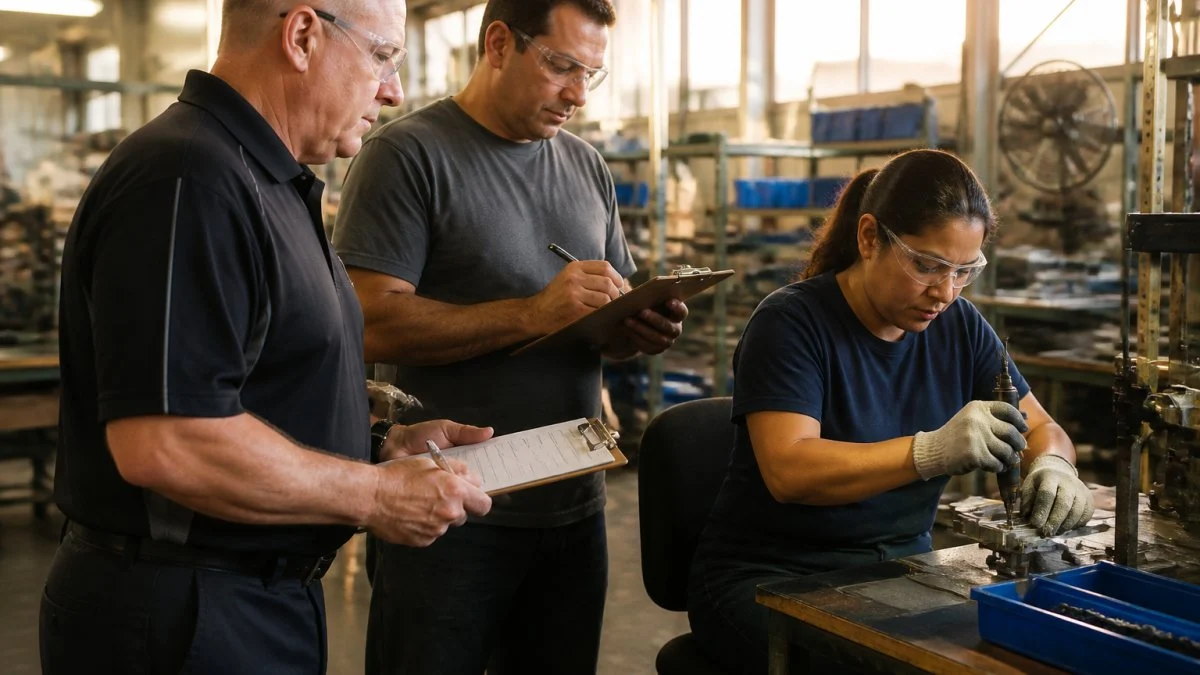
A job hazard analysis is the foundation of every credible ergonomic assessment. It breaks a job into tasks, then breaks each task into work cycles you can actually observe and time.
For assembly work, watch one operator through a full shift segment. Note every distinct task: pick, orient, insert, press, torque, inspect, pack.
Documenting Force, Repetition, and Awkward Posture Task by Task
Build a simple log. For each task, record:
- Work cycle length in seconds
- Estimated task duration per shift
- Hand and arm work involved
- Posture at the wrist, shoulder, and neck
- Any tool weight or grip force
Short-cycle work under about 30 seconds deserves the most attention. Recovery time disappears fast in those jobs. If you want a deeper walkthrough of spotting hazards before they cause harm, see our guide on identifying potential sources of accident or injury.
Repetitive Task Assessment Tools: Choosing the Right Method for the Job
No single tool fits every assembly task. The right choice depends on cycle time, whether force is present, how much posture variation the job involves, and how many distinct tasks one operator performs in a shift. Picking the wrong tool wastes observation time and produces scores you cannot defend.
What Each Tool Actually Measures
Every observational tool converts the same core inputs into a score: force, repetition, posture, duration, and recovery. What differs is how each one weights those inputs and what task shape it was built for.
| Tool | Inputs Scored | Best For | Strength | Limitation |
|---|---|---|---|---|
| Strain Index | Intensity of exertion, duration per exertion, efforts per minute, hand/wrist posture, speed of work, duration per day | Single-task hand and wrist work | Scores force, repetition, posture, and duration together; widely recognized | Weak on multi-task jobs and on shoulder/neck exposure |
| Moore-Garg Strain Index | Exertion, repetition, posture, duration | Upper limb tasks with varied posture | Handles posture variety better than the original Strain Index | Needs a trained observer; still hand/wrist focused |
| HSE ART | Repetition, force, posture, recovery, additional factors | Repetitive upper limb work across a full shift | Accounts for recovery periods and breaks; good for rotated jobs | Longer to complete; requires task-by-task breakdown |
| Observational checklist | Visible posture, force, cycle time, recovery | Screening many stations quickly | Fast; usable by supervisors | Does not produce a defensible numeric score |
When to Use Which
- Use the Strain Index when one station has a single dominant hand/wrist task with a short cycle and measurable grip or press force. It is the cleanest fit for a high-repetition insert or torque station.
- Use the Moore-Garg Strain Index when posture shifts constantly within the cycle, for example, an operator who reaches, rotates, and presses in the same 20-second task.
- Use HSE ART when you need to weigh breaks, rotation, and recovery across a full shift, or when an operator moves between several stations.
- Use an observational checklist first, to screen a whole line and decide which stations deserve a full tool-based assessment.
Match the tool to the task shape, not to the tool you know best. A Strain Index score on a rotated multi-task job will understate exposure because it was not built to weigh recovery between tasks.
Practical Selection Rules
- Count the tasks first. One dominant task points to the Strain Index. Three or more tasks in rotation points to HSE ART.
- Check for force. If grip or press force is present and measurable, a force-weighted tool beats a posture-only checklist.
- Check cycle time. Short cycles under about 30 seconds amplify repetition and shrink recovery; weight repetition heavily.
- Check observer skill. Tools that require posture judgment need a trained eye. If supervisors will run the assessment, start with a checklist and escalate.
A professional industrial hygiene program adds exposure measurement on top of these observational scores. Our article on the benefits of professional industrial hygiene programs explains what that layer contributes.
A Step-by-Step Assessment Workflow for Assembly Tasks
A workflow can move from observation to control, with each step producing a record.
Step 1: Define the Job and List Every Task
Write down the job title, the station, and every distinct task in the cycle: pick, orient, insert, press, torque, inspect, pack. Note which tasks repeat every cycle and which occur occasionally. A job with one dominant task and a job with six rotating tasks need different tools.
Step 2: Observe a Full Shift Segment and Record Cycle Times
Watch one operator through a representative segment, not a single cycle. Record:
- Cycle time in seconds, timed with a stopwatch over at least ten cycles and averaged
- Repetitions per minute, calculated from cycle time
- Task duration per shift, in minutes or hours
- Recovery periods, micro-pauses, breaks, and rotation intervals
- Force per cycle, estimated or measured with a gauge
- Posture at the wrist, shoulder, and neck at the moment of peak exertion
A single-cycle observation misses the variation that drives injury. Line speed changes, part shortages, and end-of-shift fatigue all shift exposure. Sample at least two points in the shift.
Step 3: Select the Assessment Tool
Use the selection rules in the previous section. One dominant hand/wrist task points to the Strain Index; rotated multi-task work points to HSE ART; posture-heavy varied work points to the Moore-Garg Strain Index.
Step 4: Score Each Task and Name the Dominant Risk Factor
Apply the tool and record the score alongside the input that drove it. A high score driven by repetition calls for a different control than a high score driven by force. Naming the dominant factor is what turns a number into an action.
Step 5: Rank Tasks by Score and Worker Report
Rank by score, then adjust using worker feedback. A moderate score with three symptom reports outranks a higher score with none. Document the ranking and the reason for each adjustment.
Step 6: Apply Controls to the Highest-Ranked Task First
Engineering controls first: workstation height, part placement, tool balancing, torque reaction arms. Administrative controls, rotation, micro-breaks, training, come second. Fixing the top-ranked task first concentrates effort where exposure is highest.
Step 7: Re-Score After the Change Using the Same Tool
Re-observe the task after the control is in place and re-score with the same tool and the same observer if possible. Compare before and after side by side.
Step 8: Document the Before and After
Keep the observation notes, the scores, the control applied, and the re-score together.
The workflow is only as strong as steps 7 and 8. Without a re-score and a documented comparison, you have observations, not evidence.
If you are planning the measurement side, our guide to industrial hygiene monitoring requirements covers current methods and documentation.
The Ergonomic Assessment Checklist for Manufacturing Supervisors
Supervisors need a short list they can run without a consultant on site. This ergonomic assessment checklist for manufacturing covers the basics in about fifteen minutes per station.
- Cycle time recorded in seconds
- Force estimated for each grip or press
- Wrist and shoulder posture noted
- Tool weight checked
- Workstation height and reach checked
- Recovery time between cycles noted
- Worker symptoms and early reporting reviewed
- Rotation schedule confirmed
- Assessment tool selected and applied
- Findings logged with a date
Re-check after any change to tooling, line speed, or staffing.
From Findings to Fixes: Assembly Work Ergonomic Controls That Hold Up
Controls fall into three tiers.
Assembly work ergonomic controls that hold up in practice:
- Workstation design: adjust bench height and part placement to cut reach
- Equipment adjustment: balance tools, add torque reaction arms
- Task design: combine or split tasks to break up short-cycle work
- Job rotation: rotate operators across different muscle groups
- Work breaks: schedule micro-breaks in high-repetition periods
- Worker training: teach early reporting and proper setup
Prioritizing Findings and Verifying That Controls Actually Reduce Exposure
Rank findings by score, then by worker report. A task with a moderate score and three symptom reports outranks a higher-scoring task with none.
Verification means re-scoring with the same tool after the change. Compare the before and after numbers side by side.
Request a Consultation to Assess Repetitive Motion Risks at Your Facility
McNeil Safety Consulting provides industrial hygiene, exposure assessment, and ergonomics across California and the Western US. Michael Karl McNeil, a former Fire Battalion Chief, leads every engagement personally, and our licensed vocational nurse covers medical surveillance coordination. We do not subcontract.
If you are weighing whether a formal assessment is worth the effort, our overview of workplace risk assessment benefits for small business lays out the business case. When you are ready, see the scope of our Cal/OSHA compliance assistance services and request a consultation. Call (626) 546-9384 to get started.
Frequently Asked Questions
How do you assess ergonomic risks in assembly work?
A job hazard analysis can break assembly tasks into work cycles. Factors to document can include force, repetition, and posture.
Which tools can help evaluate repetitive tasks?
Assessment methods can be selected based on the task and the factors being evaluated.
What factors increase the risk of repetitive motion injuries?
An ergonomic assessment can document task characteristics such as force, repetition, posture, and recovery time.
What are some control measures for repetitive motion?
Potential controls include workstation adjustments, job rotation, work breaks, and worker training.
Repetitive motion exposure on an assembly line rarely fixes itself. It compounds quietly until a worker files a claim. Contact McNeil Safety Consulting to assess your highest-risk stations, rank them by exposure, and verify that your controls actually reduce the load.
