Last Updated: November 9, 2026
Quick Summary
Industrial hygiene is the practice of recognizing, evaluating and controlling workplace conditions that can cause illness or injury. For California employers, it protects workers from chemical exposures, dust, noise, heat and poor air, and it helps answer questions from regulators. Starting monitoring before a problem appears is far easier than responding to a citation later.
- Industrial hygiene follows three steps: recognize the hazard, evaluate how serious it is, and control it.
- Controls should be ranked from elimination and substitution down to personal protective equipment as a last resort.
- Common California exposures include silica dust, noise, solvent vapors, welding fumes and heat stress.
- Monitoring should start before new chemicals are introduced, before symptoms are reported, and when ventilation changes.
- Cal/OSHA Title 8 standards often add requirements beyond federal OSHA, so plans should be built around state limits.
Table of Contents
- What Industrial Hygiene Means for a California Workplace
- Recognition, Evaluation, and Control: The Core of an Industrial Hygiene Program
- Industrial Hygiene Examples: Exposures Common in California Construction and Manufacturing
- How Industrial Hygiene Monitoring Works and When to Start It
- Industrial Hygiene and OSHA: Where Federal and Cal/OSHA Rules Apply
- Common Mistakes Small and Mid-Sized California Employers Make
- 1. Treating industrial hygiene as a one-time project
- 2. Reaching for PPE before engineering controls
- 3. Keeping records in a drawer instead of a system
- 4. Waiting for a citation or a complaint
- 5. Assuming a generic safety plan covers chemical and air quality hazards
- The cost-benefit view for a small employer
- Scheduling an Industrial Hygiene Assessment for Your Crew or Facility
- Frequently Asked Questions
What Industrial Hygiene Means for a California Workplace
Industrial hygiene is the science of finding, measuring and controlling health hazards in the workplace.
Industrial hygiene is the practice of recognizing, evaluating and controlling workplace conditions that can cause illness or injury.
The field covers chemical exposures, dust, noise, heat, biological agents and poor indoor air.
Many employers first think about this work only after an inspection or a worker complaint.
Recognition, Evaluation, and Control: The Core of an Industrial Hygiene Program
Most industrial hygiene programs rest on three steps: recognize the hazard, evaluate how serious it is, and control it. Each step builds on the one before it.
Recognition means identifying where hazards exist. This usually starts with a walk-through of the workplace and a review of the chemicals, equipment and tasks involved.
Evaluation means measuring how much exposure actually occurs. A hazard that looks serious on paper may be minor in practice, and the reverse is also true.
Control means reducing exposure to safe levels. Experts generally rank controls from most to least effective:
- Eliminate the hazard by removing the source
- Substitute a less harmful material or process
- Isolate workers with enclosures or barriers
Personal protective equipment, such as respirators, works only when it is chosen correctly, fitted properly and worn consistently.
Industrial Hygiene Examples: Exposures Common in California Construction and Manufacturing
California’s construction and manufacturing sectors meet several recurring exposures. Knowing what to look for is the first step toward controlling them.
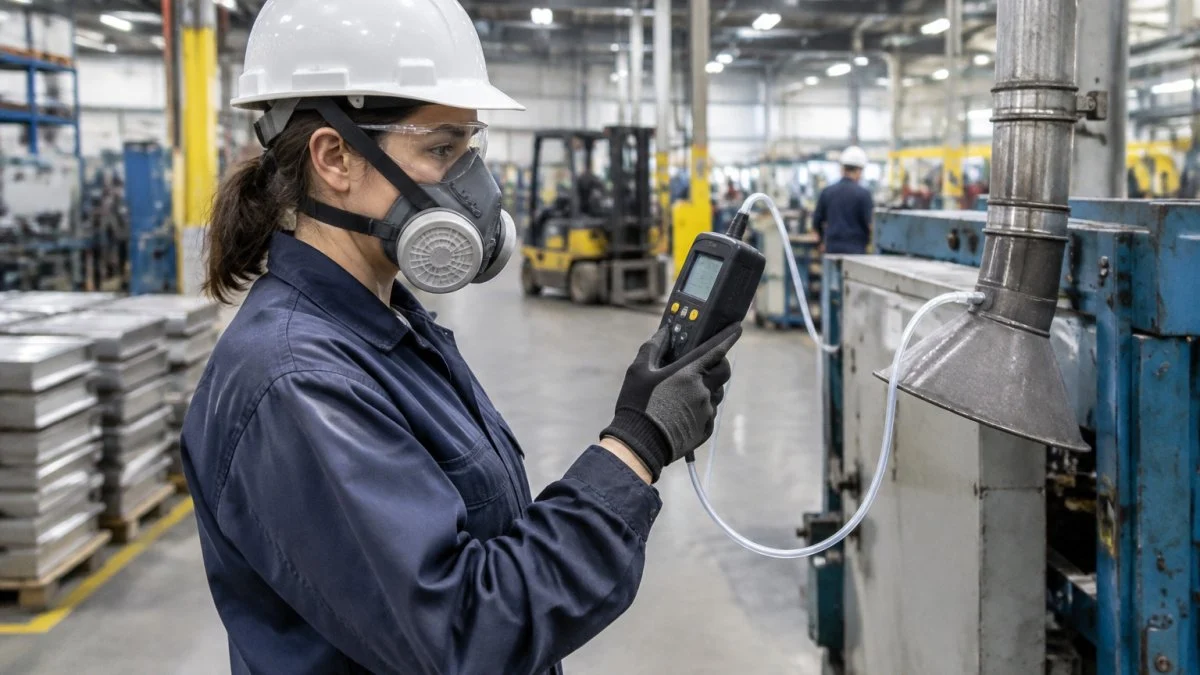
- Silica dust from cutting, grinding or drilling concrete and masonry
- Noise from saws, compressors, stamping presses and other heavy machinery
- Solvent and adhesive vapors from coatings, sealants and cleaning products
A common mistake is assuming a task is safe because workers have not complained. Many exposures produce no obvious symptoms until damage has already built up.
Take a closer look at one of these exposures with our guide to manage noise exposure in manufacturing, or see how to assess repetitive motion risks in assembly work on your own floor.
How Industrial Hygiene Monitoring Works and When to Start It
Industrial hygiene monitoring is the regular measurement of workplace exposures. It tells you whether controls are working and whether conditions have changed.
A typical monitoring cycle includes these steps:
- Identify which tasks and substances need measurement
- Collect samples or readings during normal work conditions
- Compare the results to the applicable exposure limits
- Record findings and share them with affected workers
- Adjust controls and repeat measurement as needed
Monitoring should start before any of the following happens:
- A new chemical or process is introduced
- A worker reports symptoms that could be work-related
- A ventilation system or layout changes
Many employers wait too long. Starting early gives you a baseline, which makes any later change easier to spot. For the specific requirements that may apply to your operation, read our industrial hygiene monitoring requirements guide.
Industrial Hygiene and OSHA: Where Federal and Cal/OSHA Rules Apply
Federal OSHA sets the baseline, but California runs its own program through Cal/OSHA, and that program is where most compliance questions actually get answered. The practical difference is not a slogan about being ‘stricter’, it is a set of Title 8 standards with their own exposure limits, monitoring triggers, medical surveillance duties and recordkeeping timelines. An employer who plans only against federal rules will usually be short of what a California inspector checks.
Where the two frameworks diverge
Federal OSHA enforces the general industry standards in 29 CFR 1910 and the construction standards in 29 CFR 1926. Cal/OSHA mirrors many of those in Title 8 of the California Code of Regulations, but the state versions carry additions that matter to industrial hygiene work:
- Airborne contaminants. Title 8 Section 5155 sets permissible exposure limits for airborne contaminants and includes substances and limits that go beyond the federal table. Some chemicals carry a Cal/OSHA-only limit, so a sampling plan built solely on federal values can understate the exposure.
- Respiratory protection. Title 8 Section 5144 requires a written respiratory protection program, fit testing, medical evaluation and training whenever respirators are required. That is the same shape as the federal rule, but Cal/OSHA enforcement expects the written program to be specific to the site and the hazard.
- Hazard communication. Title 8 Section 5194 requires safety data sheets, container labeling and employee training, and it applies to employers whose workers may be exposed, not only to those who manufacture chemicals.
What this means for a monitoring plan
A defensible industrial hygiene program in California is built around the state limits, not the federal ones. In practice that means:
- Identify each substance and physical agent in use, then check the Title 8 Section 5155 table for the applicable limit before designing sampling.
- Compare results to the Cal/OSHA limit, and note where a federal limit would have given a different answer.
- Where exposure reaches an action level or exceeds a limit, confirm whether a written program, medical surveillance or additional monitoring is triggered.
- Keep the sampling records, calibration records and chain-of-custody documentation together, because those are what an inspector or an insurer will ask for.
Watch out: a common failure is sampling to a federal limit, reporting a ‘pass,’ and then discovering the Cal/OSHA limit for that substance is lower, the result is a finding the employer could have caught with a single table check.
Penalties and deadlines change
Cal/OSHA penalty amounts are adjusted annually, and the figures in force this January are not the figures that applied last January. Do not carry a number from an old article, a trade show slide or a prior citation into a current compliance plan. Confirm the current penalty schedule and any abatement deadlines directly with the Department of Industrial Relations before you rely on them.
Where federal OSHA still applies
Not every worksite in the West is a Cal/OSHA site. Federal OSHA has jurisdiction over certain federal installations, tribal lands and other specific settings, and the federal states in the region enforce federal standards directly.
For an overview of current compliance obligations, see our Cal/OSHA requirements guide.
The table below summarizes the main points where California Cal/OSHA rules differ from or add to federal OSHA requirements for industrial hygiene work.
| Topic | Federal OSHA | Cal/OSHA (Title 8) |
|---|---|---|
| Airborne contaminants | 29 CFR 1910 / 1926 limits | Section 5155 limits, including some Cal/OSHA-only limits |
| Respiratory protection | Federal respiratory standard | Section 5144 written program, fit testing, medical evaluation |
| Hazard communication | Federal HazCom standard | Section 5194 SDS, labeling and training |
| Heat illness | No direct general-industry equivalent | Section 3395 heat illness prevention plan |
| Noise | Federal hearing conservation | Sections 5096 to 5099 hearing conservation program |
| Recordkeeping | Federal injury and illness records | Section 14300 injury records; Section 3204 exposure and medical records |
Common Mistakes Small and Mid-Sized California Employers Make
Smaller employers in California and the Western US usually carry the same exposures as large facilities with a fraction of the staff to manage them. The mistakes below are the ones that show up most often, and each one has a specific cost attached, which is the part most generic safety content leaves out.
1. Treating industrial hygiene as a one-time project
A single air sampling event produces a snapshot. Conditions change: a new solvent, a reorganized production line, a ventilation belt that slips, a seasonal heat wave. An employer who sampled once in 2019 and has not looked since is relying on stale data. The cost shows up when an inspector asks for current exposure data and the file contains nothing recent.
2. Reaching for PPE before engineering controls
Respirators and earplugs are the cheapest thing to buy on a Tuesday afternoon, which is exactly why they get bought first. They are also the least reliable control, because they depend on fit, selection and consistent wear. A local exhaust hood or a wet-cutting method removes the exposure instead of managing it. The trade-off is real, engineering controls cost more up front, but they also reduce the recurring cost of respirator programs, fit testing and medical evaluation.
3. Keeping records in a drawer instead of a system
Exposure records, calibration sheets, training rosters and medical surveillance files each carry their own retention period. When they are scattered across a shop office, a foreman’s truck and a bookkeeper’s email, the employer cannot produce them on request. Reconstructing a record after a citation is far more expensive than filing it correctly the first time.
4. Waiting for a citation or a complaint
Cal/OSHA inspections are often triggered by a worker complaint, a serious injury or a referral. By the time an inspector arrives, the exposure has usually existed for months. Employers who monitor on a schedule get to fix the problem on their own timeline rather than under an abatement order.
5. Assuming a generic safety plan covers chemical and air quality hazards
An injury and illness prevention program is required, and it is a good foundation, but it is not an exposure assessment. A company can have a complete IIPP and still have no idea what its welders are breathing. The two documents do different jobs, and an inspector will ask for both.
The cost-benefit view for a small employer
Industrial hygiene spending is easiest to justify when it is framed against what a failure costs.
A structured program also tends to pay back in ways that are not obvious at the outset:
- Lower respirator program cost. Better engineering controls mean fewer workers in respirators, which reduces fit testing, medical evaluation and training overhead.
- Fewer surprise shutdowns. Scheduled monitoring catches a failing ventilation system before it becomes an abatement order.
- Cleaner insurance conversations. Documented exposure data and a written program are what underwriters and auditors ask for.
A common pattern is a mid-sized shop that spends a modest amount each year on monitoring and program upkeep and avoids the multi-week disruption of a citation response. The math is not the same for every operation, but the comparison is worth running before a problem forces it.
Our overview of professional industrial hygiene program benefits explains what a well-run program delivers.
Scheduling an Industrial Hygiene Assessment for Your Crew or Facility
A good assessment starts with a clear scope. Decide which sites, tasks and substances need review, then gather existing safety data sheets, incident reports and any prior monitoring results.
When you request an assessment, expect the consultant to walk the facility, interview workers, identify exposures, and recommend controls with priorities.
To discuss your operation, contact McNeil Safety Consulting or call (626) 546-9384.
Frequently Asked Questions
What falls under industrial hygiene?
Industrial hygiene covers the recognition, evaluation, and control of workplace factors that can harm worker health, including chemical vapors, dusts, noise, heat, radiation, biological agents, and ergonomic stressors. In California, the work usually centers on identifying exposures that are regulated under Cal/OSHA standards, measuring worker exposure against those limits, and recommending engineering controls, administrative changes, or personal protective equipment. The goal is to keep exposures below established thresholds so employees are not harmed over their working lives.
What should an industrial hygiene program include?
A complete industrial hygiene program typically includes a hazard inventory, exposure assessments for relevant job tasks, written monitoring and control plans, respiratory protection and training where needed, medical surveillance coordination, and periodic reevaluation. Records should show when exposures were measured, what results were found, and what corrective actions were taken. Programs should be reviewed whenever processes, materials, or staffing change, because a plan that was accurate two years ago may no longer reflect current conditions.
When should a business conduct exposure monitoring?
Exposure monitoring is usually warranted when a new chemical or process is introduced, when workers report symptoms such as headaches, respiratory irritation, or skin problems, when a regulated substance is present, or when an inspection or citation raises questions about exposure levels. Many employers also monitor during routine reviews to confirm that existing controls still work. Early monitoring is generally less costly than responding to a citation or a worker injury claim after the fact.
